Integrated data-driven credit default prediction in Uganda using machine learning models
Keywords:
SVM, XGBoost, Credit defaulter, Prediction model, Financial dataAbstract
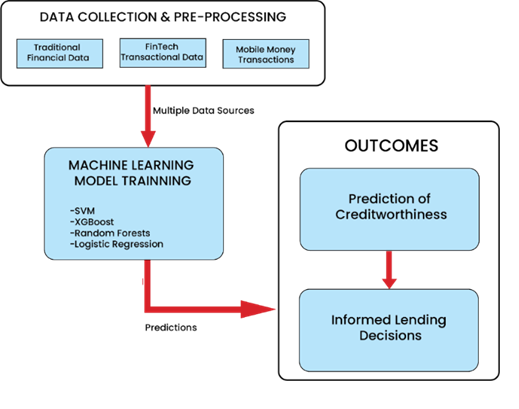
The prediction of credit facility defaulters is quite a challenge in Uganda, particularly for those without a formal banking history. Existing prediction models cater for prediction using conventional banking records which is not sufficient. The use of integrated data to cater for the unbanked population is required to further enhance financial inclusivity and stability in Uganda’s financial landscape. This study therefore aims at filling this gap by using machine learning techniques on a rich blend of financial data, including mobile money and Fintech (Financial Technology) services, as well as traditional banking records. Several machine learning algorithms used for loan default prediction were compared, such as Random Forest, Logistic Regression, Support Vector Machines (SVM), and Extreme Gradient Boosting (XGBoost). Random Forest Model showed 96.66% accuracy, 79.65% recall, 96.52% precision and 0.85 AUC. XGBoost model was found to have an accuracy of 95.23%; recall, 73.32%; precision, 94.11%; and Area Under the Curve (AUC) of 0.81. However, Random Forest performed best by all metrics with XGBoost following slightly. Logistic Regression showed 89.53% accuracy but had a very low recall at 43.24% and precision at 66.59%. SVM performed averagely with 93.21% accuracy and 62.80% recall all falling below that of XGBoost and Random Forest. Thus, the study revealed the significance of machine learning models like Random Forest and XGBoost for credit scoring prediction. Overall, it will improve the ability of institutions and policymakers to identify potential default borrowers so as to mitigate loan default rates and ensure economic growth in underserved communities through more accurate and inclusive credit evaluation tools.
Published
How to Cite
Issue
Section
Copyright (c) 2025 George Muddu, Shefiu Olusegun Ganiyu, Adekunle Olugbenga Ejidokun, Yusuf Abass Aleshinloye (Author)

This work is licensed under a Creative Commons Attribution 4.0 International License.
How to Cite
Similar Articles
- Adeniyi F. Fagbamigbe, Gomolemo K. Basele, Boikanyo Makubate, Broderick O. Oluyede, Application of the Exponentiated Log-Logistic Weibull Distribution to Censored Data , Journal of the Nigerian Society of Physical Sciences: Volume 1, Issue 1, February 2019
- Bolarinwa Bolaji, B. I. Omede, U. B. Odionyenma, P. B. Ojih, Abdullahi A. Ibrahim, Modelling the transmission dynamics of Omicron variant of COVID-19 in densely populated city of Lagos in Nigeria , Journal of the Nigerian Society of Physical Sciences: Volume 5, Issue 2, May 2023
- Gabriel O. Odekina, Adedayo F. Adedotun, Ogbu F. Imaga, Modeling and Forecasting the Third wave of Covid-19 Incidence Rate in Nigeria Using Vector Autoregressive Model Approach , Journal of the Nigerian Society of Physical Sciences: Volume 4, Issue 1, February 2022
- Ogechi Regina Amanso, Jeconia Okelo Abonyo, Phineas Roy Kiogora, Obiora Cornelius Collins, A novel mathematical model for transmission dynamics of HPV and cervical cancer progression with cancer-reliant awareness , Journal of the Nigerian Society of Physical Sciences: Volume 8, Issue 2, May 2026
- G. A. Shewa, F. I. Ugwuowo, Combating the Multicollinearity in Bell Regression Model: Simulation and Application , Journal of the Nigerian Society of Physical Sciences: Volume 4, Issue 3, August 2022
- Peter Chibuike Okoye, Samuel Ogochukwu Azi, Taoreed O. Owolabi, Perovskite tetragonality modeling for functional properties enhancement using Newtonian search based support vector regression computational method , Journal of the Nigerian Society of Physical Sciences: Volume 4, Issue 1, February 2022
- S. N. Enemuo, O. N. Akande, M. O. Lawrence, I. C. Saidu, Optimized aspect level sentiment analysis of tweet data using deep learning and rule-based techniques , Journal of the Nigerian Society of Physical Sciences: Volume 7, Issue 2, May 2025
- Paavithashnee Ravi Kumar, Majid Khan Majahar Ali, Olayemi Joshua Ibidoja, Identifying heterogeneity for increasing the prediction accuracy of machine learning models , Journal of the Nigerian Society of Physical Sciences: Volume 6, Issue 3, August 2024
- Idongesit E. Eteng, Udeze L. Chinedu, Ayei E. Ibor, A stacked ensemble approach with resampling techniques for highly effective fraud detection in imbalanced datasets , Journal of the Nigerian Society of Physical Sciences: Volume 7, Issue 1, February 2025
- Emmanuel Gbenga Dada, Aishatu Ibrahim Birma, Abdulkarim Abbas Gora, Ensemble machine learning algorithm for cost-effective and timely detection of diabetes in Maiduguri, Borno State , Journal of the Nigerian Society of Physical Sciences: Volume 6, Issue 4, November 2024
You may also start an advanced similarity search for this article.