Integrated data-driven credit default prediction in Uganda using machine learning models
Keywords:
SVM, XGBoost, Credit defaulter, Prediction model, Financial dataAbstract
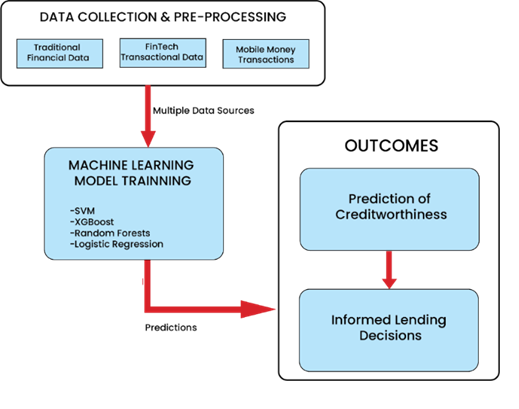
The prediction of credit facility defaulters is quite a challenge in Uganda, particularly for those without a formal banking history. Existing prediction models cater for prediction using conventional banking records which is not sufficient. The use of integrated data to cater for the unbanked population is required to further enhance financial inclusivity and stability in Uganda’s financial landscape. This study therefore aims at filling this gap by using machine learning techniques on a rich blend of financial data, including mobile money and Fintech (Financial Technology) services, as well as traditional banking records. Several machine learning algorithms used for loan default prediction were compared, such as Random Forest, Logistic Regression, Support Vector Machines (SVM), and Extreme Gradient Boosting (XGBoost). Random Forest Model showed 96.66% accuracy, 79.65% recall, 96.52% precision and 0.85 AUC. XGBoost model was found to have an accuracy of 95.23%; recall, 73.32%; precision, 94.11%; and Area Under the Curve (AUC) of 0.81. However, Random Forest performed best by all metrics with XGBoost following slightly. Logistic Regression showed 89.53% accuracy but had a very low recall at 43.24% and precision at 66.59%. SVM performed averagely with 93.21% accuracy and 62.80% recall all falling below that of XGBoost and Random Forest. Thus, the study revealed the significance of machine learning models like Random Forest and XGBoost for credit scoring prediction. Overall, it will improve the ability of institutions and policymakers to identify potential default borrowers so as to mitigate loan default rates and ensure economic growth in underserved communities through more accurate and inclusive credit evaluation tools.
Published
How to Cite
Issue
Section
Copyright (c) 2025 George Muddu, Shefiu Olusegun Ganiyu, Adekunle Olugbenga Ejidokun, Yusuf Abass Aleshinloye (Author)

This work is licensed under a Creative Commons Attribution 4.0 International License.
How to Cite
Similar Articles
- Paavithashnee Ravi Kumar, Majid Khan Majahar Ali, Olayemi Joshua Ibidoja, Identifying heterogeneity for increasing the prediction accuracy of machine learning models , Journal of the Nigerian Society of Physical Sciences: Volume 6, Issue 3, August 2024
- Idongesit E. Eteng, Udeze L. Chinedu, Ayei E. Ibor, A stacked ensemble approach with resampling techniques for highly effective fraud detection in imbalanced datasets , Journal of the Nigerian Society of Physical Sciences: Volume 7, Issue 1, February 2025
- Emmanuel Gbenga Dada, Aishatu Ibrahim Birma, Abdulkarim Abbas Gora, Ensemble machine learning algorithm for cost-effective and timely detection of diabetes in Maiduguri, Borno State , Journal of the Nigerian Society of Physical Sciences: Volume 6, Issue 4, November 2024
- Sunday D. Olorunfunmi, Armand Bahini, Samuel A. Adeojo, Velocity-in/dependent double folding analysis of 12C + 12C elastic scattering cross section at different energies , Journal of the Nigerian Society of Physical Sciences: Volume 8, Issue 1, February 2026
- Timothy Kayode Samson, Francis Olatunbosun Aweda, Wind speed prediction in some major cities in Africa using Linear Regression and Random Forest algorithms , Journal of the Nigerian Society of Physical Sciences: Volume 6, Issue 4, November 2024
- A. K. Usman, Y. A. Hassan, A. A. Bery, A. S. Akingboye, M. D. Dick, B. M. Ahmed, R. O. Aderoju, Hybrid deep belief network and fuzzy clustering approach for geothermal prospectivity mapping in northeastern Nigeria using magnetic and landsat data , Journal of the Nigerian Society of Physical Sciences: Volume 8, Issue 1, February 2026
- J. Andrawus, J. Y. Musa, S. Babuba, A. Yusuf, S. Qureshi, U. T. Mustapha, A. Oghenefejiro, I. S. Mamba, Modeling the dynamics of pertussis to assess the influence of timely awareness with optimal control analysis , Journal of the Nigerian Society of Physical Sciences: Volume 7, Issue 4, November 2025
- Yakubu Aliyu, Umar Usman, On Bivariate Nadarajah-Haghighi Distribution derived from Farlie-Gumbel-Morgenstern copula in the Presence of Covariates , Journal of the Nigerian Society of Physical Sciences: Volume 5, Issue 2, May 2023
- Catherine N. Ogbizi-Ugbe, Osowomuabe Njama-Abang, Samuel Oladimeji, Idongetsit E. Eteng, Edim A. Emanuel, Synergistic intelligence: a novel hybrid model for precision agriculture using k-means, naive Bayes, and knowledge graphs , Journal of the Nigerian Society of Physical Sciences: Volume 8, Issue 1, February 2026
- Majid Khan Bin Majahar Ali, Shahida Shahnawaz, An inverse physics-informed neural network (I-PINN) framework for parameter estimation in mixed convection and melting effects , Journal of the Nigerian Society of Physical Sciences: Volume 8, Issue 2, May 2026
You may also start an advanced similarity search for this article.