Effective tweets classification for disaster crisis based on ensemble of classifiers
Keywords:
Disaster Crisis Management, Social Media Analytics, Twitter, Machine Learning Classifiers, Ensemble Methods, Feature ExtractionAbstract
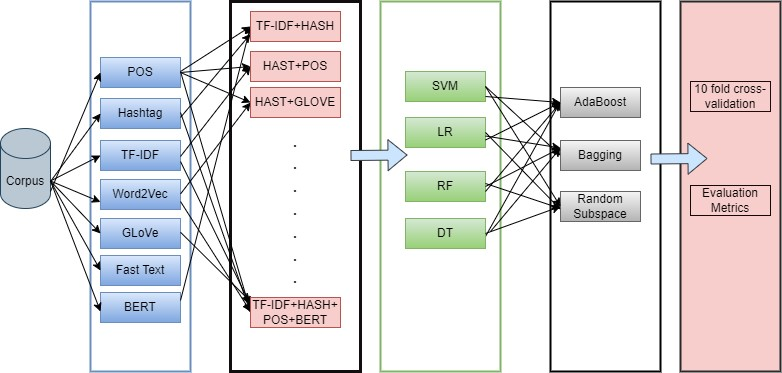
In the field of disaster management, social media analytics has gained significant recognition. Social media platforms, particularly Twitter, have become an invaluable source for disseminating information during disasters, offering real-time updates on events, crisis reports, and casualty information. However, the deluge of information on social media can also be overwhelming, with a substantial amount of irrelevant content. To address this challenge, researchers leverage machine learning (ML) classifiers to automatically categorize disaster-related tweets. However, ML classifiers, while being effective, also face issues such as overfitting and class imbalance. This study proposes an ensemble-based approach that integrates a variety of linguistic and word embedding features, including Parts-Of-Speech (POS), hashtags, Term Frequency-Inverse Document Frequency (TF-IDF), GloVe, Word2Vec, and BERT. A range of supervised learning algorithms like Decision Trees, Logistic Regression, Support Vector Machines, and Random Forests, were evaluated individually and as part of ensemble methods like AdaBoost, Bagging, and Random Subspace. The results show that combining TF-IDF with word embeddings and using the AdaBoost ensemble model yields superior performance, achieving a classification accuracy of 98.92%. This represents a notable improvement over the conventional standalone classifiers and highlights the advantage of ensemble methods in enhancing model robustness and minimizing overfitting. The proposed approach demonstrates not only high predictive capacity but also scalability for real-time tweet filtering during emergencies. In addition to demonstrating the efficacy of ensemble methods in disaster tweet classification, this study also provides valuable insights for improving social media-based crisis response. It also establishes a foundation for future research, particularly in multi-lingual and multi-disaster scenarios.
Published
How to Cite
Issue
Section
Copyright (c) 2025 Christopher Ifeanyi Eke, Kholoud Maswadi, Musa Phiri, Mulenga Mwege, Mohammad Imran, Dekera Kenneth Kwaghtyo, Akeremale Olusola Collins

This work is licensed under a Creative Commons Attribution 4.0 International License.
How to Cite
Similar Articles
- Pushap Lata Sharma, Deepak Bains, Pankaj Thakur, Thermal instability of rotating Jeffrey nanofluids in porous media with variable gravity , Journal of the Nigerian Society of Physical Sciences: Volume 5, Issue 2, May 2023
- M. Ramanuja, J. Kavitha, A. Sudhakar, N. Radhika, Study of MHD SWCNT-Blood Nanofluid Flow in Presence of Viscous Dissipation and Radiation Effects through Porous Medium , Journal of the Nigerian Society of Physical Sciences: Volume 5, Issue 1, February 2023
- J. O. Kuboye, O. R. Elusakin, O. F. Quadri, Numerical Algorithms for Direct Solution of Fourth Order Ordinary Differential Equations , Journal of the Nigerian Society of Physical Sciences: Volume 2, Issue 4, November 2020
- B. I. Akinnukawe, K. O. Muka, L-Stable Block Hybrid Numerical Algorithm for First-Order Ordinary Differential Equations , Journal of the Nigerian Society of Physical Sciences: Volume 2, Issue 3, August 2020
- Folake Lois Joseph, Adeyemi Sunday Olagunju, Emmanuel Oluseye Adeyefa, Adewale Adeyemi James, Hybrid Block Methods with Constructed Orthogonal Basis for Solution of Third-Order Ordinary Differential Equations , Journal of the Nigerian Society of Physical Sciences: Volume 5, Issue 1, February 2023
- Mark I. Modebei, Olumide O. Olaiya, Ignatius P. Ngwongwo, Computational study of a 3-step hybrid integrators for third order ordinary differential equations with shift of three off-step points , Journal of the Nigerian Society of Physical Sciences: Volume 3, Issue 4, November 2021
- Joshua Sunday, Joel N. Ndam, Lydia J. Kwari, An Accuracy-preserving Block Hybrid Algorithm for the Integration of Second-order Physical Systems with Oscillatory Solutions , Journal of the Nigerian Society of Physical Sciences: Volume 5, Issue 1, February 2023
- S. E. Ogunfeyitimi, M. N. O Ikhile, P. O. Olatunji, High order boundary value linear multistep method for the numerical solution of IVPs in ODEs , Journal of the Nigerian Society of Physical Sciences: Volume 7, Issue 4, November 2025
- Friday Obarhua, Oluwasemire John Adegboro, An Order Four Continuous Numerical Method for Solving General Second Order Ordinary Differential Equations , Journal of the Nigerian Society of Physical Sciences: Volume 3, Issue 1, February 2021
- J. A. Adebisi, O. M. Babatunde, Green Information and Communication Technologies Implementation in Textile Industry Using Multicriteria Method , Journal of the Nigerian Society of Physical Sciences: Volume 4, Issue 2, May 2022
You may also start an advanced similarity search for this article.
Most read articles by the same author(s)
- Dekera Kenneth Kwaghtyo, Christopher Ifeanyi Eke, Timothy Moses, CropGAN: A conditional GAN framework for synthetic tabular data augmentation in crop recommendation systems , Journal of the Nigerian Society of Physical Sciences: Volume 8, Issue 3, August 2026 (In Progress)