Deep neural network model for vertical total electron content prediction at a single low latitude station
Keywords:
Deep learning neural network, TEC model, Solar activity proxy, NeQuick 2Abstract
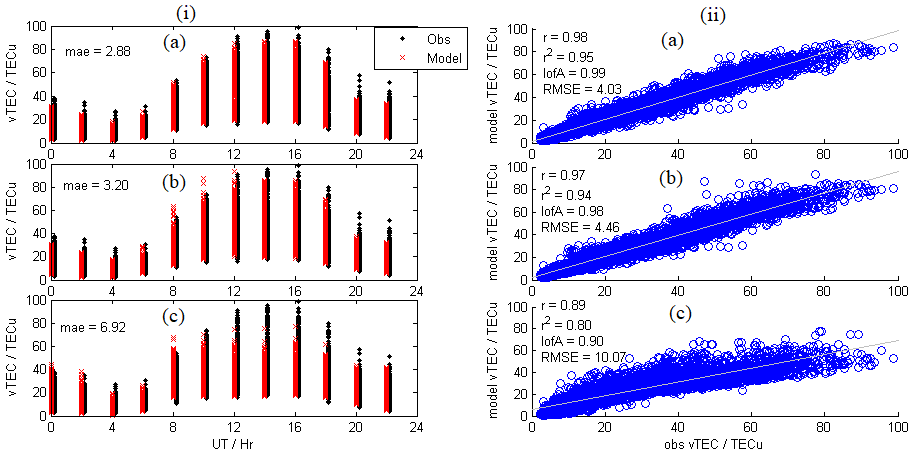
Modeling ionospheric parameters at low and equatorial stations is quite challenging due to the nature of the variation in the region. In this study, a Deep Neural Network (DNN) was configured via optimization of its hyperparameters and then trained to predict vertical Total Electron Content (vTEC) at a single low latitude location. Input parameters to the model are universal time, day of the year and solar activity index (EUV / ), while the target parameter is vTEC at a single location. EUV and values were used separately as the solar ionizing index leading to two trained models. The data used for training were for the solar cycle 24 and the data were split into 75 % for training and 25 % for validation. The training process was completed by the number of iterations. In addition, the derived model was also validated using data for the whole of 2000 and 2021 which are years outside the solar cycle 24. For completeness, the two models were also compared with NeQuick 2 model which is a global empirical model. The results obtained showed that the DNN models were able to predict reasonably well within the solar cycle 24 and slightly outperformed NeQuick 2 model. Similar results were obtained when the models were validated in 2021 with DNN slightly performed better that NeQuick 2 model. However, large deviation was recorded in 2000 – the DNN and NeQuick 2 models underestimated vTEC.
References
[1] R. Cont, “Empirical properties of asset returns: stylized facts and statistical issues”, Quantitative Finance 1 (2001) 223. https://doi.org/10.1080/713665670.
[2] H. Y. Kim & C. H. Won, “Forecasting the volatility of stock price index: A hybrid model integrating LSTM with multiple GARCH-type models”, Expert Systems with Applications 103 (2018) 25. https://doi.org/10.1016/j.eswa.2018.03.002.
[3] Y. LeCun, Y. Bengio & G. Hinton, “Deep learning”, Nature 521 (2015) 436. https://doi.org/10.1038/nature14539.
[4] J. L. Speiser, M. E. Miller, J. Tooze & E. Ip, “A comparison of random forest variable selection methods for classification prediction modeling”, Expert Systems with Applications 134 (2019) 93. https://doi.org/10.1016/j.eswa.2019.05.028.
[5] M. Sheykhmousa, M. Mahdianpari, H. Ghanbari, F. Mohammadimanesh, P. Ghamisi & S. Homayouni, “Support vector machine versus random forest for remote sensing image classification: A meta-analysis and systematic review”, IEEE Journal of Selected Topics in Applied Earth Observations and Remote Sensing 13 (2020) 6308. https://doi.org/10.1109/JSTARS.2020.3026724.
[6] Y. LeCun & Y. Bengio, “Convolutional networks for images, speech, and time series”, The Handbook of Brain Theory and Neural Networks 3361 (1995) 1995. https://dl.acm.org/doi/10.5555/303568.303704.
[7] A. Krizhevsky, I. Sutskever & G. E. Hinton, “ImageNet classification with deep convolutional neural networks”, Communications of the ACM 60 (2017) 84. https://doi.org/10.1145/3065386.
[8] S. Liu, F. Shen, Y. Wang, M. Rastegar-Mojarad, R. K. Elayavilli, V. Chaudhary & H. Liu, “Extracting chemical?protein relations using attention-based neural networks”, Database 2018 (2018) bay102. http://dx.doi.org/10.1093/database/bay102.
[9] Y. Chen, F. Ding & L. Zhai, “Multi-scale temporal features extraction based graph convolutional network with attention for multivariate time series prediction”, Expert Systems with Applications 200 (2022) 117011. https://doi.org/10.1016/j.eswa.2022.117011.
[10] S. Mehtab, J. Sen & S. Dasgupta, “Robust analysis of stock price time series using CNN and LSTM-based deep learning models”, in 2020 4th International Conference on Electronics, Communication and Aerospace Technology (ICECA), 2020, pp. 1481–1486. https://doi.org/10.1109/ICECA49313.2020.9297652.
[11] S. Mehtab & J. Sen, “Stock price prediction using convolutional neural networks on a multivariate time-series”, arXiv preprint arXiv:2001.09769, 2020. https://arxiv.org/abs/2001.09769.
[12] A. Borovykh, S. Bohte & C. W. Oosterlee, “Conditional time series forecasting with convolutional neural networks”, arXiv preprint arXiv:1703.04691, 2017. https://arxiv.org/abs/1703.04691.
[13] J. Yang, M. N. Nguyen, P. P. San, X. Li & S. Krishnaswamy, “Deep convolutional neural networks on multichannel time series for human activity recognition”, in IJCAI, 2015, pp. 3995–4001. https://www.ijcai.org/Proceedings/15/Papers/561.pdf.
[14] J. Kim & N. Moon, “BiLSTM model based on multivariate time series data in multiple field for forecasting trading area”, Journal of Ambient Intelligence and Humanized Computing 2019 (2019) 1. https://doi.org/10.1007/s12652-019-01398-9.
[15] P. Malhotra, L. Vig, G. Shroff & P. Agarwal, “Long short term memory networks for anomaly detection in time series”, presented at ESANN, 2015. [Online]. https://www.researchgate.net/publication/304782562_Long_Short_Term_Memory_Networks_for_Anomaly_Detection_in_Time_Series.
[16] H. Lee, P. Pham, Y. Largman & A. Ng, “Unsupervised feature learning for audio classification using convolutional deep belief networks”, Advances in Neural Information Processing Systems 22 (2009) 1. [Online]. https://www.researchgate.net/publication/221619818_Unsupervised_feature_learning_for_audio_classification_using_convolutional_deep_belief_networks.
[17] E. Chong, C. Han & F. C. Park, “Deep learning networks for stock market analysis and prediction: Methodology, data representations, and case studies”, Expert Systems with Applications 83 (2017) 187. https://doi.org/10.1016/j.eswa.2017.04.030.
[18] J. N. K. Liu, Y. Hu, J. J. You & P. W. Chan, “Deep neural network based feature representation for weather forecasting”, in Proceedings on the International Conference on Artificial Intelligence, 2014, p. 1. https://research.polyu.edu.hk/en/publications/deep-neural-network-based-feature-representation-for-weather-fore.
[19] A. Gasparin, S. Lukovic & C. Alippi, “Deep learning for time series forecasting: The electric load case”, CAAI Transactions on Intelligence Technology 7 (2022) 1. https://doi.org/10.1049/cit2.12060.
[20] S. M. J. Jalali, S. Ahmadian, A. Khosravi, M. Shafie-khah, S. Nahavandi & J. P. S. Catalão, “A novel evolutionary-based deep convolutional neural network model for intelligent load forecasting”, IEEE Transactions on Industrial Informatics 17 (2021) 8243. https://doi.org/10.1109/TII.2021.3065718.
[21] K. Zhang & M. Hong, “Forecasting crude oil price using LSTM neural networks”, Data Science in Finance and Economics 2 (2022) 163. https://doi.org/10.3934/DSFE.2022008.
[22] B. Amirshahi & S. Lahmiri, “Hybrid deep learning and GARCH-family models for forecasting volatility of cryptocurrencies”, Machine Learning with Applications 12 (2023) 100465. https://doi.org/10.1016/j.mlwa.2023.100465.
[23] M. Markova, “Convolutional neural networks for forex time series forecasting”, in AIP Conference Proceedings 2459 (2022) 030024. https://doi.org/10.1063/5.0083533.
[24] M. Zulqarnain, R. Ghazali, M. G. Ghouse, Y. M. M. Hassim & I. Javid, “Predicting financial prices of stock market using recurrent convolutional neural networks”, International Journal of Intelligent Systems and Applications 12 (2020) 21. https://doi.org/10.5815/ijisa.2020.06.02.
[25] M. Längkvist, L. Karlsson & A. Loutfi, “A review of unsupervised feature learning and deep learning for time-series modeling”, Pattern Recognition Letters 42 (2014) 11. https://doi.org/10.1016/j.patrec.2014.01.008.
[26] Y. Tang, Z. Song, Y. Zhu, H. Yuan, M. Hou, J. Ji, C. Tang & J. Li, “A survey on machine learning models for financial time series forecasting”, Neurocomputing 512 (2022) 363. https://doi.org/10.1016/j.neucom.2022.09.003.
[27] O. B. Sezer, M. U. Gudelek & A. M. Ozbayoglu, “Financial time series forecasting with deep learning: A systematic literature review: 2005-2019”, Applied Soft Computing 90 (2020) 106181. https://doi.org/10.1016/j.asoc.2020.106181.
[28] A. Thakkar & K. Chaudhari, “A comprehensive survey on deep neural networks for stock market: The need, challenges, and future directions”, Expert Systems with Applications 177 (2021) 114800. https://doi.org/10.1016/j.eswa.2021.114800.
[29] Z. Hajirahimi & M. Khashei, “Hybrid structures in time series modeling and forecasting: A review”, Engineering Applications of Artificial Intelligence 86 (2019) 83. https://doi.org/10.1016/j.engappai.2019.08.018.
[30] P. Lara-Benı́tez, M. Carranza-Garcı́a & J. C. Riquelme, “An experimental review on deep learning architectures for time series forecasting”, International Journal of Neural Systems 31 (2021) 21300011. https://doi.org/10.1142/S0129065721300011.
[31] E. Ramos-Pérez, P. J. Alonso-González & J. J. Núñez-Velázquez, “Forecasting volatility with a stacked model based on a hybridized Artificial Neural Network”, Expert Systems with Applications 129 (2019) 1. https://doi.org/10.1016/j.eswa.2019.03.046.
[32] W. Xu, H. Peng, X. Zeng, F. Zhou, X. Tian & X. Peng, “A hybrid modelling method for time series forecasting based on a linear regression model and deep learning”, Applied Intelligence 49 (2019) 3002. https://doi.org/10.1007/s10489-019-01426-3.
[33] J.-F. Chen, W.-L. Chen, C.-P. Huang, S.-H. Huang & A.-P. Chen, “Financial time-series data analysis using deep convolutional neural networks”, in 2016 7th International Conference on Cloud Computing and Big Data (CCBD), 2016, pp. 87–92. https://doi.org/10.1109/CCBD.2016.027.
[34] S. Li, H. Huang & W. Lu, “A neural networks based method for multivariate time-series forecasting”, IEEE Access 9 (2021) 63915. https://doi.org/10.1109/ACCESS.2021.3075063.
[35] W. Jiang, L. Ling, D. Zhang, R. Lin & L. Zeng, “A time series forecasting model selection framework using CNN and data augmentation for small sample data”, Neural Processing Letters 55 (2023) 5783. https://doi.org/10.1007/s11063-022-11113-z.
[36] S. Lahmiri, “Modeling and predicting historical volatility in exchange rate markets”, Physica A: Statistical Mechanics and its Applications 471 (2017) 387. https://doi.org/10.1016/j.physa.2016.12.061.
[37] X. Lu, D. Que & G. Cao, “Volatility forecast based on the hybrid artificial neural network and GARCH-type models”, Procedia Computer Science 91 (2016) 1044. https://doi.org/10.1016/j.procs.2016.07.145.
[38] W. Kristjanpoller, A. Fadic & M. C. Minutolo, “Volatility forecast using hybrid neural network models”, Expert Systems with Applications 41 (2014) 2437. https://doi.org/10.1016/j.eswa.2013.09.043.
[39] E. Hajizadeh, A. Seifi, M. H. Fazel Zarandi & I. B. Turksen, “A hybrid modeling approach for forecasting the volatility of S&P 500 index return”, Expert Systems with Applications 39 (2012) 431. https://doi.org/10.1016/j.eswa.2011.07.033.
[40] J. Liu, “A hybrid model integrating LSTM with multiple GARCH-type models for volatility and VaR forecast”, in Proceedings of the 2nd International Conference on Big Data Economy and Digital Management, 2023, Changsha, China. [Online]. http://dx.doi.org/10.4108/eai.6-1-2023.2330313.
[41] E. Koo & G. Kim, “A hybrid prediction model integrating GARCH models with a distribution manipulation strategy based on LSTM networks for stock market volatility”, IEEE Access 10 (2022) 34743. https://doi.org/10.1109/ACCESS.2022.3163723.
[42] S. Fatima & M. Uddin, “On the forecasting of multivariate financial time series using hybridization of DCC-GARCH model and multivariate ANNs”, Neural Computing and Applications 34 (2022) 21911. https://doi.org/10.1007/s00521-022-07631-5.
[43] H. M. Markowitz, “Portfolio selection”, Journal of Finance 7 (1952) 71. https://doi.org/10.2307/2975974.
[44] Y.-H. Wang, “Nonlinear neural network forecasting model for stock index option price: Hybrid GJR-GARCH approach”, Expert Systems with Applications 36 (2009) 564. https://doi.org/10.1016/j.eswa.2007.09.056.
[45] C.-H. Tseng, S.-T. Cheng, Y.-H. Wang & J.-T. Peng, “Artificial neural network model of the hybrid EGARCH volatility of the Taiwan stock index option prices”, Physica A: Statistical Mechanics and its Applications 387 (2008) 3192. https://doi.org/10.1016/j.physa.2008.01.074.
Published
How to Cite
Issue
Section
Copyright (c) 2025 F. U. Salifu, O. A. Oladipo, E. O. Ebock, B. Nava (Author)

This work is licensed under a Creative Commons Attribution 4.0 International License.