Chemometric authentication of branded and crude spices using integrated GC–MS fingerprints and elemental profiling
Keywords:
Spice authentication, Integrated chemical fingerprinting, GC–MS profiling, Elemental analysis, ChemometricsAbstract
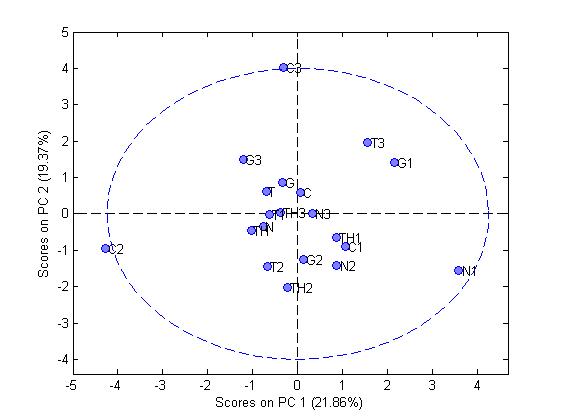
Counterfeit and substandard spice products present significant risks to food safety, nutritional quality, and consumer confidence. This study applied an integrated chemometric approach, GC--MS chemical profiling, and elemental analysis to authenticate and discriminate among crude, genuine-branded, and potentially adulterated spice products. Twenty spice samples from curry, ginger, turmeric, nutmeg, and thyme were analysed using gas chromatography--mass spectrometry (GC--MS) for volatile compounds, flame photometry for macroelements, and atomic absorption spectrometry (AAS) for microelements, respectively. Principal component analysis (PCA) and hierarchical cluster analysis (HCA) revealed clear separation between crude and branded spices. An optimized model framework using two principal components explained 70.55% of the total calibration variance (70.29% cross-validated variance). The hierarchical cluster analysis (HCA) dendrograms confirmed distinct clustering, highlighting close substitutability among certain spices based on their nutrient profiles. Elemental analysis indicated significant variation across samples: branded curry 3 and branded ginger 3 were rich in zinc and selenium, while branded nutmeg 1 exhibited exceptionally high iron content. Conversely, some branded products, such as branded curry powder, consistently showed low or absent levels of essential micronutrients. GC--MS profiling identified dominant fatty acids, including Octadec-9-enoic acid and Octadecanoic acid. These compositional differences underpin the discriminatory power of chemometric models, enabling reliable authentication of the crude and branded spices and the detection of potential adulteration. The study demonstrated that integrated chemical fingerprinting with multivariate analysis provides a robust framework for quality assurance and regulatory monitoring of commercial spice products.
References
[1] S. Izcara, R. Perestrelo, S. Morante-Zarcero, I. Sierra & J. S. Câmara, ``Spices volatilomic fingerprinting--A comprehensive approach to explore its authentication and bioactive properties'', Molecules 27 (2022) 6403. https://doi.org/10.3390/molecules27196403
[2] E. O. Adedayo, I. O. Dada, K. Ajayi & D. T. Adesimiloye, ``Nutritional and phytochemical profile of commonly consumed spices in Nigeria'', European Journal of Nutrition and Food Safety 16 (2024) 166. https://doi.org/10.9734/ejnfs/2024/v16i111584
[3] S. Girisa, M. Hegde & A. B. Kunnumakkara, ``Molecular mechanism of spices and their active constituents for the prevention and treatment of diseases'', in Handbook of Spices in India: 75 Years of Research and Development, Springer Nature Singapore, Singapore, 2023, pp. 695--753. https://doi.org/10.1007/978-981-19-3728-6_11
[4] T. A. Jiang, ``Health benefits of culinary herbs and spices'', Journal of AOAC International 102 (2019) 395. https://doi.org/10.5740/jaoacint.18-0418
[5] M. N. Mashabela, P. T. Ndhlovu & W. O. Mbeng, ``Herbs and spices' antimicrobial properties and possible use in the food sector'', in Herbs and Spices-New Advances, IntechOpen, London, United Kingdom, 2022. https://doi.org/10.5772/intechopen.108143
[6] B. Gidwani, R. Bhattacharya, S. S. Shukla & R. K. Pandey, ``Indian spices: Past, present and future challenges as the engine for bio-enhancement of drugs: Impact of COVID-19'', Journal of the Science of Food and Agriculture 102 (2022) 3065. https://doi.org/10.1002/jsfa.11771
[7] R. Matera, E. Lucchi & L. Valgimigli, ``Plant essential oils as healthy functional ingredients of nutraceuticals and diet supplements: A review'', Molecules 28 (2023) 901. https://doi.org/10.3390/molecules28020901
[8] H. Onyeaka, A. Anyogu, O. A. Odeyemi, M. U. Ukwuru, U. Eze, F. J. Isaac-Bamgboye, C. K. Anumudu, O. O. Akinwunmi, O. P. Sotayo & Y. A. Jeff-Agboola, ``Navigating food fraud: A survey of Nigerian consumer knowledge and attitudes'', Foods 13 (2024) 3270. https://doi.org/10.3390/foods13203270
[9] R. Velázquez, A. Rodríguez, A. Hernández, R. Casquete, M. J. Benito & A. Martín, ``Spice and herb frauds: Types, incidence, and detection: The state of the art'', Foods 12 (2023) 3373. https://doi.org/10.3390/foods12183373
[10] W. A. Abia, S. A. Haughey, R. Radhika, B. P. Taty, H. Russell, M. Carey, B. M. Maestroni, A. Petchkongkaew, C. T. Elliott & P. N. Williams, ``Africa, an emerging exporter of turmeric: Combating fraud with rapid detection systems'', Foods 14 (2025) 1590. https://doi.org/10.3390/foods14091590
[11] M. B. Rahman, M. Hussain, M. P. Kabiraz, N. Nordin, S. A. Siddiqui, S. Bhowmik & M. Begum, ``An update on formaldehyde adulteration in food: Sources, detection, mechanisms, and risk assessment'', Food Chemistry 427 (2023) 136761. https://doi.org/10.1016/j.foodchem.2023.136761
[12] World Health Organization, UNEP United Nations Environment Programme & World Organisation for Animal Health, One health joint plan of action (2022--2026): Working together for the health of humans, animals, plants and the environment, World Health Organization, Rome, Italy, 2022, 86. Available online: https://www.who.int/publications/i/item/9789240059139.
[13] B. O. Ekute, M. E. Khan, A. A. Pam & J. E. Emurotu, ``Assessment of the nutritional and phytochemical composition of selected mushroom species grown in Southern Nigeria'', Journal of the Nigerian Society of Physical Sciences 7 (2025) 2978. https://doi.org/10.46481/jnsps.2025.2978
[14] G. B. Tola, ``Food contaminants: A scoping review of sources, toxicity, pathophysiological insights, and mitigation strategies'', Preprints (2025). https://doi.org/10.20944/preprints202502.0030.v1
[15] U. C. Okafor, C. C. Aniekwu, E. V. Onwujiobi, C. L. Okafor & V. I. Onyeneho, ``Evaluation of the microbiological and physicochemical properties of selected indigenous food spices vended in Eke Awka Market, Anambra State Nigeria'', International Journal of Research and Innovation in Applied Science 9 (2024) 462. https://doi.org/10.51584/IJRIAS.2024.906041
[16] U. F. Evuen, N. P. Okolie & A. Apiamu, ``Evaluation of the mineral composition, phytochemical and proximate constituents of three culinary spices in Nigeria: A comparative study'', Scientific Reports 12 (2022) 20705. https://doi.org/10.1038/s41598-022-25204-3
[17] A. Y. Bamigboye, O. T. Adepoju & P. O. Oladipo, ``Evaluation of physicochemical properties and mineral content of some indigenous spices retailed in Ibadan, Nigeria'', International Journal of Nutrition 6 (2020) 20. https://doi.org/10.14302/issn.2379-7835.ijn-20-3471
[18] V. Srinivasan, M. Murugan & R. Dinesh, ``Spices'', in Soil Health Management for Plantation Crops, G. V. Thomas & V. Krishnakumar (Eds.), Springer, Singapore, 2024, 207–252. https://doi.org/10.1007/978-981-97-0092-9_5
[19] N. Nwanagba, A. Ukom, G. Pipi, Y. Jacob, J. Okoli, J. Keke & J. Ezehmalu, ``Evaluation of the effect of drying methods on the chemical compositions and antimicrobial properties of selected leafy spices'', Nigeria Agricultural Journal 55 (2025) 135. https://www.ajol.info/index.php/naj/article/view/294964
[20] P. Szefer, ``Chemometrics in Food Control Based on Elemental Analysis'', Springer (2025). https://doi.org/10.1007/978-3-031-99687-0.
[21] M. Noshad, B. A. Behbahani & I. K. Karabagias, ``Volatilomic with chemometrics: A toward authentication approach for food authenticity control'', European Food Research and Technology 249 (2023) 2215. https://doi.org/10.1007/s00217-023-04291-0
[22] W. He & Q. Zeng, ``Non-invasive food authentication using vibrational spectroscopy techniques for low-resolution food fingerprinting'', Applied Sciences 15 (2025) 5948. https://doi.org/10.3390/app15115948
[23] R. Ahmad, A. Alqathama, M. Aldholmi, M. Riaz, A. N. Abdalla, A. Mostafa, H. M. Al-Said, A. M. Alqarni, R. Ullah, S. S. Asgher, M. Amir, H. Shaaban & W. Ahmad, ``Gas chromatography-mass spectrometry (GC-MS) metabolites profiling and biological activities of various Capsicum annum cultivars'', Plants 11 (2022) 1022. https://doi.org/10.3390/plants11081022
[24] S. Tripathy, P. K. Sahu, R. Sahu, T. Cecchi, B. Vysetti & K. A. Chowdary, ``Quality control of spices: Regulatory guidelines and the role of analytical techniques'', Journal of Food Measurement and Characterization (2026) 1. https://doi.org/10.1007/s11694-026-04287-w
[25] K. O. Omeje, B. O. Ezema, F. Okonkwo, N. C. Onyishi, J. Ozioko, W. A. Rasaq, G. Sardo & C. O. R. Okpala, ``Quantification of heavy metals and pesticide residues in widely consumed Nigerian food crops using atomic absorption spectroscopy (AAS) and gas chromatography (GC)'', Toxins 13 (2021) 870. https://doi.org/10.3390/toxins13120870
[26] A. C. Marcus & V. C. Anyadiegwu, ``Studies on the mineral contents of the pod of Abelmoschus esculentus harvested from some parts of Rivers State, Nigeria'', Journal of Advanced Research in Chemical Science 8 (2021) 1. https://www.researchgate.net/publication/350314840_Studies_on_the_Mineral_Contents_of_the_Pod_of_Abelmoschus_Esculentus_Harvested_from_Some_Parts_of_Rivers_State_Nigeria
[27] D. Okoro, O. E. Ididama, G. O. Tesi & J. C. Ossai, ``Contamination levels, occurrence pattern and associated risk of organophosphate pesticide residues in spices and herbs sold in Southern Nigeria'', Journal of the Nigerian Society of Physical Sciences (2026) 3065 https://doi.org/10.46481/jnsps.2026.3065.
[28] W. G. Ayoade, L. Gbadamosi, M. G. Ajayi & M. O. Badmus, ``Assessment of minerals and vitamin constituents of some commonly consumed spices'', International Journal of Scientific Research Archive 10 (2023) 53. https://doi.org/10.30574/ijsra.2023.10.1.0702
[29] A. A. Okwelle & T. F. Mac-Pepple, ``Analysis of heavy metals concentrations in food spices from some markets in Port Harcourt Metropolis, Rivers State, Nigeria'', Current Journal of Applied Science and Technology 39 (2020) 61. https://doi.org/10.9734/CJAST/2020/v39i3030971
[30] A. P. Biswas, M. Tasnim, Ö. Süfer, S. C. Das, S. Sarker, M. Zhang & N. Islam., ``Honey adulteration detection: A comprehensive review of traditional and modern techniques'', Food Measurement 20 (2026) 3929. https://doi.org/10.1007/s11694-025-03954-8
[31] Y. Otoki, S. Ogisu, S. Watanabe, S. Kato, D. Ishikawa, K. Miyazaki, Y. Ozaki, & K. Nakagawa., ``Rapid and non-destructive quantification of trace-level lignans in sesame oil using FT-NIR spectroscopy and chemometric modeling'', Journal of the American Oil Chemists' Society (2026). https://doi.org/10.1002/aocs.70090
[32] J. S. Ng, S. A. Muhammad, B. Ibrahim, V. Baeten, Q. Arnould & O. Ogundipe, ``Refined, bleached, deodorized palm oil adulteration screening using near infrared red spectroscopy'', Journal of the Science of Food and Agriculture 105 (2025) 7282. https://doi.org/10.1002/jsfa.14435
[33] J. P. Cruz-Tirado, R. L. de Franca, M. Tumbajulca, G. Barraza-Jauregui, D. F. Barbin & R. Siche, ``Detection of cumin powder adulteration with allergenic nutshells using FT-IR and portable NIRS coupled with chemometrics'', Journal of Food Composition and Analysis 116 (2023) 105044. https://doi.org/10.1016/j.jfca.2022.105044
[34] W. Vera, R. Salvador-Reyes, G. Quispe-Santivañez & G. Kemper, ``Detection of adulterants in powdered foods using near-infrared spectroscopy and chemometrics: Recent advances, challenges, and future perspectives'', Foods 14 (2025) 3195. https://doi.org/10.3390/foods14183195
[35] Ò. Vidal, X. Castilla, N. Aliaga-Alcalde, A. M. López-Periago, C. Domingo, S. Sentellas& J. Saurina, ``Determination of curcuminoids by liquid chromatography with diode array detection: Application to the characterization of turmeric and curry samples'', Current Analytical Chemistry 16 (2020) 95. https://doi.org/10.2174/1573411014666180629125729
[36] E. K. Essuman, E. Teye, L. K. Sam-Amoah & C. L. Amuah, ``Rapid and non-destructive prediction of adulterated chilli powder by employing pocket-sized NIR spectrometer and chemometrics'', Infrared Physics and Technology 135 (2023) 104961. https://doi.org/10.1016/j.infrared.2023.104961
[37] J. M. Njiru, E. Njeru, J. Kang'iri, I. Lunani, H. Rotich, G. Muriira & E. N. Nyaboga, ``Food fraud in selected sub-Saharan Africa countries: A wake-up call to national regulatory bodies to support enforcement and food safety'', Frontiers in Food Science and Technology 5 (2025) 1499271. https://doi.org/10.3389/frfst.2025.1499271
[38] M. N. N. Palma, G. C. Rocha, S. D. C. Valadares Filho & E. Detmann, ``Evaluation of acid digestion procedures to estimate mineral contents in materials from animal trials'', Asian-Australasian Journal of Animal Sciences 28 (2015) 1624. https://doi.org/10.5713/ajas.15.0068
Published
How to Cite
Issue
Section
Copyright (c) 2026 E. Udensi, R. B. Salau, S. O. Salihu, M. M. Ndamitso, M. T. Bisiriyu (Author)

This work is licensed under a Creative Commons Attribution 4.0 International License.