An empirical evaluation of mathematical, machine learning, and hybrid modeling approaches for COVID-19 forecasting
Keywords:
SEIR model, Hybrid modeling, Infectious disease prediction, Epidemic forecasting, COVID-19Abstract
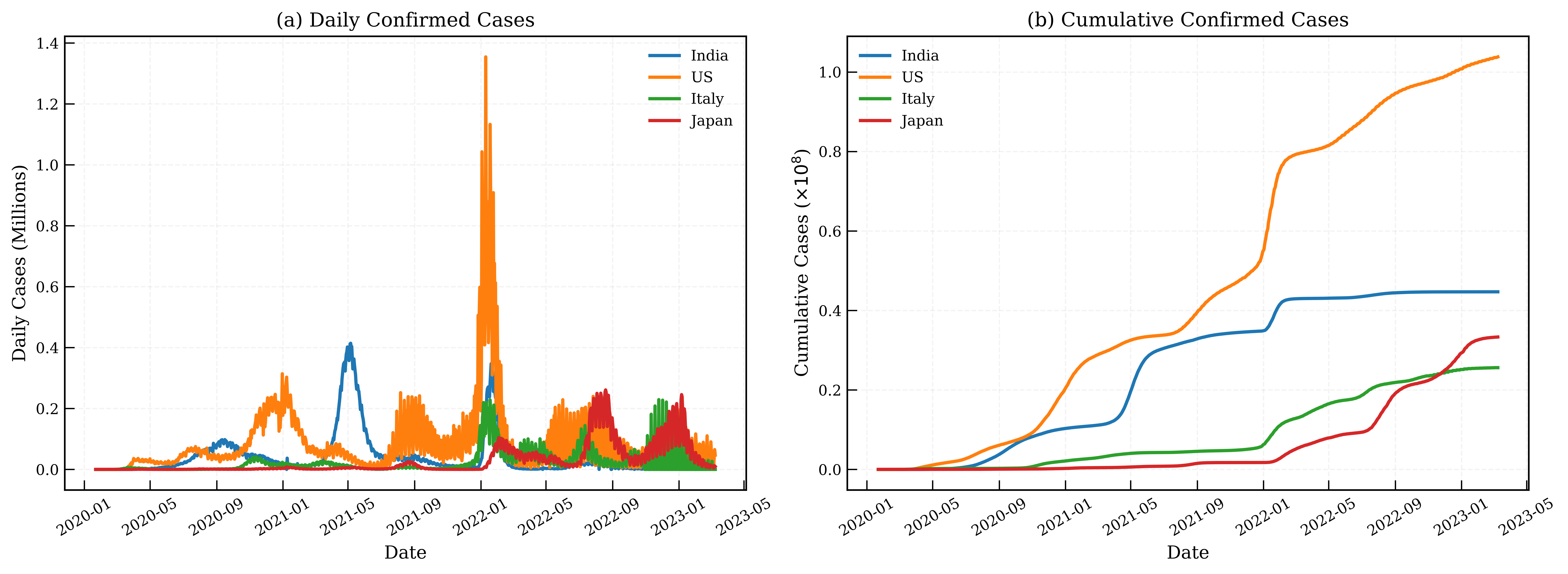
Accurate forecasting of infectious disease spread is essential for public health decision-making. This study compares mechanistic susceptible-exposed-infectious-removed (SEIR) models, machine-learning methods, and hybrid artificial intelligence (AI)-driven epidemiological frameworks using coronavirus disease 2019 (COVID-19) case data from India, the United States, Italy, and Japan. After preprocessing and exploratory analysis, we estimate time-varying transmission rates and develop two hybrid extensions: one predicts beta(t) using machine learning, and the other learns residual errors from the SEIR model. A baseline machine-learning model using lag-based and effective reproduction number (Rt)-driven features is also evaluated. Performance is assessed using mean absolute error (MAE), root mean squared error (RMSE), mean absolute percentage error (MAPE), high-incidence MAPE (on days with observed incidence ge 100 cases), and peak-timing error. With the SEIR transmission-rate spline fitted strictly to training data and all models evaluated on an identical 223-day held-out test window, a simple persistence baseline outperforms the mechanistic SEIR model, both hybrid AI extensions (Tracks A and B), and the pure machine-learning Random Forest model across all four countries (Diebold--Mariano test, p<0.001 in every comparison). The hybrid AI components do not consistently improve forecasting accuracy relative to the SEIR baseline. None of the mechanistic or machine-learning approaches anticipates new epidemic waves beyond the training period, underscoring the difficulty of medium-range epidemic forecasting under genuinely held-out conditions. The comparative evaluation highlights the complementary strengths and limitations of these approaches and provides guidance for future epidemic forecasting models.
References
[1] W. O. Kermack & A. G. McKendrick, ``A contribution to the mathematical theory of epidemics'', Proceedings of the Royal Society of London. Series A 115 (1927) 700. https://doi.org/10.1098/rspa.1927.0118.
[2] R. Gupta, G. Pandey, P. Chaudhary & S. Pal, ``SEIR and regression model based COVID-19 outbreak predictions in India'', medRxiv (2020) 2020.04.01.20049825. https://doi.org/10.1101/2020.04.01.20049825.
[3] R. C. Poonia, A. K. J. Saudagar, A. Altameem, M. Alkhathami, M. B. Khan & M. H. A. Hasanat, ``An enhanced SEIR model for prediction of COVID-19 with vaccination effect'', Life 12 (2022) 647. https://doi.org/10.3390/life12050647.
[4] B. Ivorra, M. R. Ferr'andez, M. Vela-P'erez & A. M. Ramos, ``Mathematical modeling of the spread of the coronavirus disease 2019 (COVID-19) taking into account the undetected infections: the case of China'', Communications in Nonlinear Science and Numerical Simulation 88 (2020) 105303. https://doi.org/10.1016/j.cnsns.2020.105303.
[5] Y. Mohamadou, A. Halidou & P. T. Kapen, ``A review of mathematical modeling, artificial intelligence and datasets used in the study, prediction and management of COVID-19'', Applied Intelligence 50 (2020) 3913. https://doi.org/10.1007/s10489-020-01770-9.
[6] M. S. Rahman & A. H. Chowdhury, ``A data-driven eXtreme gradient boosting machine learning model to predict COVID-19 transmission with meteorological drivers'', PLOS ONE 17 (2022) e0273319. https://doi.org/10.1371/journal.pone.0273319.
[7] R. Chandra, A. Jain & D. S. Chauhan, ``Deep learning via LSTM models for COVID-19 infection forecasting in India'', PLOS ONE 17 (2022) e0262708. https://doi.org/10.1371/journal.pone.0262708.
[8] S. M. Shakeel, N. S. Kumar, P. P. Madalli, R. Srinivasaiah & D. R. Swamy, ``COVID-19 prediction models: a systematic literature review'', Osong Public Health and Research Perspectives 12 (2021) 215. https://doi.org/10.24171/j.phrp.2021.0100.
[9] R. Qasrawi, G. Issa, S. Thwib, R. AbuGhoush, M. Amro, R. Ayyad, S. Vicu~na, E. Badran, Y. Khader, R. Al Qutob, F. Al Bakri, H. Trigui, E. Sokhn, E. Musa & J. D. Kong, ``The role of machine learning in infectious disease early detection and prediction in the MENA region: a systematic review'', Informatics in Medicine Unlocked 56 (2025) 101651. https://doi.org/10.1016/j.imu.2025.101651.
[10] M. Ala'raj, M. Majdalawieh & N. Nizamuddin, ``Modeling and forecasting of COVID-19 using a hybrid dynamic model based on SEIRD with ARIMA corrections'', Infectious Disease Modelling 6 (2021) 98. https://doi.org/10.1016/j.idm.2020.11.007.
[11] R. Vega, L. Flores & R. Greiner, ``SIMLR: machine learning inside the SIR model for COVID-19 forecasting'', Forecasting 4 (2022) 72. https://doi.org/10.3390/forecast4010005.
[12] J. Gao, R. Sharma, C. Qian, L. M. Glass, J. Spaeder, J. Romberg, J. Sun & C. Xiao, ``STAN: spatio-temporal attention network for pandemic prediction using real-world evidence'', Journal of the American Medical Informatics Association 28 (2021) 733. https://doi.org/10.1093/jamia/ocaa322.
[13] M. Z. Sayed-Ahmed, M. A. Hossain, S. Limkar, H. S. El-Bahkiry, N. Alam & S. T. Amin, ``Mathematical modelling and deep learning techniques for predicting cardiovascular disease'', Panamerican Mathematical Journal 34 (2024) 230. https://doi.org/10.52783/pmj.v34.i4.1880.
[14] B. Rai, A. Shukla & L. K. Dwivedi, ``COVID-19 in India: predictions, reproduction number and public health preparedness'', medRxiv (2020) 2020.04.09.20059261. https://doi.org/10.1101/2020.04.09.20059261.
[15] T. Phan, S. Brozak, B. Pell, A. Gitter, A. Xiao, K. D. Mena, Y. Kuang & F. Wu, ``A simple SEIR-V model to estimate COVID-19 prevalence and predict SARS-CoV-2 transmission using wastewater-based surveillance data'', Science of The Total Environment 857 (2023) 159326. https://doi.org/10.1016/j.scitotenv.2022.159326.
[16] D. Bolatova, S. Kadyrov & A. Kashkynbayev, ``Mathematical modeling of infectious diseases and the impact of vaccination strategies'', Mathematical Biosciences and Engineering 21 (2024) 7103. https://doi.org/10.3934/mbe.2024314.
[17] H. Verma, S. Mandal & A. Gupta, ``Temporal deep learning architecture for prediction of COVID-19 cases in India'', Expert Systems with Applications 195 (2022) 116611. https://doi.org/10.1016/j.eswa.2022.116611.
[18] J. Luo, Z. Zhang, Y. Fu & F. Rao, ``Time series prediction of COVID-19 transmission in America using LSTM and XGBoost algorithms'', Results in Physics 27 (2021) 104462. https://doi.org/10.1016/j.rinp.2021.104462.
[19] M. Saqib, ``Forecasting COVID-19 outbreak progression using hybrid polynomial--Bayesian ridge regression model'', Applied Intelligence 51 (2020) 2703. https://doi.org/10.1007/s10489-020-01942-7.
[20] B. Fatimah, P. Aggarwal, P. Singh & A. Gupta, ``A comparative study for predictive monitoring of COVID-19 pandemic'', Applied Soft Computing 122 (2022) 108806. https://doi.org/10.1016/j.asoc.2022.108806.
[21] Y. Alali, F. Harrou & Y. Sun, ``A proficient approach to forecast COVID-19 spread via optimized dynamic machine learning models'', Scientific Reports 12 (2022) 2467. https://doi.org/10.1038/s41598-022-06218-3.
[22] G. O. Odekina, A. F. Adedotun & O. F. Imaga, ``Modeling and forecasting the third wave of COVID-19 incidence rate in Nigeria using vector autoregressive model approach'', Journal of the Nigerian Society of Physical Sciences 4 (2022) 117. https://doi.org/10.46481/jnsps.2022.431.
[23] D. O. Oyewola, E. G. Dada, J. N. Ndunagu, T. A. Umar & S. A. Akinwunmi, ``COVID-19 risk factors, economic factors, and epidemiological factors nexus on economic impact: machine learning and structural equation modelling approaches'', Journal of the Nigerian Society of Physical Sciences 3 (2021) 395. https://doi.org/10.46481/jnsps.2021.173.
[24] T. Ozturk, M. Talo, E. A. Yildirim, U. B. Baloglu, O. Yildirim & U. R. Acharya, ``Automated detection of COVID-19 cases using deep neural networks with X-ray images'', Computers in Biology and Medicine 121 (2020) 103792. https://doi.org/10.1016/j.compbiomed.2020.103792.
[25] Y. Fang, H. Zhang, J. Xie, M. Lin, L. Ying, P. Pang & W. Ji, ``Sensitivity of chest CT for COVID-19: comparison to RT-PCR'', Radiology 296 (2020) E115. https://doi.org/10.1148/radiol.2020200432.
[26] D. J. McDonald, J. Bien, A. Green, A. J. Hu, N. DeFries, S. Hyun, N. L. Oliveira, J. Sharpnack, J. Tang, R. Tibshirani, V. Ventura, L. Wasserman & R. J. Tibshirani, ``Can auxiliary indicators improve COVID-19 forecasting and hotspot prediction?'', Proceedings of the National Academy of Sciences 118 (2021) e2111453118. https://doi.org/10.1073/pnas.2111453118.
[27] H. Alkhalefah, D. Preethi, N. Khare, M. H. Abidi & U. Umer, ``Deep learning infused SIRVD model for COVID-19 prediction: XGBoost-SIRVD-LSTM approach'', Frontiers in Medicine 11 (2024) 1427239. https://doi.org/10.3389/fmed.2024.1427239.
[28] M. U. G. Kraemer et al., ``Artificial intelligence for modelling infectious disease epidemics'', Nature 638 (2025) 623. https://doi.org/10.1038/s41586-024-08564-w.
[29] R. Vaishya, M. Javaid, I. H. Khan & A. Haleem, ``Artificial intelligence (AI) applications for COVID-19 pandemic'', Diabetes & Metabolic Syndrome: Clinical Research & Reviews 14 (2020) 337. https://doi.org/10.1016/j.dsx.2020.04.012.
[30] E. Dong, H. Du & L. Gardner, ``An interactive web-based dashboard to track COVID-19 in real time'', The Lancet Infectious Diseases 20 (2020) 533. https://doi.org/10.1016/S1473-3099(20)30120-1.
[31] World Bank, ``Population, total'' (indicator SP.POP.TOTL), World Development Indicators, accessed 5 July 2025. https://data.worldbank.org/indicator/SP.POP.TOTL.
[32] F. X. Diebold & R. S. Mariano, ``Comparing predictive accuracy'', Journal of Business & Economic Statistics 13 (1995) 253. https://doi.org/10.1080/07350015.1995.10524599.
Published
How to Cite
Issue
Section
Copyright (c) 2026 Pooja Satwani, Sudhir Kumar Mishra (Author)

This work is licensed under a Creative Commons Attribution 4.0 International License.