Mathematical Model of In-host Dynamics of Snakebite Envenoming
Keywords:
Snakebite, in-host model, venom, antivenom, stability analysisAbstract
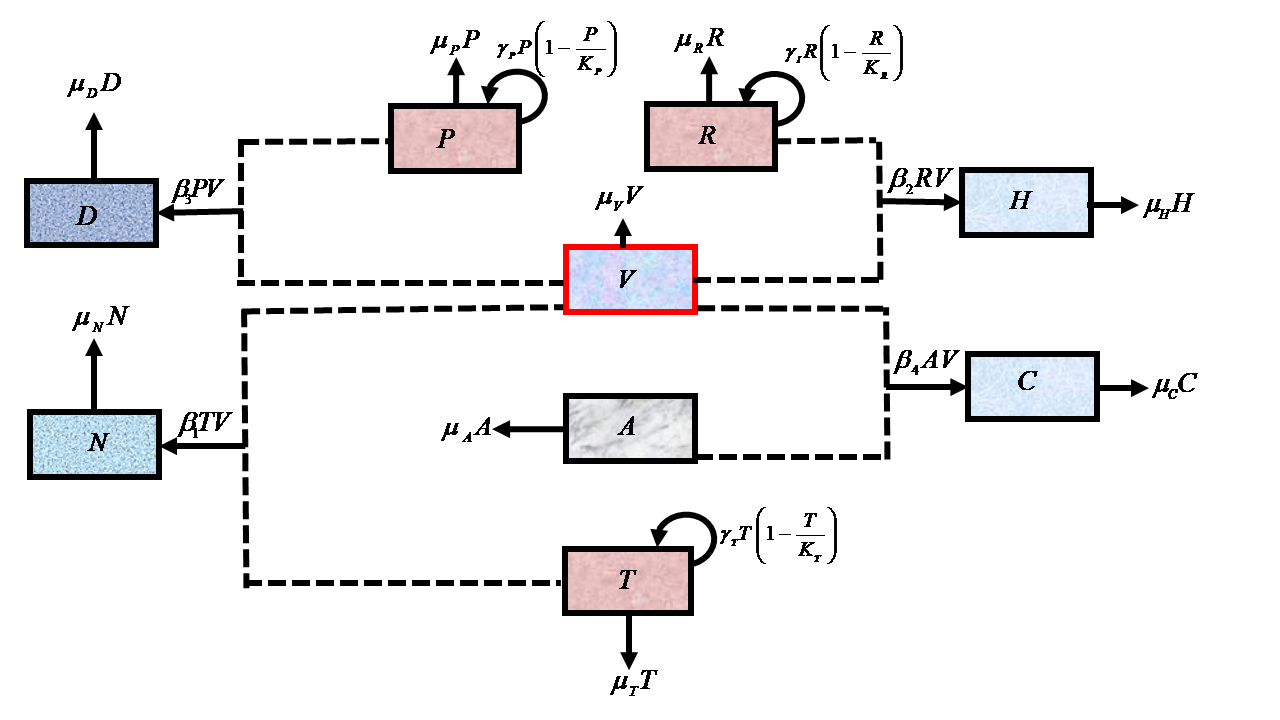
In this paper, we develop an in-host mathematical model of snakebite envenoming that includes tissue, red blood and platelet cells of humans as specific targets of different kinds of toxins in the snake venom. The model is use to study some harmful effects of cytotoxic and hemotoxic snake venom on their target cells under the influence of snake antivenom. The model has two equilibrium points, namely, trivial and venom free. It has been shown that both the equilibrium points are globally asymptotically stable and numerical simulations illustrate the global asymptotic stability of the venom free equilibrium point. Furthermore, simulations reveal the importance of administering antivenom to avert the possible damage from venom toxins on the target cells. It is also shown through simulation that administering the required dose of antivenom can lead to the elimination of venom toxins within one week. Therefore, we recommend the administration of an adequate dose of antivenom therapy as it helps in deactivating venom toxins faster and consequently enhances the recovery time.
Published
How to Cite
Issue
Section
Copyright (c) 2022 Journal of the Nigerian Society of Physical Sciences

This work is licensed under a Creative Commons Attribution 4.0 International License.
How to Cite
Similar Articles
- Bukola Oluwatosin Falomo, Olugbenga John Fenuga, Israel Olutunji Abiala, Unsteady MHD Casson nanofluid transport over an inclined permeable cylinder in an anisotropic porous medium: effects of nonlinear radiation and Joule heating , Journal of the Nigerian Society of Physical Sciences: Volume 8, Issue 3, August 2026
- Ghada A. Ahmed, Fractional-order modeling of visceral leishmaniasis disease transmission dynamics : strategies in eastern Sudan , Journal of the Nigerian Society of Physical Sciences: Volume 5, Issue 4, November 2023
- C. A. Onate, S. O. Mobolaji, J. A. Akinpelu, Eigensolutions and thermodynamic properties constrained by magnetic field of cyclotron frequency , Journal of the Nigerian Society of Physical Sciences: Volume 7, Issue 4, November 2025
- Oluwaseun IGE, Keng Hoon Gan, Ensemble feature selection using weighted concatenated voting for text classification , Journal of the Nigerian Society of Physical Sciences: Volume 6, Issue 1, February 2024
- F. U. Salifu, O. A. Oladipo, E. O. Ebock, B. Nava, Deep neural network model for vertical total electron content prediction at a single low latitude station , Journal of the Nigerian Society of Physical Sciences: Volume 7, Issue 4, November 2025
- W. A. Yahya, Alpha decay half-lives of 171-189Hg isotopes using Modified Gamow-like model and temperature dependent proximity potential , Journal of the Nigerian Society of Physical Sciences: Volume 2, Issue 4, November 2020
- U. S. Aliyu, I. G. Geidam, M. S. Otto, M. Hussaini, Investigations of the Elastic Moduli of Er2O3 NPs Doped TeO2 – B2O3 – SiO2 Glasses using Theoretical Models , Journal of the Nigerian Society of Physical Sciences: Volume 4, Issue 1, February 2022
- Umaru Hassan, Mohd Tahir Ismail, Improving forecasting accuracy using quantile regression neural network combined with unrestricted mixed data sampling , Journal of the Nigerian Society of Physical Sciences: Volume 5, Issue 4, November 2023
- Ahmed Fadhil Noaman, Zaid Adil Abdalkareem, Bareq Baqi Salman, Application of the SEE transform with the Adomian decomposition method to a nonlinear tumor growth model , Journal of the Nigerian Society of Physical Sciences: Volume 8, Issue 3, August 2026
- V Umarani, A Julian, J Deepa, Sentiment Analysis using various Machine Learning and Deep Learning Techniques , Journal of the Nigerian Society of Physical Sciences: Volume 3, Issue 4, November 2021
You may also start an advanced similarity search for this article.
Most read articles by the same author(s)
- L. Adamu, N. Hussaini, An Epidemic Model of Zoonotic Visceral Leishmaniasis with Time Delay , Journal of the Nigerian Society of Physical Sciences: Volume 1, Issue 1, February 2019