Corrosion Inhibition Potential of Thiosemicarbazide Derivatives on ALuminium: Insight from Molecular Modelling and QSARs Approaches
Keywords:
DFT, corrosion inhibitors, QSARs, ThiosemicarbazideAbstract
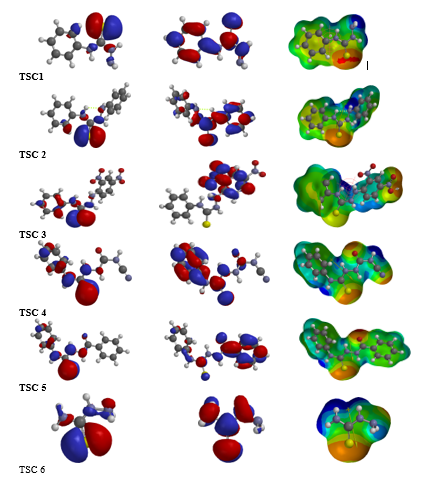
The potentials of six thiosemicarbazide derivatives towards corrosion inhibition were investigated theoretically using density functional theory (DFT) and quantitative structural-activity relationships (QSARs) methods. Their performance as corrosion inhibitors were evaluated using their calculated quantum chemical parameters such as molecular weight, softness, electronegativity, dipole moments, hardness, bandgap energy (\Delta E), highest occupied molecular orbital energy (EHOMO), and the lowest unoccupied molecular orbital energy (ELUMO). Regression analysis was carried out using the ordinary least square method to develop a model that establishes the relationship between chemical parameters and inhibition efficiencies that have been measured experimentally. According to the results, quantum chemical parameters confirm the inhibition potential of TSC5 to be greater than TSC2, while the predicted inhibition efficiencies of the studied thiosemicarbazide derivatives correspond to experimentally reported values with a root mean square error (%) of 1.116 and correlation coefficient of 0.998. The high correlation demonstrates and validates the quantum chemical approach’s reliability in studying corrosion inhibition on a metal surface. The validation of the developed model internally and externally demonstrates that it is robust and stable, with high predictability
References
K. K. Adamaa & I. B. Onyeachub ,“The corrosion characteristics of SS316L stainless steel in a typical acid cleaning solution and its inhibition by1-benzylimidazole: Weight loss, electrochemical and SEM characterizations”, Journal of the Nigerian Society of Physical Sciences 4 (2022) 214.
P. Vijayan & M. Al-Maadeed, “Self-Repairing Composites for Corrosion Protection: A Review on Recent Strategies and Evaluation Methods”, Materials 12 (2019) 2754. https://doi.org/10.3390/ma12172754
M. Finsgar & J. Jackson, “Application of corrosion inhibitors for steels in acidic media for the oil and gas industry: A review”, Corrosion Science 86 (2014) 17.
C. G. Dariva & A. F. Galio “Corrosion Inhibitors - Principles, Mechanisms and Applications, in Developments in Corrosion Protection”, In-Tech (2014) 365.
Y. Meng, W. Ning, B. Xu, W. Yang, K. Zhang, Y. Chen, et al. “Inhibition of mild steel corrosion in hydrochloric acid using two novel pyridine Schiff base derivatives: A comparative study of experimental and theoretical results”, RSC Advances 7 (2017) 43014.
O. Krim, A. Elidrissi, B. Hammouti, A. Ouslim & M. Benkaddour, “Synthesis, characterization, and comparative study of pyridine derivatives as corrosion inhibitors of mild steel in HCl medium”, Chemical Engineering Communications 196 (2009) 1536.
L. H. Madkour & S. K. Elroby, “Aminic nitrogen-bearing polydentate Schiff base compounds as corrosion inhibitors for iron in acidic and alkaline media: A combined experimental and DFT studies”, Journal of corrosion science and engineering 17 (2014) 745.
C.W. Chidieberea, C. E. Durua, JP. C. Mbagwub, “Application of computational chemistry in chemical reactivity: a review”, Journal of the Nigerian Society of Physical Sciences 3 (2021) 292.
B. T Ogunyemi, D. F. Latona & I. A. Adejoro, “Molecular modeling and quantitative structure–property relationships (QSPRs) of purine derivatives as corrosion inhibitor in acid medium”, Scientific African 8 (2020) e00336. https://doi.org/10.1016/j.sciaf.2020.e00336
R. Solmaz, “Investigation of the inhibition e ect of 5-((E)-4-phenylbuta-1,3- dienylideneamino)-1,3,4-thiadiazole-2-thiol Schi base on mild steel corrosion in hydrochloric acid”, Corrosion. Science 52 (2010) 3321.
S. Chitra, K. Parameswari & A. Selvaraj, “Dianiline Schi Bases as Inhibitors of Mild Steel Corrosion in Acid Media”, Int. J. Electrochem. Sci. 5 (2010) 1675.
R. Solmaz, E. Altunbas¸b & G. Kardas, “Adsorption and corrosion inhibition effect of 2-((5-mercapto-1,3,4-thiadiazol-2-ylimino) methyl)phenol Schiff base on mild steel, G¨ulfeza Kardas¸b”, Materials Chemistry
and Physics 125 (2011) 796.
M. Larouj, H. Lgaz, R. Salghi, S. Jodeh, M. Messali, M. Zougagh, H. Oudda & A. Chetouani, “E ect of chlorine group position on adsorption behavior and corrosion inhibition of Chlorobenzylideneamino-5-methyl-2, 4-dihydro-1, 2, 4-triazole3-thione Schiff bases: Experimental study”, Moroccan Journal of Chemistry 4 (2016) 567.
R. A. Prabhu, T. V. Venkatesha, A.V. Shanbhag, B. M. Praveen, G. M. Kulkarni & R.G. Kalkhambkar, “Quinol-2-thione compounds as corrosion inhibitors for mild steel in acid solution”, Materials Chemistry and Physics 108 (2008) 283.
A. S. Fonda, M. N. Mousa, F. I. Taha & A. I. Elneanaa, “The role of the thiosemicarbazide derivatives in the corrosion inhibition of Aluminium in hydrochloric acid”, Corrosion Science 26 (1986) 719.
W. J. Hehre & W. A Ohlinger, Spartan ’14, Wavefunction, Inc., Irvine (2014).
A. D. Becke, “Density-functional exchange-energy approximation with correct asymptotic behavior”, Phys. Rev. A 38 (1988) 3098.
A. D. Becke, “Density-functional thermochemistry, III. The role of exact exchange”, Journal of Chemical Physics 98 (1993) 5648.
R. G. Pearson, “Absolute electronegativity and hardness: application to inorganic chemistry”, Inorganic Chemistry 27 (1988) 734.
R. G. Pearson, “Absolute electronegativity and hardness correlated with the molecular orbital theory”, Proceedings of the National Academy of Sciences 83 (1986) 8440.
N. S. Abdelshafi, M. A. Sadik, M. A. Shoeib & S. A. Halim, “Corrosion inhibition of aluminum in 1 M HCl by novel pyrimidine derivatives, EFM measurements, DFT calculations and MD simulation Arabian Journal of Chemistry 15 (2022) 103459. https://doi.org/10.1016/j.arabjc.2021.103459
R. G Parr, L.V. Szentpaly & S. Liu “Electrophilicity index”, Journal of the American Chemical Society. 121 (1999) 1922.
K. Anton, “Molecular modeling of organic corrosion inhibitors: Calculations, pitfalls, and conceptualization of molecule–surface bonding”, Corrosion Science 193 (2021) 109650.
Z. Zhou & H. V. Navangul, “Absolute hardness and aromaticity: MNDO study of benzenoid hydrocarbons”, J. Phys. Org. Chem. 3 (1990) 784.
I. Lukovits, E. K´alm´an, & F. Zucchi, “Corrosion Inhibitors—Correlation Between Electronic Structure and Efficiency”, Corrosion 57 (2001) 118.
P. A. John, E. F. Awe, O. Adedirin & B. Olusupo, “Exploring structure indenture for some Schiff bases as anti-Salmonella typhi drugs: A QSAR Approach”, International Journal of Advances in Scientific Research 2 (2016) 48.
K. Roy, “A Primer on QSAR/QSPR Modeling”, Springer Briefs in Molecular Science. (2015). https://doi.org/10.1007/978-3-319-17281-1 2.
O. M. Akinlosotu1, B. T. Ogunyemi & B. B. Adeleke, “Substituent Effect on Bithiophene-Bipyridine Organic Conjugated Systems: Theoretical Investigation”, Advanced Journal of Chemistry-Section A, 5 (2022) 70.
L. H. Madkour & I. H. Elshamy, “Experimental and Computational Studies on the Inhibition Performances of Benzimidazole and Its Derivatives for the Corrosion of Copper in Nitric Acid”, International Journal of Industrial Chemistry 7 (2016) 195
M. M. Kabanda, S. K. Shukla, A.K Singh, L. C. Murulana, & E.E. Ebenso, “Electrochemical and Quantum Chemical Studies on Calmagite and Fast Sulphone Black F Dyes as Corrosion Inhibition for Mild Steel in Hydrochloric Medium”, International Journal of Electrochemical Science 7 (2012) 8813.
K. Kathirvel, B. Thirumalairaj, & M. Jaganathan, “Quantum Chemical Studies on the Corrosion Inhibition of Mild Steel by Piperidin-4-One Derivatives in 1 M H3PO4 Open Journal of Metal 4 (2014) 73.
D. Datta, “Geometric mean principle for hardness equalization: a corollary of Sanderson’s geometric mean principle of electronegativity equalization”, Journal of Physical Chemistry 90 (1986) 4216.
R. G. Pearson, “The principle of maximum hardness”, Account of Chemical Research 26 (1993) 250.
S. Kaya & C. Kaya, “A new method for calculation of molecular hardness: A theoretical study”, computational and theoretical chemistry 1060 (2015) 66. https://doi.org/10.1016/j.comptc.2015.03.004
C. Kaya, Inorganic chemistry 1 and 2, Palme Publishing, Ankara, (2011).
M. Gholami, I. Danaee, M. M Hosein & R. A. Mehdi, “Correlated ab Initio and Electroanalytical Study on Inhibition Behavior of 2-Mercaptobenzothiazole and Its Thiole-Thione Tautomerism Effect for the Corrosion of Steel (API 5L X52) in Sulphuric Acid Solution”, Industrial & Engineering Chemistry Research 52 (2011) 14875.
B. T. Ogunyemi, D. F. Latona, A. A. Ayinde & I. A. Adejoro, “Theoretical Investigation to Corrosion Inhibition Efficiency of Some Chloroquine Derivatives Using Density Functional Theory”, Advance Journal of Chemistry-section A 3 (2020) 485. https://doi.org/10.33945/SAMI/AJCA.2020.4.10
E. E. Ebenso, D.A. Isabirye, & N. O. Eddy, “Adsorption and quantum chemical studies on the inhibition potentials of some thiosemicarbazides for the corrosion of mild steel in acidic medium”, International Journal of Molecular Science 11 (2010) 2473. https://doi.org/10.3390/ijms11062473
X. Li, S. Deng, H. Fu & T. Li, “Adsorption and Inhibition Effect of 6-Benzylaminopurine on Cold Rolled Steel in 1.0 M HCl”, Electrochimica Acta 54 (2009) 4089.
N. O. Eddy & E. E. Ebenso, “quantum chemical studies on the inhibition potentials of some penicillin compounds for the corrosion of mild steel in 0.1 m HCl” Journal of Molecular Modelling 16 (2010) 1291.
B. T. Ogunyemi & G. S. Borisade, “Theoretical Modeling of Iminoisatin Derivatives as Corrosion Inhibitors of Steel in Acid Solution”, FUDMA Journal of Sciences (FJS) 4 (2020) 672. https://doi.org/10.33003/fjs-2020-0403-372
K. Adardour, R. Touir, M. Elbakri et al., “Thermodynamic study of mild steel corrosion in hydrochloric acid by new class synthesized quinoxaline derivatives: Part II”, Research on Chemical Intermediate 39 (2013) 4175.
https://doi.org/10.1007/s11164-012-0934-x
M. Sahin, G. Gece, E. Karci & S. Bilgic, “Experimental and theoretical study of the e ect of some heterocyclic compounds on the corrosion of low carbon steel in 3.5% NaCl medium”, Journal of Applied Electrochemistry 38 (2008) 809.
M. E. Elshakre, H. H. Alalawy, M. I. Awad & B. E. El-Anadouli, “On the role of the electronic states of corrosion inhibitors: Quantum chemicalelectrochemical correlation study on urea derivatives”, Corrosion Science 124 (2017) 121.
I. B. Obot, N. O. Obi-Egbedi, & S. A. Umeren, “Adsorption characteristics and corrosion inhibitive properties of clotrimazole for aluminium corrosion in hydrochloric acid”, International Journal of Electrochemical Science 4 (2009) 863.
Published
How to Cite
Issue
Section
Copyright (c) 2023 B. T. Ogunyemi, F. K. Ojo

This work is licensed under a Creative Commons Attribution 4.0 International License.