Investigation of Point Refractivity Gradient and Geoclimatic Factor at 70 m Altitude in Yenagoa, Nigeria
Keywords:
GSM, WAN, Inter-Terrestrial, Microwave, Geoclimatic Factor, Refractivity GradientAbstract
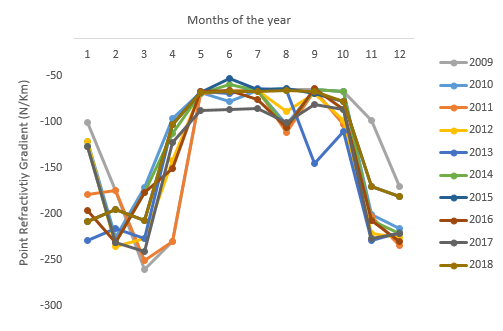
The quality of services provided via Inter-Terrestrial radio communication links such as GSM networks, Wide Area Network (WAN), Radio and TV broadcasts is largely influenced by some meteorological parameters such as temperature, pressure and humidity. Proper knowledge of these parameters, specifically at microwave antenna heights (about 70m) is important in order to maintain an effective line-of-sight (LOS) link even during the worst weather conditions. The geoclimatic factor is an important quantity that must be considered in the design of terrestrial links for effective wireless communication. This work utilized satellite data from the European Center for Medium-Range Weather Forecasts (ECMWF) to compute the point refractivity gradient and geoclimatic factor for Yenagoa and its environs. The research was necessitated by the paucity of research on this subject matter for Yenegoa. The results of the research show that point refractivity gradient and geoclimatic factor in the study area vary with season. The average point refractivity gradient and geoclimatic factor at 70 m above the ground level are:136.433 N-unit/Km and 6.638633E-05 respectively. This implies that radiowaves propagating in this region at the said altitude is most likely to be super refractive in both rain and clear air atmospheric conditions. Rain or worst condition refers to the period when atmospheric components such as hydrometeor, lithometeor, aerosol have significant effects on propagated radio signals. Clear-air conditions means when maximum possible signal is received such that the most threatening atmospheric components (rain drops) have negligible effects on propagated signal. The results will be useful for radio engineers in the design and configuration of inter-terrestrial microwave links in Yenagoa and Its environs for optimum quality of service.
Published
How to Cite
Issue
Section
Copyright (c) 2023 Y. B. Lawal, E. T. Omotoso

This work is licensed under a Creative Commons Attribution 4.0 International License.
How to Cite
Similar Articles
- Muhammad Alhassan, Azhar Abdul Rahman, Iskandar Shahrim Mustafa, Kabiru Alhaji Bala, Factors influencing the thermal stability of HEMA polymer gel dosimeters for clinical radiotherapy , Journal of the Nigerian Society of Physical Sciences: Volume 8, Issue 2, May 2026
- Shah Zeb, Awais Ahmad, Rizwana Kausar, Siti Ainor Mohd Yatim, Nurulhuda Ramli, Muhammad Rafiq, Evaluating lung cancer control through a time-delay mathematical model with detailed sensitivity analysis , Journal of the Nigerian Society of Physical Sciences: Volume 8, Issue 3, August 2026
- Oludare Adedire, J. N. Ndam, Mathematical modelling of concentration profiles for species transport through the single and the interconnected multiple-compartment systems , Journal of the Nigerian Society of Physical Sciences: Volume 2, Issue 2, May 2020
- E. E. Etim, Benchmark Studies on the Isomerization Enthalpies for Interstellar Molecular Species , Journal of the Nigerian Society of Physical Sciences: Volume 5, Issue 2, May 2023
- U. Rilwan, M. I. Sayyed, K. A. Mahmoud, S. Muhammad, A. Alkasim, S. I. Ikpughul, S. J. Iwa, Jibrin Ahmed Guto, O. A. Adeyeba, M. W. Marashdeh, Evaluation of radiation shielding and mechanical properties of palm nut shell ash modernized concrete: a comparative analysis , Journal of the Nigerian Society of Physical Sciences: Volume 8, Issue 1, February 2026
- Paul Tawo Bukie, Idongesit E. Eteng, Eyo E. Essien, Development of internet of things-based petroleum pipeline topology leak monitoring and detection system using sensors , Journal of the Nigerian Society of Physical Sciences: Volume 7, Issue 4, November 2025
- Suraj Sharma, Ravinder Kumar, Analysis of love-type surface waves in an isotropic thermoelastic layer over a non-homogeneous elastic half-space with interface irregularity , Journal of the Nigerian Society of Physical Sciences: Volume 8, Issue 2, May 2026
- David Opeoluwa Oyewola, Emmanuel Gbenga Dada, Juliana Ngozi ndunagu, Terrang Abubakar Umar, Akinwunmi S.A, COVID-19 Risk Factors, Economic Factors, and Epidemiological Factors nexus on Economic Impact: Machine Learning and Structural Equation Modelling Approaches , Journal of the Nigerian Society of Physical Sciences: Volume 3, Issue 4, November 2021
- Boikanyo Makubate, Marang Pearl Matsuokwane, Lesego Gabaitiri, Broderick O. Oluyede, Simbarashe Chamunorwa, The Type II Topp-Leone-G Power Series Distribution with Applications on Bladder Cancer , Journal of the Nigerian Society of Physical Sciences: Volume 4, Issue 3, August 2022
- Farukh Ahmed Mulani, Waseem Ahmad Khan, Shahid Ahmad Wani, On the construction and structural analysis of Bell-enriched Appell-lambda polynomials via quasi-monomiality , Journal of the Nigerian Society of Physical Sciences: Volume 8, Issue 4, November 2026 (in progress)
You may also start an advanced similarity search for this article.