Investigating the Performance of Point to Multipoint Microwave Connectivity across Undulating Landscape during Rainfall
Keywords:
Landscape, Microwave, Nodes, Performance, SignalAbstract
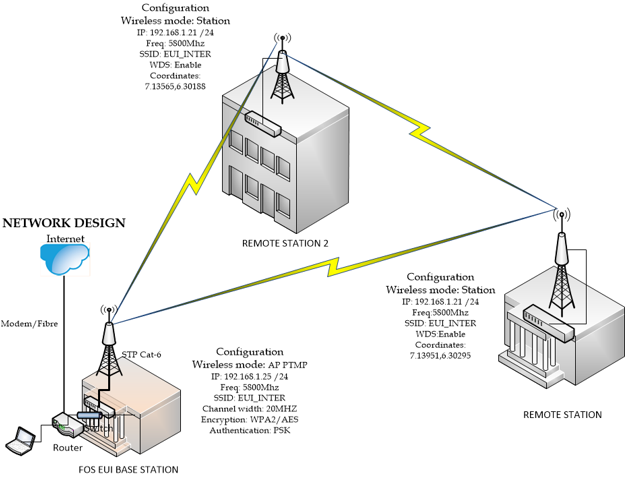
One of the most debated issues surrounding wireless connectivity is performance especially under different topographic and climatic scenarios. Performance has a direct relationship with throughput measured in terms of how well a given wireless connectivity provides consistent services over a given period compared to the wired alternative. Research has shown that wireless connectivity is constrained by significant physical components such as topography, weather conditions, propagation frequency, and distance. It is commonplace to see notable vendors of wireless network products make claims as to how their technologies are designed to remedy any signal degradation that may arise from the aforementioned physical elements. This paper is aimed at evaluating the performance of a point to multipoint connectivity using Ubiquiti’s 5.8 GHz Point to Multipoint Base Stations deployed within a landscape marked by series of undulating highlands and lowlands. In this experiment, a base station node is established with connectivity to two other nodes of same specifications with one node as the destination radio whereas the other acts as the control which is located on a table land. The nodes were separated by triangular distances of 3 km and network connectivity was maintained over thirty days during periods of rainfall. Packets sent and received across each node was carefully recorded. The results from the analysis showed that packet losses to and from the control node was significantly lower than that of the other node under same weather conditions.
References
G.R. Maurya, P.A. Kokate, S.K. Lokhande & J.A. Shrawankar J.A, “A Review on Investigation and Assessment of Path Loss Models in Urban and Rural Environment”, IOP Conf. Ser.: Mater. Sci. Eng. 225 (2017) 012219.
K.E. Ukhurebor, M.S. Maor & E.E. Aigbe E.E “Mollification of WCDMA Interference on Uplink Channels in Cellular Network Using the Power Control Approach”, British Journal of Applied Science & Technology, 20 (2017) 1.
B.Y. Lawal, K.E. Ukhurebor, M.A. Adekoya & E.E. Aigbe E.E “Quality of Service and Performance Analysis of A GSM Network in Eagle Square, Abuja and Its Environs, Nigeria”, International Journal of Scientific & Engineering Research, 7 (2016) 1992.
D.Y. Choi, J.Y. Pyun, S.K. Noh & S.W. Lee “Comparison of Measured Rain Attenuation in the 12.25 GHz Band with Prediction by the ITU-R Model”, International Journal of Antennas and Propagation, 415398 (2012) 1.
L.A.R Da Silva Mello, M.S. Pontes, R.M. de Souza & N.A. Pérez-García “Prediction of Rain Attenuation in Terrestrial Links using Full Rainfall Rate Distribution”, Electronics Letters, 43 (2007) 1442.
J.W.F. Goddard “Propagation in Rain and Cloud Spatial Temporal Structures of Rain. In: Propagation of Radio Waves”, (2nd ed) UK, IEE, London (2013).
J.S Ojo, M.O. Ajewole & S.K. Sarkar “Rain Rate and Rain Attenuation Prediction for Satellite Communication in Ku and Ka Bands over Nigeria”, Progress in Electromagnetic Research B, 5 (2008) 207.
A.Y. Abdulrahman, T.A. Rahman, S.K.A. Rahim & M.R.U. Islam “A New Rain Attenuation Conversion Technique for Tropical Regions”, Progress in Electromagnetics Research B, 26 (2010) 53.
U. Siddique, L. Ahmad L & G. Raja “Microwave Attenuation and Prediction of Rain Outage for Wireless Networks in Pakistan's Tropical Region”, International Journal of Microwave Science and Technology, 14927 (2011) 1.
Y.S. Meng & Y.H. Lee “Investigations of Foliage Effect on Modern Wireless Communication Systems: A Review”, Progress in Electromagnetics Research, 105 (2010) 313.
G.N. Ezeh, N.S. Chukwuneke, N.C. Ogujiofor & U.H. Diala U.H “Effects of Rain Attenuation on Satellite Communication Link.”, Advances in Science and Technology Research Journal, 8 (2014) 1.
M.C. Kestwal, S. Joshi & L.S. Garia (2014): “Prediction of Rain Attenuation and Impact of Rain in Wave Propagation at Microwave Frequency for Tropical Region (Uttarakhand, India)”, International Journal of Microwave Science and Technology, 958498 (2014) 1.
K.E. Ukhurebor, S.O. Azi, I.C. Abiodun & E. Enoyoze “Approximation of the Dew Point Temperature Using a Cost-Effective Weather Monitoring System”, Physical Science International Journal, 14 (2017) 1.
K.E. Ukhurebor, T.B. Batubo, 1.C. Abiodun & E. Enoyoze “The Influence of Air Temperature on the Dew Point Temperature in Benin City, Nigeria”, Journal for Applied Science and Environmental Management, 21 (2017) 657.
K.E. Ukhurebor, I.C. Abiodun & F. Bakare “Relationship between Relative Humidity and the Dew Point Temperature in Benin City, Nigeria”, Journal for Applied Science and Environmental Management, 21 (2017) 953.
K.E. Ukhurebor & S.O. Azi “Review of Methodology to Obtain Parameters for Radio Wave Propagation at Low Altitudes from Meteorological Data: New Results for Auchi Area in Edo State, Nigeria”, Journal of King Saud University – Science , https://doi.org/10.1016/j.jksus.2018.03.001 (2018).
K.E. Ukhurebor, S.O. Azi, I.C. Abiodun & S.E. Ojiemudia “The Influence of Weather Variables on Atmospheric Refractivity over Auchi, South-South, Nigeria”, Journal for Applied Science and Environmental Management, 22 (2018) 471.
K.E. Ukhurebor & I. Odesanya “Relationship between Meteorological Variables and Effective Earth Radius Factor over Auchi, Edo State, South-South, Nigeria”, Covenant Journal of Physical & Life Sciences, 7(2019) 1.
M. Hashim & S. Stavrou “Measurements and Modelling of Wind Influence on Radiowave Propagation through Vegetation” IEEE Transactions on Wireless Communications, 5 (2006) 1055.
S. Perras & L. Bouchard “Fading Characteristics of RF Signals due to Foliage in Frequency Bands from 2 to 60 GHz”, The 5th International and Symposium Wireless Personal Multimedia Communications, (2002) 1.
E.R. Pelet, J.E. Salt & G. Wells “Effect of Wind on Foliage Obstructed Line-of-Sight Channel at 2.5 GHz”, IEEE Trans. Broadcast, 50 (2004) 224.
J.C.R. Dal Bello, L.S. Glaucio & L.B. Henry “Theoretical Analysis and Measurement Results of Vegetation Effects on Path Loss for Mobile Cellular Communication Systems”, IEEE Transactions on Vehicular Technology 49 (2000).
I. Cuiñas, A.V. Alejos, M.G. Sánchez & R.F.S. Caldeirinha “Wind Effect on the Scattering from Vegetation at Cellular Phone Frequencies”, Proceedings of the IEEE International Geoscience & Remote Sensing Symposium, IGARSS Barcelona, Spain (2007).
M. Zennaro, H. Ntareme & A. Bagula “Experimental Evaluation of Temporal and Energy Characteristics of an Outdoor Sensor Network”, Proceedings of the International Conference on Mobile Technology, Applications, and Systems, 99 (2008).
J. Zhao & R. Govindan “Understanding Packet Delivery Performance in Dense Wireless Sensor”, Proceedings of the 1st International Conference on Embedded Networked Sensor Systems, Los Angeles, California, USA (2003).
D. Puccinelli & M. Haenggi “Multipath Fading in Wireless Sensor Networks: Measurements and Interpretation”, Proceedings of the International Conference on Wireless Communications and Mobile Computing, Vancouver, British Columbia, Canada (2006).
K.E. Ukhurebor K.E, S.A. Olayinka, W. Nwankwo & C. Alhasan “Evaluation of the Effects of some Weather Variables on UHF and VHF Receivers within Benin City, South-South Region of Nigeria”, Journal of Physics: IOP Conference Series. 1299 (2019) 012052.
K.E. Ukhurebor & O.J. Umukoro “Influence of Meteorological Variables on UHF Radio Signal: Recent Findings for EBS, Benin City, South-South, Nigeria”, IOP Conference Series: Earth & Environment Science, 173 (2018) 012017.
ECC Report 192 “The Current Status of Dynamic Frequency Selection (DFS) In the 5 GHz Frequency Range”, (2014).
Published
How to Cite
Issue
Section
Copyright (c) 2019 Journal of the Nigerian Society of Physical Sciences

This work is licensed under a Creative Commons Attribution 4.0 International License.