Comments on “The Solution of a Mathematical Model for Dengue Fever Transmission Using Differential Transformation Method: J. Nig. Soc. Phys. Sci. 1 (2019) 82-87”
Keywords:
SIR model, Differential Transformation Method (DTM), Dengue Fever, TreatmentAbstract
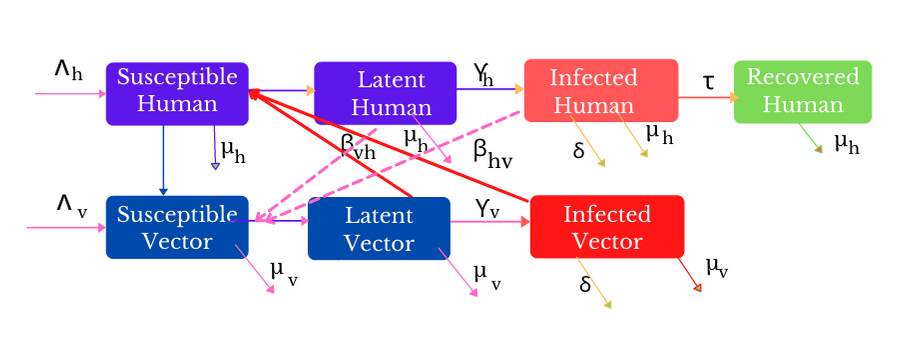
The mathematical model for dengue fever transmission studied by [1], has been re-investigated. The differential transformation method (DTM) is used to compute the semi-analytical solutions of the non-linear differential equations of the compartment (SIR) model of dengue fever. This epidemiology problem is well-posed. The effect of treatment as a control measure is studied through the growth equations of exposed and infected humans. The inadvertent errors in the recurrence relations (DTM) of equations for dengue disease transmission including initial conditions have been removed. Furthermore, the semi-analytic solutions of the model are obtained and verified with the built-in function AsymptoticDSolveValue of Wolfram Mathematica. It has been found that results obtained from the DTM are valid only for small-time t (t < 1.5), as t becomes large, the human population (exposed and recovered) and infected vector population become negative.
Published
How to Cite
Issue
Section
Copyright (c) 2021 Journal of the Nigerian Society of Physical Sciences

This work is licensed under a Creative Commons Attribution 4.0 International License.
How to Cite
Similar Articles
- Onyeke Idoko Charles, John Kolo Alhassan, Mohammed Danlami Abdulmalik, Kehinde Dele Tolorunse, A hybrid process-based and neural network post-processing model for cowpea yield prediction under climate variability in North Central Nigeria , Journal of the Nigerian Society of Physical Sciences: Volume 8, Issue 2, May 2026
- Waheed B. Yahya, Yusuf Bello, Abdulrazaq AbdulRaheem, Model Fitness and Predictive Accuracy in Linear Mixed-Effects Models with Latent Clusters , Journal of the Nigerian Society of Physical Sciences: Volume 5, Issue 3, August 2023
- Samson Olaniyi, Furaha M. Chuma, Sulaimon F. Abimbade, Asymptotic stability analysis of a fractional epidemic model for Ebola virus disease in Caputo sense , Journal of the Nigerian Society of Physical Sciences: Volume 7, Issue 1, February 2025
- Sunday Olorunfunmi, Armand Bahini, Adenike Olatinwo, Theoretical Study on 10C Elastic Scattering Cross Sections Using Different Cluster Density Distributions and Different Potentials , Journal of the Nigerian Society of Physical Sciences: Volume 5, Issue 2, May 2023
- Merabti Nesrine Lamya, Iqbal M. Batiha, Imad Rezzoug, Adel Ouannas, Taki-Eddine Ouassaeif, On sentinel method of one-phase Stefan problem , Journal of the Nigerian Society of Physical Sciences: Volume 5, Issue 4, November 2023
- Olusegun Olotu, Charles Aladesaye, Kazeem Adebowale Dawodu, Modified Gradient Flow Method for Solving One-Dimensional Optimal Control Problem Governed by Linear Equality Constraint , Journal of the Nigerian Society of Physical Sciences: Volume 4, Issue 1, February 2022
- K. Ahmed, M. Y. Waziri, A. S. Halilu, I. A. R. Moghrab, H. Abdullahi, S. M. Ibrahim, Y. B. Musa, S. Murtala, A. M. Awwal, A. Sambas, A Dai-Kou-Type method with image de-blurring application , Journal of the Nigerian Society of Physical Sciences: Volume 7, Issue 3, August 2025
- George Muddu, Shefiu Olusegun Ganiyu, Adekunle Olugbenga Ejidokun, Yusuf Abass Aleshinloye, Integrated data-driven credit default prediction in Uganda using machine learning models , Journal of the Nigerian Society of Physical Sciences: Volume 8, Issue 1, February 2026
- Tunde Tajudeen Yusuf, Afeez Abidemi, Ayodeji Sunday Afolabi, Emmanuel Jesuyon Dansu, Optimal Control of the Coronavirus Pandemic with Impacts of Implemented Control Measures , Journal of the Nigerian Society of Physical Sciences: Volume 4, Issue 1, February 2022
- Abbas Ja'afaru Badakaya, Bilyaminu Muhammad, A Purusit Differential Game Problem on a Closed Convex Subset of a Hilbert Space , Journal of the Nigerian Society of Physical Sciences: Volume 2, Issue 3, August 2020
You may also start an advanced similarity search for this article.