A study of growth of COVID-19 with super-spreaders using the modified SIR model including iceberg phenomenon
Keywords:
SIR model, COVID-19, Super-spreaders, Super Spreading Event, Iceberg phenomenon in epidemiology, Basic reproduction numberAbstract
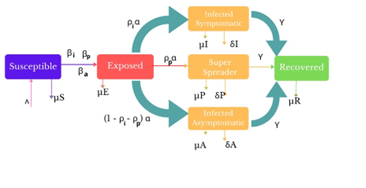
This paper explores the dynamics of COVID-19 transmission, particularly focusing on super-spreaders, through the lens of the SIR model. The model comprises six compartments representing susceptible, exposed, symptomatic infected, super-spreader, asymptomatic infected, and recovered individuals. Utilizing a set of non-linear, interdependent differential equations, we numerically solve for model parameters to examine the influence of super-spreaders on infection spread within the population. We calculate the basic reproduction number (R0) and discuss the stability of disease-free equilibrium. Our findings underscore the significant role played by super-spreaders and asymptomatic individuals in disease dissemination. Drawing on the epidemiological concept of the iceberg phenomenon, we offer insights into super-spreader events (SSEs) in India and their ramifications.
Published
How to Cite
Issue
Section
Copyright (c) 2024 Gurpreet Singh Tuteja, Tapshi Lal

This work is licensed under a Creative Commons Attribution 4.0 International License.
How to Cite
Similar Articles
- Samuel Olorunfemi Adams, Davies Abiodun Obaromi, Alumbugu Auta Irinews, Goodness of Fit Test of an Autocorrelated Time Series Cubic Smoothing Spline Model , Journal of the Nigerian Society of Physical Sciences: Volume 3, Issue 3, August 2021
- A. E. Ibor, D. O. Egete, A. O. Otiko, D. U. Ashishie, Detecting network intrusions in cyber-physical systems using deep autoencoder-based dimensionality reduction approach anddeep neural networks , Journal of the Nigerian Society of Physical Sciences: Volume 7, Issue 3, August 2025
- Opeyemi Odetunde, Tunde Alesinloye, Omoniyi Francis, Modeling the dynamics of type 2 diabetes with modifiable lifestyle influence , Journal of the Nigerian Society of Physical Sciences: Volume 8, Issue 3, August 2026
- Jamilu Adamu, Aminu Sulaiman Halliru, Bala Ma’aji Abdulhamid, On Some Pursuit Differential Game Problem in a Hilbert Space , Journal of the Nigerian Society of Physical Sciences: Volume 4, Issue 1, February 2022
- S. O. Salawu, R. A. Kareem, J. O. Ajilore, Eyring-Powell MHD nanoliquid and entropy generation in a porous device with thermal radiation and convective cooling , Journal of the Nigerian Society of Physical Sciences: Volume 4, Issue 4, November 2022
- Ibrahim Adamu Mohammed, Majid Khan Majahar Ali, Sani Rabiu, Raja Aqib Shamim, Shahida Shahnawaz, Development and validation of hybrid drying kinetics models with finite element method integration for black paper in a v-groove solar dryer , Journal of the Nigerian Society of Physical Sciences: Volume 7, Issue 4, November 2025
- Ahmad Alhawarat, Sultanah Masmali, Shahrina Ismail, Hamid El Hor, A descent-safeguarded PRP-type conjugate gradient with global convergence and CUTEst benchmarks , Journal of the Nigerian Society of Physical Sciences: Volume 8, Issue 2, May 2026
- T. W. David, B. J. Adekoya, C. M. Michael, S. A. Adekoya, O. A. Adenuga, S. O. Kareem, H. T. Oladunjoye, A. E. Ajetunmobi, O. T. Williams, D. T. Ogundele, A Study of the Relationship Between Southward Bz > -10 nT and Storm Time Disturbance Index During Solar Cycle 23 , Journal of the Nigerian Society of Physical Sciences: Volume 4, Issue 4, November 2022
- Abiodun Oluwatosin Adeoye, Rukayat Oluwatobiloba Quadri, Olayide Samuel Lawal, Sustainable remediation of vancomycin polluted water using pyrolysis biochar of pressed oil palm fruit fibre , Journal of the Nigerian Society of Physical Sciences: Volume 7, Issue 2, May 2025
- Monika Saini, Ashish Kumar, Vijay Singh Maan, Deepak Sinwar, Efficient and Intelligent Decision Support System for Smart Irrigation , Journal of the Nigerian Society of Physical Sciences: Volume 4, Issue 4, November 2022
You may also start an advanced similarity search for this article.