Food and environmental degradation as causative agents of honey bee colonies decline: Mathematical model approach
Keywords:
Honey Bees, Colony Collapse Disorder, degradation, EnvironmentAbstract
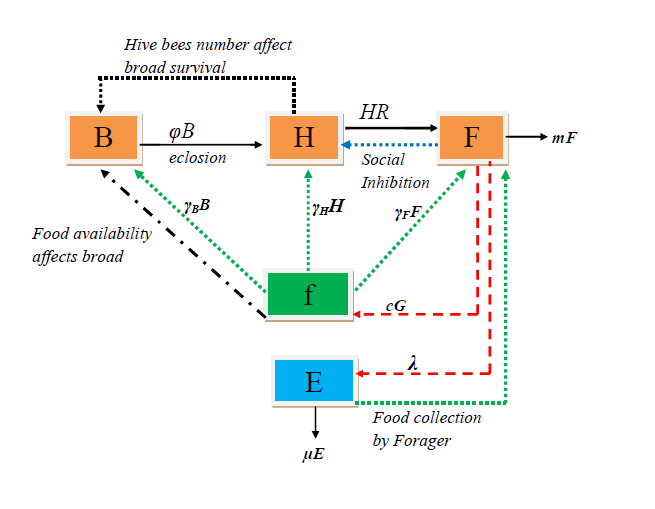
In this research, a new compartment model of honey bee population is developed to study the effects of gradual change of food availability and environmental degradation on bee population growth and development. The model is proved to be mathematical well posed and a non-trivial equilibrium point is shown to exist and asymptotically stable under certain conditions. The model predicts a critical threshold environmental degradation rate above which the population size of bees decline and subsequently collapse. Low environmental degradation and high food availability leads to stable bee population. Global sensitivity analysis is conducted to determine the most sensitive parameters of the model that can lead to colony collapse disorder. Numerical simulations are conducted to illustrate all the results.
Published
How to Cite
Issue
Section
Copyright (c) 2021 Journal of the Nigerian Society of Physical Sciences

This work is licensed under a Creative Commons Attribution 4.0 International License.
How to Cite
Similar Articles
- Samsudeen Olanrewaju Azeez, Akeem Adebayo Jimoh, Ismaila Olalekan Saheed, Kabir Opeyemi Otun, Aliru Olajide Mustapha, Folahan Amoo Adekola, Optimization by Box Behnken Design for Eosin Yellow Dye Removal from Aqueous Medium using Date Palm Seeds-Porous Carbon@TiO2 Blend , Journal of the Nigerian Society of Physical Sciences: Volume 4, Issue 2, May 2022
- N. K. Olasunkanmi, D. T. Ogundele, V. T. Olayemi, W. A. Yahya, A. R. Olasunkanmi, Z. O. Yusuf, S. A. Aderoju, Assessing leachate contamination and groundwater vulnerability in urban dumpsites: a case study of the Ipata Area, Ilorin, Nigeria , Journal of the Nigerian Society of Physical Sciences: Volume 6, Issue 2, May 2024
- Israel Aruoriwo Abiodun Etobro, Omobehere Innocent Ejeh, Multi-proxy evidence from the exposed strata at Okpekpe, Imiegba, and environs for nomenclature as Mamu Formation, Benin Flank, NW Anambra basin, Nigeria , Journal of the Nigerian Society of Physical Sciences: Volume 8, Issue 1, February 2026
- Wilson Nwankwo, Kingsley Ukhurebor, Investigating the Performance of Point to Multipoint Microwave Connectivity across Undulating Landscape during Rainfall , Journal of the Nigerian Society of Physical Sciences: Volume 1, Issue 3, August 2019
- Leonce Wehnelt TOKAM, Sanoussi S. OURO-DJOBO, Non-Intrusive Load Monitoring (NILM), Interests and Applications , Journal of the Nigerian Society of Physical Sciences: Volume 5, Issue 2, May 2023
- Ogheneovo Akpoyibo, Ezekiel Onoriode Abriku, F. C. Ugbe, Ochuko Anomohanran, Geophysical and geotechnical assessment of Obiaruku-Agbor road failure in Western Niger-Delta, Nigeria , Journal of the Nigerian Society of Physical Sciences: Volume 7, Issue 1, February 2025
- Tertsea Igbawua, Martha Hembafan Gbanger, Fanan Ujoh, Suitability Analysis for Yam Production in Nigeria using Satellite and Observation Data , Journal of the Nigerian Society of Physical Sciences: Volume 4, Issue 4, November 2022
- R. Latha, K. Lakshminarayanachari, C. Bhaskar, An analytical model for point source pollutants in an urban area with mesoscale wind and wet deposition , Journal of the Nigerian Society of Physical Sciences: Volume 6, Issue 4, November 2024
- Opeyemi Odetunde, Tunde Alesinloye, Omoniyi Francis, Modeling the dynamics of type 2 diabetes with modifiable lifestyle influence , Journal of the Nigerian Society of Physical Sciences: Volume 8, Issue 3, August 2026
- O. E. Ojo, M. K. Kareem, O. Samuel, C. O. Ugwunna, An Internet-of-Things based Real-time Monitoring System for Smart Classroom , Journal of the Nigerian Society of Physical Sciences: Volume 4, Issue 2, May 2022
You may also start an advanced similarity search for this article.
Most read articles by the same author(s)
- Adamu Shitu Hassan, Nafiu Hussaini, Analysis of an HIV - HCV simultaneous infection model with time delay , Journal of the Nigerian Society of Physical Sciences: Volume 3, Issue 1, February 2021