Chemometric authentication of branded and crude spices using integrated GC–MS fingerprints and elemental profiling
Keywords:
Spice authentication, Integrated chemical fingerprinting, GC–MS profiling, Elemental analysis, ChemometricsAbstract
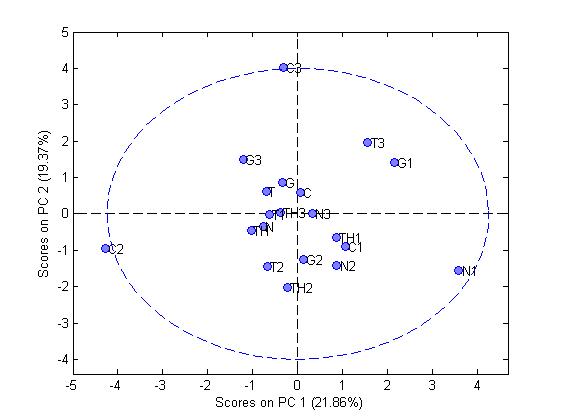
Counterfeit and substandard spice products present significant risks to food safety, nutritional quality, and consumer confidence. This study applied an integrated chemometric approach, GC--MS chemical profiling, and elemental analysis to authenticate and discriminate among crude, genuine-branded, and potentially adulterated spice products. Twenty spice samples from curry, ginger, turmeric, nutmeg, and thyme were analysed using gas chromatography--mass spectrometry (GC--MS) for volatile compounds, flame photometry for macroelements, and atomic absorption spectrometry (AAS) for microelements, respectively. Principal component analysis (PCA) and hierarchical cluster analysis (HCA) revealed clear separation between crude and branded spices. An optimized model framework using two principal components explained 70.55% of the total calibration variance (70.29% cross-validated variance). The hierarchical cluster analysis (HCA) dendrograms confirmed distinct clustering, highlighting close substitutability among certain spices based on their nutrient profiles. Elemental analysis indicated significant variation across samples: branded curry 3 and branded ginger 3 were rich in zinc and selenium, while branded nutmeg 1 exhibited exceptionally high iron content. Conversely, some branded products, such as branded curry powder, consistently showed low or absent levels of essential micronutrients. GC--MS profiling identified dominant fatty acids, including Octadec-9-enoic acid and Octadecanoic acid. These compositional differences underpin the discriminatory power of chemometric models, enabling reliable authentication of the crude and branded spices and the detection of potential adulteration. The study demonstrated that integrated chemical fingerprinting with multivariate analysis provides a robust framework for quality assurance and regulatory monitoring of commercial spice products.
Published
How to Cite
Issue
Section
Copyright (c) 2026 E. Udensi, R. B. Salau, S. O. Salihu, M. M. Ndamitso, M. T. Bisiriyu (Author)

This work is licensed under a Creative Commons Attribution 4.0 International License.
How to Cite
Similar Articles
- Peter Urane Achimugwu, Mathew Ngugi Kinyanjui, David Mumo Malonza, Analysis of a fractional order climate model due to excessive emission and accumulation of carbon dioxide in the atmosphere , Journal of the Nigerian Society of Physical Sciences: Volume 5, Issue 4, November 2023
- Idris Babaji Muhammad, Salisu Usaini, Dynamics of Toxoplasmosis Disease in Cats population with vaccination , Journal of the Nigerian Society of Physical Sciences: Volume 3, Issue 1, February 2021
- Catherine N. Ogbizi-Ugbe, Osowomuabe Njama-Abang, Samuel Oladimeji, Idongetsit E. Eteng, Edim A. Emanuel, Synergistic intelligence: a novel hybrid model for precision agriculture using k-means, naive Bayes, and knowledge graphs , Journal of the Nigerian Society of Physical Sciences: Volume 8, Issue 1, February 2026
- Hamza Abubakar, Abdu Sagir Masanawa, Surajo Yusuf, G. I. Boaku, Optimal representation to High Order Random Boolean kSatisability via Election Algorithm as Heuristic Search Approach in Hopeld Neural Networks , Journal of the Nigerian Society of Physical Sciences: Volume 3, Issue 3, August 2021
- Ahmad Alhawarat, Sultanah Masmali, Shahrina Ismail, Hamid El Hor, A descent-safeguarded PRP-type conjugate gradient with global convergence and CUTEst benchmarks , Journal of the Nigerian Society of Physical Sciences: Volume 8, Issue 2, May 2026
- O. E. Ojo, M. K. Kareem, O. Samuel, C. O. Ugwunna, An Internet-of-Things based Real-time Monitoring System for Smart Classroom , Journal of the Nigerian Society of Physical Sciences: Volume 4, Issue 2, May 2022
- Richard O. Akinola, Ezekiel O. Omole, Joshua Sunday, Stephen Y. Kutchin, A ninth-order first derivative method for numerical integration , Journal of the Nigerian Society of Physical Sciences: Volume 7, Issue 1, February 2025
- M. O. Ogunniran, A Class of Block Multi-derivative Numerical Techniques for Singular Advection Equations , Journal of the Nigerian Society of Physical Sciences: Volume 1, Issue 2, May 2019
- Osowomuabe Njama-Abang, Denis U. Ashishie, Paul T. Bukie, Addressing class imbalance in lassa fever epidemic data, using machine learning: a case study with SMOTE and random forest , Journal of the Nigerian Society of Physical Sciences: Volume 7, Issue 3, August 2025
- Nikita Bhardwaj, Monika Saini, Ashish Kumar, Estimation of reliability characteristics of single-unit repairable system with preventive maintenance and server arrival time , Journal of the Nigerian Society of Physical Sciences: Volume 8, Issue 2, May 2026
You may also start an advanced similarity search for this article.