Applications of quadrilateral finite element meshes with four-node, eight-node, and twelve-node for efficient microwave energy transfer in curved waveguides

Authors

  • K. Lekhana
    Department of Mathematics, Dayananda Sagar College of Engineering, Visvesvaraya Technological University, Bangalore, India
  • K. T. Shivaram
    Department of Mathematics, Dayananda Sagar College of Engineering, Visvesvaraya Technological University, Bangalore, India

Keywords:

Quadrilateral meshing, Multiply connected regions, Eigenvalue, Finite element method

Abstract

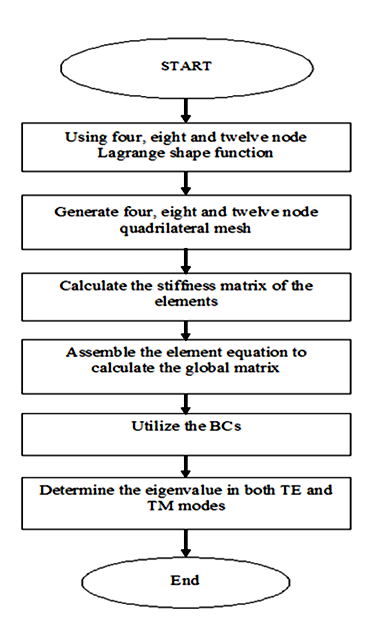
This study proposes a two-dimensional higher-order finite element method for computing eigenvalues in planar and multiply connected curved domains relevant to microwave energy transfer and electromagnetic waveguide problems. A fully automated quadrilateral mesh generator implemented in MAPLE-18 is used to convert triangular finite elements into quadrilateral elements with Four-node, Eight-node, and Twelve-node so that curved boundaries can be represented with improved accuracy. The formulation combines a Galerkin finite element procedure, an automated higher-order meshing strategy, and a Gauss quadrature rule to obtain numerical solutions of Helmholtz-type eigenvalue problems. Five curved waveguide domains are considered: an annular circular domain, a circular domain with a square hole, the union of two circular disks, a circular region with two unequal holes, and an L-shaped domain with a quarter-circular curved boundary. The computed eigenvalues are compared with published numerical and analytical results. The comparisons show that increasing the element order from Four-node, Eight-node, and Twelve-node improves the accuracy of the predicted eigenvalues while reducing the number of elements required to obtain comparable convergence. The proposed method therefore provides a practical and efficient finite element framework for eigenvalue estimation in curved waveguide geometries.
Dimensions

[1] A. Bondeson, T. Rylander & P. Ingelstrom, Computational electromagnetics, Springer, New York, USA, 2005, pp. 87--151. https://doi.org/10.1007/0-387-29150-1.

[2] S. Zaglmayr, High order finite element methods for electromagnetic field computation, Ph.D. dissertation, Institute for numerical mathematics, Johannes Kepler University, Altenberger Strasse, Austria, 2006. Available online: https://www.numerik.math.tugraz.at/~zaglmayr/pub/szthesis.pdf.

[3] E. Kurt, H. Gor & M. Demirtas, ``Theoretical and experimental analyses of a single phase permanent magnet generator (PMG) with multiple cores having axial and radial directed fluxes'', Energy conversion and management 77 (2014) 163. https://doi.org/10.1016/j.enconman.2013.09.013.

[4] Z. G. Shen, S. Y. Wu, L. Xiao & Z. Chen, ``Proposal and assessment of a solar thermoelectric generation system characterized by a fresnel lens, cavity receiver and heat pipe'', Energy 141 (2017) 215. https://doi.org/10.1016/j.energy.2017.09.051.

[5] Z. G. Shen, S. Y. Wu & L. Xiao, ``Assessment of the performance of annular thermoelectric couples under constant heat flux condition'', Energy conversion and management 150 (2017) 704. https://doi.org/10.1016/j.enconman.2017.08.058.

[6] M. J. Navardi, B. Babaghorbani & A. Ketabi, ``Efficiency improvement and torque ripple minimization of switched reluctance motor using FEM and seeker optimization algorithms'', Energy conversion and management 78 (2014) 237. https://doi.org/10.1016/j.enconman.2013.11.001.

[7] L. N. Trefethen & T. Betcke, ``Computed eigenmodes of planar regions'', Contemporary mathematics 412 (2006) 297. https://people.maths.ox.ac.uk/trefethen/publication/PDF/2006_116.pdf.

[8] J. T. Chen, L. W. Liu & S. W. Chyuan, ``Acoustic eigenanalysis for multiply-connected problems using dual boundary element method'', Communications in numerical methods in engineering 20 (2004) 419. https://doi.org/10.1002/cnm.679.

[9] E. Akhmetgaliyev, O. P. Bruno & N. A. Nigam, ``Boundary integral algorithm for the Laplace Dirichlet-Neumann mixed eigenvalue problem'', Journal of computational physics 298 (2015) 1. https://doi.org/10.1016/j.jcp.2015.06.009.

[10] R. Misawa, K. Niino & N. Nishimura, ``A fast multipole method (FMM) for waveguide problems of 2-D Helmholtz equation and its application to eigenvalue problems'', Wave motion 63 (2016) 1. https://doi.org/10.1016/j.wavemoti.2015.12.006.

[11] K. Asha, N. K. Suryanarayana, K. Narayan & P. K. Pattnaik, ``Design and modeling of microfluidic channel in a dielectric planar waveguide using COMSOL multiphysics'', in Emerging research in computing, information, communication and applications, Springer, New Delhi, India, 2016, pp. 79-87. https://doi.org/10.1007/978-81-322-2553-9_8.

[12] C. J. Zheng, C. Zhang, C. X. Bi, H. F. Gao, L. Du & H. B. Chen, ``Coupled FE-BE method for eigenvalue analysis of elastic structures submerged in an infinite fluid domain'', International journal for numerical methods in engineering 110 (2017) 163. https://doi.org/10.1002/nme.5351.

[13] T. Flisgen, U. van Rienen & J. Heller, ``Computation of eigenmodes in long and complex accelerating structures by means of concatenation strategies'', in Proceedings of the 5th international particle accelerator conference, JACoW publishing, Dresden, Germany, 2014, pp. 947--949. https://proceedings.jacow.org/IPAC2014/papers/tuoab01.pdf.

[14] J. S. Alves Carlos & R. S. Antunes Pedro, ``The method of fundamental solutions applied to the calculation of eigenfrequencies and eigenmodes of 2D simply connected shapes'', Computer modeling in engineering & sciences 2 (2005) 251. https://doi.org/10.3970/cmc.2005.002.251.

[15] J. T. Chen, J. W. Lee, I. L. Chen & P. S. Kuo, ``On the null and nonzero fields for true and spurious eigenvalues of annular and confocal elliptical membranes'', engineering analysis with boundary elements 37 (2013) 42. https://doi.org/10.1016/j.enganabound.2012.08.005.

[16] J. T. Chen, J. W. Lee, Y. T. Lee & W. C. Lee, ``True and spurious eigensolutions of an elliptical membrane by using the nondimensional dynamic influence function method'', Journal of vibration and acoustics 136 (2014) 021018. https://doi.org/10.1115/1.4026354.

[17] C. J. Zheng, H. B. Chen, H. F. Gao & L. Du, ``Is the Burton-Miller formulation really free of fictitious eigenfrequencies'', Engineering analysis with boundary elements 59 (2015) 43. https://doi.org/10.1016/j.enganabound.2015.04.014.

[18] D. V. Griffiths, J. Huang & R. P. Schiermeyer, ``Elastic stiffness of straight-sided triangular finite elements by analytical and numerical integration'', Communications in numerical methods in engineering 25 (2009) 247. https://doi.org/10.1002/cnm.1124.

[19] K. T. Shivaram & H. R. Jyothi, ``Finite element approach for numerical integration over family of eight node linear quadrilateral element for solving Laplace equation'', Materials today: proceedings 46 (2021) 4336. https://doi.org/10.1016/j.matpr.2021.03.437.

[20] K. T. Shivaram, L. M. P. Harshitha, H. P. Chethana & K. Nidhi, ``Finite element mesh generation technique for numerical computation of cutoff wave numbers in rectangular and l-shaped waveguide'', in Proceedings of the 3rd international conference on inventive computation technologies, IEEE xplore, Coimbatore, India, 2018, pp. 704--706. https://ieeexplore.ieee.org/document/9034432.

[21] A. M. Yogitha, K. T. Shivaram, S. M. Rajesh & N. Mahesh Kumar, ``Numerical computation of cut off wave number in polygonal waveguide by eight node finite element mesh generation approach'', Journal of the Nigerian society of physical sciences 6 (2024) 2149. https://doi.org/10.46481/jnsps.2024.2149.

[22] K. Lekhana & K. T. Shivaram, ``A method for creating twelve-node finite element meshes to find the cutoff wave number for polygonal and circular waveguides'', International journal of basic and applied sciences 14 (2025) 59. https://doi.org/10.14419/y9648s16.

[23] A. M. Yogitha & K. T. Shivaram, ``A twelve-noded finite element approximation to 2D-Poisson equations with a dirac line source'', Journal of mechanics of continua and mathematical sciences 20 (2025) 26. https://doi.org/10.26782/jmcms.2025.05.00003.

[24] H. T. Rathod & M. S. Karim, ``Synthetic division based integration of rational functions of bivariate polynomial numerators with linear denominators over a unit triangle (0 leq xi, eta leq 1, xi+eta leq 1) in the local parametric space ((xi,eta))'', Computer methods in applied mechanics and engineering 181 (2000) 191. https://doi.org/10.1016/S0045-7825(99)00225-6.

[25] C. J. Zheng, C. X. Bi, C. Zhang, Y. B. Zhang & H. B. Chen, ``Fictitious eigenfrequencies in the BEM for interior acoustic problems'', Engineering analysis with boundary elements 104 (2019) 170. https://doi.org/10.1016/j.enganabound.2019.03.042.

[26] J. T. Chen, J. H. Lin, S. R. Kuo & S. W. Chyuan, ``Boundary element analysis for the Helmholtz eigenvalue problems with a multiply connected domain'', Proceedings of the royal society of London A: mathematical, physical and engineering sciences 457 (2001) 2521. https://doi.org/10.1098/rspa.2001.0806.

[27] O. C. Zienkiewicz, R. L. Taylor & J. Z. Zhu, The finite element method: its basis and fundamentals, 7th ed., Elsevier, 2005, pp. 1-20. https://doi.org/10.1016/B978-1-85617-633-0.00001-0.

[28] J. N. Reddy, An introduction to the finite element method, 3rd ed., McGraw-Hill, New York, USA, 2006. ISBN: 0-07-246685-5.

fig 6

Published

2026-06-08

How to Cite

Applications of quadrilateral finite element meshes with four-node, eight-node, and twelve-node for efficient microwave energy transfer in curved waveguides. (2026). Journal of the Nigerian Society of Physical Sciences, 8(3), 3412. https://doi.org/10.46481/jnsps.2026.3412

Issue

Section

Mathematics & Statistics

How to Cite

Applications of quadrilateral finite element meshes with four-node, eight-node, and twelve-node for efficient microwave energy transfer in curved waveguides. (2026). Journal of the Nigerian Society of Physical Sciences, 8(3), 3412. https://doi.org/10.46481/jnsps.2026.3412

Similar Articles

41-50 of 187

You may also start an advanced similarity search for this article.

Most read articles by the same author(s)