Synthesis, characterization, and antifungal and antioxidant evaluation of novel ethylenediamine-derived Schiff bases and their Ni(II), Co(II), Cd(II), and Cu(II) complexes
Keywords:
Antifungal activity, Antioxidant activity, Schiff base complexes, Spectroscopic characterization, Transition metal complexesAbstract
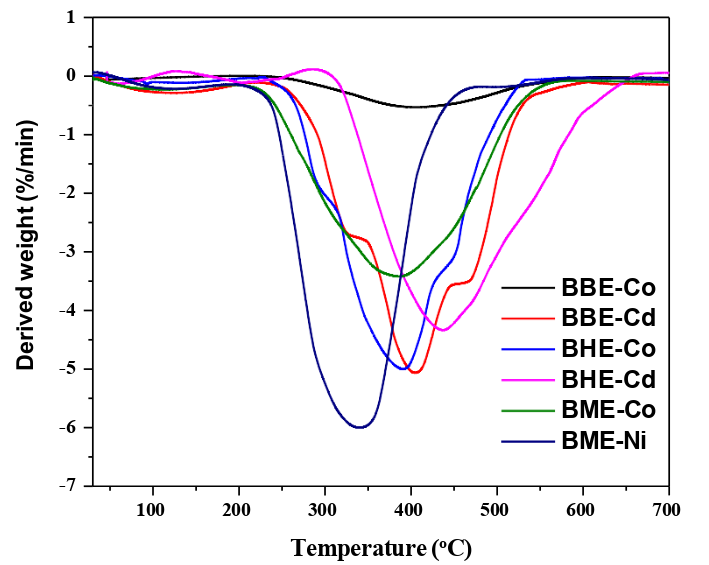
Three Schiff base ligands derived from condensation of ethylenediamine with benzaldehyde, salicylaldehyde, and vanillin, namely (1E,1'E)-N,N'-(ethane-1,2-diyl)bis(1-phenylmethanimine) (BBE), 4,4'-((1E,1'E)-(ethane-1,2-diylbis(azaneylylidene))bis(methaneylylidene))bis(2-methoxyphenol) (BHE), and 2,2'-((1E,1'E)-(ethane-1,2-diylbis(azaneylylidene))bis(methaneylylidene))diphenol (BME), were synthesized and complexed with Co(II), Cu(II), Ni(II), and Cd(II) ions. To the best of our knowledge, these specific metal complexes have not been reported previously, and their biological activities have not been evaluated. The ligands and complexes were characterized by melting point determination, solubility tests, molar conductivity, UV--visible and FTIR spectroscopy, magnetic susceptibility, X-ray fluorescence, powder X-ray diffraction (XRD), and thermogravimetric/differential thermal analyses (TGA/DTA). Low molar conductivity values (10.5--12.0 Omega-1 cm2 mol-1) indicate non-electrolytic behavior, while FTIR and X-ray fluorescence studies indicate coordination through azomethine nitrogen and oxygen donor atoms. XRD patterns show crystalline structures with sharp diffraction peaks, and thermal analyses indicate multistep decomposition and good thermal stability. Biological analysis indicates increased antifungal activity of the metal complexes over the free ligands, with lower minimum inhibitory concentrations; some complexes also showed improved 2,2-diphenyl-1-picrylhydrazyl (DPPH) radical scavenging activity (IC50 = 0.68101 mg/mL). The first-row transition metals are biologically relevant, while Cd(II) was included only for comparative structure--activity evaluation despite its known toxicity. This study provides insight into Ni(II) and Cd(II) complexes through integrated structural, thermal, and biological characterization.
References
[1] R. Meena, P. Meena, A. Kumari, N. Sharma & N. Fahmi, ``Schiff bases and their metal complexes: synthesis, structural characteristics and applications'', In Schiff Base in Organic, Inorganic and Physical Chemistry, IntechOpen, 2023. https://doi.org/10.5772/intechopen.108396.
[2] L. Fabbrizzi, ``Beauty in chemistry: Making artistic molecules with Schiff bases'', The Journal of Organic Chemistry 85 (2020) 12212. https://doi.org/10.1021/acs.joc.0c01420.
[3] M. Malakyan, N. Babayan, R. Grigoryan, N. Sarkisyan, V. Tonoyan, D. Tadevosyan, V. Matosyan, R. Aroutiounian & A. Arakelyan, ``Synthesis, characterization and toxicity studies of pyridinecarboxaldehydes and L-tryptophan derived Schiff bases and corresponding copper(II) complexes'', F1000Research 5 (2016) 1921. https://doi.org/10.12688/f1000research.9226.1.
[4] P. Ghanghas, A. Choudhary, D. Kumar & K. Poonia, ``Coordination metal complexes with Schiff bases: Useful pharmacophores with comprehensive biological applications'', Inorganic Chemistry Communications 130 (2021) 108710. https://doi.org/10.1016/j.inoche.2021.108710.
[5] J. Anastassopoulou & T. Theophanides, ``The role of metal ions in biological systems and medicine'', in Bioinorganic Chemistry: An Inorganic Perspective of Life, NATO ASI Series, vol 459, Springer, Dordrecht, 1995, pp. 209--218. https://doi.org/10.1007/978-94-011-0255-1_17.
[6] P. Singh, P. Yadav, K. K. Sodhi, A. Tomer & S. B. Mehta, ``Advancement in the synthesis of metal complexes with special emphasis on Schiff base ligands and their important biological aspects'', Results in Chemistry 7 (2024) 101222. https://doi.org/10.1016/j.rechem.2023.101222.
[7] M. S. Sinicropi, J. Ceramella, D. Iacopetta, A. Catalano, A. Mariconda, C. Rosano, C. Saturnino, H. El-Kashef & P. Longo, ``Metal complexes with Schiff bases: Data collection and recent studies on biological activities'', International Journal of Molecular Sciences 23 (2022) 14840. https://doi.org/10.3390/ijms232314840.
[8] K. O. Eberendu, J. I. Iheanyichukwu, O. M. Mac-kalunta, C. I. Nwankwo, I. E. Otuokere & J. C. Nnaji, ``Zn(II) and Fe(II) complexes of 2,4-dinitro-N-[(Z)-[(E)-3-(2-nitrophenyl)prop-2-enylidene] amino] aniline: Synthesis, characterization and in silico SARS-CoV-2 inhibition studies'', Journal of the Nigerian Society of Physical Sciences 7 (2025) 2326. https://doi.org/10.46481/jnsps.2025.2326.
[9] R. O. Awolope, I. P. Ejidike & H. S. Clayton, ``Schiff base metal complexes as a dual antioxidant and antimicrobial agents'', Journal of Applied Pharmaceutical Science 13 (2023) 132. https://doi.org/10.7324/JAPS.2023.91056.
[10] S. David, V. Barros, C. Cruz & R. Delgado, ``In vitro effect of free and complexed indium(III) against Mycobacterium tuberculosis'', FEMS Microbiology Letters 251 (2005) 119. https://doi.org/10.1016/j.femsle.2005.07.044.
[11] S. D. Oladipo, A. A. Adeleke, A. A. Badeji, K. I. Babalola, A. H. Labulo, I. Hassan, S. T. Yussuf & S. O. Olalekan, ``Computational investigation and biological activity of selected Schiff bases'', Journal of the Nigerian Society of Physical Sciences 6 (2024) 2103. https://doi.org/10.46481/jnsps.2024.2103.
[12] B. Rogalewicz & A. Czylkowska, ``Recent advances in the discovery of copper(II) complexes as potential anticancer drugs'', European Journal of Medicinal Chemistry 292 (2025) 117702. https://doi.org/10.1016/j.ejmech.2025.117702.
[13] R. A. Murcia-Galán, S. M. Durán, S. M. Leal-Pinto, M. V. Roa-Cordero, J. D. Vargas, L. V. Herrera, A. Muñoz-Castro, D. MacLeod-Carey, T. W. Naranjo, P. L. Rodríguez-Kessler & J. J. Hurtado, ``Antifungal activity of Co(II) and Cu(II) complexes containing 1,3-bis(benzotriazol-1-yl)-propan-2-ol on the growth and virulence traits of fluconazole-resistant Candida species: Synthesis, DFT calculations, and biological activity'', BMC Chemistry 17 (2023) 135. https://doi.org/10.1186/s13065-023-01037-7.
[14] H. A. Ibrahim, U. F. Muhammed, A. Aliyu & M. S. Bunza, ``Synthesis, characterization, and biological studies of Ni(II), Cu(II), and Zn(II) complexes with a Schiff base derived from 3-formylchromone and benzohydrazide'', Science World Journal 20 (2025) 1059. https://doi.org/10.4314/swj.v20i3.20.
[15] G. Behera, R. Sidhanty, A. K. Sutar & T. Maharana, ``Schiff bases and their transition metal complexes as cornerstones in applied chemistry'', Discover Chemistry 3 (2026) 119. https://doi.org/10.1007/s44371-026-00536-5.
[16] D. P. Rao, A. K. Gautam, A. Verma & Y. Gautam, ``Schiff bases and their possible therapeutic applications: A review'', Results in Chemistry 13 (2025) 101941. https://doi.org/10.1016/j.rechem.2024.101941.
[17] H. M. Masena, I. Waziri, S. Sookai, A. Mafika & A. J. Muller, ``Salicylidene Schiff base metal complexes: Crystal structures, biological evaluation, computational and DNA binding study'', Journal of Molecular Structure 1365 (2026) 146012. https://doi.org/10.1016/j.molstruc.2026.146012.
[18] M. M. Hossain, M. A. Bashar, M. N. Khan, P. K. Roy, M. A. Mannan, M. S. Ali & M. A. Farooque, ``Physical and spectral characterization of Ni(II), Cu(II), Co(II) and Cd(II) complexes with Schiff base of salicylaldehyde and 2-aminopyridine towards potential microbial application'', American Journal of Applied Chemistry 6 (2018) 147. https://doi.org/10.11648/j.ajac.20180604.13.
[19] A. K. Elshewemy, E. A. Gomaa, H. M. Abou El Nadar, A. H. Mannaa, R. R. Zaky, M. G. Elghalban & M. N. Abd El-Hady, ``Coordination versatility and enhanced bioactivity of Co$^{2+}$, Cu$^{2+}$ and Cd$^{2+}$ complexes derived from pyridyl Schiff base: Structural, electronic and electrochemical insights'', BMC Chemistry 20 (2026) 42. https://doi.org/10.1186/s13065-026-01730-3.
[20] M. A. Salam, M. Y. Al-Amin, M. T. Salam, J. S. Pawar, N. Akhter, A. A. Rabaan & M. A. Alqumber, ``Antimicrobial resistance: A growing serious threat for global public health'', Healthcare 11 (2023) 1946. https://doi.org/10.3390/healthcare11131946.
[21] E. Kabir, M. R. O. K. Noyon & M. A. Hossain, ``Synthesis, biological and medicinal impacts of metallodrugs: A study'', Results in Chemistry 5 (2023) 100935. https://doi.org/10.1016/j.rechem.2023.100935.
[22] M. S. Iorungwa, R. A. Wuana & S. T. Dafa, ``Synthesis, characterization, kinetics, thermodynamic and antimicrobial studies of Fe(III), Cu(II), Zn(II), N,N$^prime$-bis(2-hydroxy-1,2-diphenylethanone) ethylenediamine complexes'', Chemical Methodologies 3 (2019) 408. https://doi.org/10.22034/chemm.2018.147922.1085.
[23] M. Benmabrouka, S. Seridi, Y. Aimene & S. Almi, ``Synthesis, spectroscopic characterization, DFT, and molecular docking analysis of some salicylideneaniline Schiff base derivatives as potential antioxidant compounds'', Polycyclic Aromatic Compounds 44 (2024) 6448. https://doi.org/10.1080/10406638.2023.2276252.
[24] W. J. Geary, ``The use of conductivity measurements in organic solvents for the characterisation of coordination compounds'', Coordination Chemistry Reviews 7 (1971) 81. https://doi.org/10.1016/S0010-8545(00)80009-0.
[25] D. L. Pavia, G. M. Lampman, G. S. Kriz & J. R. Vyvyan, Introduction to Spectroscopy, Harcourt College Publishers, Belmont, USA, 2001, p. 13.
[26] P. A. Vigato & S. Tamburini, ``The challenge of cyclic and acyclic Schiff bases and related derivatives'', Coordination Chemistry Reviews 248 (2004) 1717. https://doi.org/10.1016/j.cct.2003.09.003.
[27] S. Kumar, P. K. Pandey, N. Sinha, S. Chaudhari & S. Sharma, ``Spectroscopic characterisation of metal complexes with tetradentate ligand'', Journal of Physical Science 29 (2018) 1. https://jps.usm.my/wp-content/uploads/2018/11/JPS-293_Art1-1-11.pdf.
[28] K. Nakamoto, Infrared and Raman Spectra of Inorganic and Coordination Compounds, Part B: Applications in Coordination, Organometallic, and Bioinorganic Chemistry, 6th ed., John Wiley & Sons, Hoboken, NJ, 2009. https://doi.org/10.1002/9780470405888.
[29] A. A. Zakeyah, J. Whitt, C. Duke, D. Gilmore, D. Meeker, D. Smeltzer & M. Alam, ``Synthesis and antimicrobial studies of hydrazone derivatives of 4-[3-(2,4-difluorophenyl)-4-formyl-1H-pyrazol-1-yl] benzoic acid and 4-[3-(3,4-difluorophenyl)-4-formyl-1H-pyrazol-1-yl] benzoic acid'', Bioorganic & Medicinal Chemistry Letters 28 (2018) 2914. https://doi.org/10.1016/j.bmcl.2018.07.016.
[30] M. S. Iorungwa, C. L. Mamah & R. A. Wuana, ``Synthesis, characterization, kinetic, thermodynamic and antimicrobial activity studies of complexes of Cd(II), Cr(III), and Zr(IV) derived from benzaldehyde and ethylenediamine'', ChemSearch Journal 10 (2019) 10. https://www.ajol.info/index.php/csj/article/view/192125
[31] J. Devi, B. Taxak, B. Kumar & S. Rani, ``Synthesis, characterization and bioactivity of diorganotin(IV) Schiff base complexes as potential antimalarial and antioxidant agents: Insights through cytotoxicity and molecular docking studies'', Dalton Transactions 54 (2025) 7167. https://doi.org/10.1039/d5dt00274e.
[32] M. S. Alhussaini, A. A. I. Alyahya & A. A. Al-Ghanayem, ``Chelation-driven antimicrobial potency of Cu(II) complexes with N- and O-donor ligands: A review (2022--2025)'', Dyes and Pigments 243 (2025) 113040. https://doi.org/10.1016/j.dyepig.2025.113040.
[33] A. Frei, A. D. Verderosa, A. G. Elliott, J. Zuegg & M. A. T. Blaskovich, ``Metals to combat antimicrobial resistance'', Nature Reviews Chemistry 7 (2023) 202. https://doi.org/10.1038/s41570-023-00463-4.
[34] M. S. Rana, N. M. A. Rayhan, M. S. H. Emon, M. T. Islam, K. Rathry, M. M. Hasan, M. M. I. Mansur, B. C. Srijon, M. S. Islam, A. Ray, M. A. Rakib, A. Islam, M. Kudrat-E-Zahan, M. F. Hossen & M. A. Asraf, ``Antioxidant activity of Schiff base ligands using the DPPH scavenging assay: An updated review'', RSC Advances 14 (2024) 33094. https://doi.org/10.1039/d4ra04375h.
[35] R. D. Mohan, S. Sarukrishna, A. S. Babu, D. Santhosh, S. A. Fathima & B. Parvathy, ``A review of ligand denticity in copper--Schiff base complexes: Structural tuning toward enhanced antioxidant activity'', Inorganica Chimica Acta 590 (2026) 122980. https://doi.org/10.1016/j.ica.2025.122980.
[36] H. M. Abd El-Lateef, T. El-Dabea, M. M. Khalaf & A. M. Abu-Dief, ``Recent overview of potent antioxidant activity of coordination compounds'', Antioxidants 12 (2023) 213. https://doi.org/10.3390/antiox12020213.
Published
How to Cite
Issue
Section
Copyright (c) 2026 P. D. Iorungwa, M. S. Iorungwa, S. D. Umoh, R. A. Wuana, E. N. Iornumbe, A. G. Ugama, L. T. Tyagher (Author)

This work is licensed under a Creative Commons Attribution 4.0 International License.