Evaluating lung cancer control through a time-delay mathematical model with detailed sensitivity analysis
Keywords:
Lung cancer, Basic reproduction number, Sensitivity analysis, Existence and uniqueness, Nonstandard finite differenceAbstract
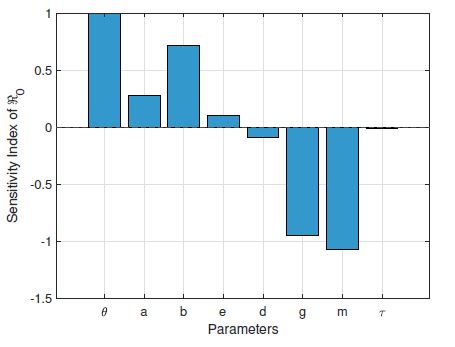
Lung cancer (LC) is a leading cause of cancer-related deaths worldwide, posing a significant threat to public health due to its complex development, late diagnosis, and poor response to treatment. Rising rates, particularly among those exposed to tobacco consumption and environmental pollution, highlight the need for a realistic interpretation of disease dynamics through mathematical modeling. In this study, a nonlinear dynamical model of LC with time delay is formulated to represent the lag associated with smoking exposure and the evolution of smoking-related effects. The delay acts specifically through the delayed smoking-exposure interaction terms and does not represent treatment or immune response. The model is analyzed to confirm that solutions remain positive and bounded, ensuring biological feasibility. The basic reproduction number is calculated to describe threshold dynamics, and local stability of both the disease-free and endemic equilibrium is examined. Sensitivity analysis identifies the parameters influencing the model threshold quantity. The displayed analysis shows positive effects of theta, a, b, and e on Re0 and negative effects of d, g, m, and tau. These signs describe the mathematical sensitivity of the threshold quantity and do not establish treatment or recovery effects. Numerical simulations using nonstandard finite difference (NSFD), Euler, and fourth-order Runge--Kutta (RK4) methods validate the analytical results, with NSFD proving to be more stable and dynamically consistent. Findings suggest that government interventions, including tobacco control, education, and early screening awareness, can reduce the disease burden. These results offer insights for policymakers to develop cost-effective strategies.
References
[1] I. B. Ekeanyanwu, P. Nwagor & I. George, ``A binary stability and Monte Carlo simulation analysis of the simultaneous impact of smoking on the dynamics of lung cancer'', Faculty of Natural and Applied Sciences Journal of Mathematical Modeling and Numerical Simulation 2 (2025) 132. https://www.fnasjournals.com/index.php/FNAS-JMNS/article/view/774.
[2] O. P. Loko, P. Nwagor & I. George, ``A simulation study of predator--prey interaction model with changing climatic factors in an aquatic environment'', Faculty of Natural and Applied Sciences Journal of Scientific Innovations 4 (2023) 211. https://www.fnasjournals.com/index.php/FNAS-JSI/article/view/136.
[3] N. Ilmayasinta, E. Anjarsari & M. W. Ahdi, ``Optimal control for smoking epidemic model'', 7th International Conference on Research, Implementation, and Education of Mathematics and Sciences (ICRIEMS 2020), Yogyakarta, Indonesia, 2021, pp. 323--328. https://doi.org/10.2991/assehr.k.210305.046.
[4] M. H. A. Biswas, L. T. Paiva & M. R. de Pinho, ``A SEIR model for control of infectious diseases with constraints'', Mathematical Biosciences and Engineering 11 (2014) 761. https://doi.org/10.3934/mbe.2014.11.761.
[5] D. Deb, S. Ghosh, S. Dalui, A. Dey & P. C. Sil, ``Lung cancer in non-smokers: Molecular, immunological and potential therapeutic approaches'', Indian Journal of Clinical Biochemistry (2026). https://doi.org/10.1007/s12291-026-01422-8.
[6] G. Dawson, ``Cancer sourcebook, Health Reference Series'', Journal of the National Medical Association 96 (2004) 1514.
[7] H.-U. Kauczor, L. Bonomo, M. Gaga, K. Nackaerts, N. Peled, M. Prokop, M. Remy-Jardin, O. von Stackelberg & J.-P. Sculier, ``ESR/ERS white paper on lung cancer screening'', European Radiology 25 (2015) 2519. https://doi.org/10.1007/s00330-015-3697-0.
[8] T. E. Roswarski, M. D. Murray & R. W. Proctor, ``Framing, patient characteristics, and treatment selection in medical decision-making'', in Human Interface and the Management of Information. Interacting in Information Environments, M. J. Smith & G. Salvendy (Eds.), Springer, Berlin, Heidelberg, Germany, 2007, pp. 315--322. https://doi.org/10.1007/978-3-540-76805-0_26.
[9] A. Besaratinia & G. P. Pfeifer, ``Second-hand smoke and human lung cancer'', The Lancet Oncology 9 (2008) 657. https://doi.org/10.1016/S1470-2045(08)70172-4.
[10] F. Brauer, ``Infectious disease models with chronological age structure and epidemiological age structure'', in Mathematical Approaches for Emerging and Reemerging Infectious Diseases: Models, Methods, and Theory, C. Castillo-Chavez, S. Blower, P. van den Driessche, D. Kirschner & A.-A. Yakubu (Eds.), Springer, New York, NY, USA, 2002, pp. 231--243. https://doi.org/10.1007/978-1-4613-0065-6_13.
[11] L. D. Johnston, P. M. O'Malley & J. G. Bachman, Smoking, Drinking, and Illicit Drug Use among American Secondary School Students, College Students, and Young Adults, 1975--1991, National Institute on Drug Abuse, U.S. Department of Health and Human Services, Rockville, MD, USA, 1992. NIH Publication No. 93-3480. Available online: https://monitoringthefuture.org/wp-content/uploads/2022/08/mtf-vol1_1991.pdf.
[12] G. Zaman, ``Optimal campaign in the smoking dynamics'', Computational and Mathematical Methods in Medicine 2011 (2011) 163834. https://doi.org/10.1155/2011/163834.
[13] G. ur Rahman, R. P. Agarwal & Q. Din, ``Mathematical analysis of giving up smoking model via harmonic mean type incidence rate'', Applied Mathematics and Computation 354 (2019) 128. https://doi.org/10.1016/j.amc.2019.01.053.
[14] G. M. S. Casagrande, M. de O. Silva, R. M. Reis & L. F. Leal, ``Liquid biopsy for lung cancer: Up-to-date and perspectives for screening programs'', International Journal of Molecular Sciences 24 (2023) 2505. https://doi.org/10.3390/ijms24032505.
[15] E. C. Farlow, K. Patel, S. Basu, B.-S. Lee, A. W. Kim, J. S. Coon, L. P. Faber, P. Bonomi, M. J. Liptay & J. A. Borgia, ``Development of a multiplexed tumor-associated autoantibody-based blood test for the detection of non-small cell lung cancer'', Clinical Cancer Research 16 (2010) 3452. https://doi.org/10.1158/1078-0432.CCR-09-3192.
[16] Trisilowati, ``Stability analysis and optimal control of lung cancer growth model with education'', IOP Conference Series: Materials Science and Engineering 546 (2019) 052081. https://doi.org/10.1088/1757-899X/546/5/052081.
[17] D. Gale, A. R. J. Lawson, K. Howarth, M. Madi, B. Durham, S. Smalley, J. Calaway, S. Blais, G. Jones, J. Clark, P. Dimitrov, M. Pugh, S. Woodhouse, M. Epstein, A. Fernandez-Gonzalez, A. S. Whale, J. F. Huggett, C. A. Foy, G. M. Jones, H. Raveh-Amit, K. Schmitt, A. Devonshire, E. Green, T. Forshew, V. Plagnol & N. Rosenfeld, ``Development of a highly sensitive liquid biopsy platform to detect clinically relevant cancer mutations at low allele fractions in cell-free DNA'', PLOS ONE 13 (2018) e0194630. https://doi.org/10.1371/journal.pone.0194630.
[18] V. Beljanski & J. Hiscott, ``The use of oncolytic viruses to overcome lung cancer drug resistance'', Current Opinion in Virology 2 (2012) 629. https://doi.org/10.1016/j.coviro.2012.07.006.
[19] R. Kanzaki, H. Chikaraishi, T. Tokunaga, H. Samejima, M. Kobayashi, T. Maniwa & J. Okami, ``Treatment strategies and outcomes in patients with synchronous multiple primary malignancies involving lung cancer'', International Journal of Clinical Oncology (2026). https://doi.org/10.1007/s10147-026-03098-9.
[20] A. Atangana & S. Igret Araz, ``Modeling and forecasting the spread of COVID-19 with stochastic and deterministic approaches: Africa and Europe'', Advances in Difference Equations 2021 (2021) 57. https://doi.org/10.1186/s13662-021-03213-2.
[21] H. J. de Koning, C. M. van der Aalst, P. A. de Jong, E. T. Scholten, K. Nackaerts, M. A. Heuvelmans, J.-W. J. Lammers, C. Weenink, U. Yousaf-Khan, N. Horeweg, S. van 't Westeinde, M. Prokop, W. P. Mali, F. A. A. Mohamed Hoesein, P. M. A. van Ooijen, J. G. J. V. Aerts, M. A. den Bakker, E. Thunnissen, J. Verschakelen, R. Vliegenthart, J. E. Walter, K. ten Haaf, H. J. M. Groen & M. Oudkerk, ``Reduced lung-cancer mortality with volume CT screening in a randomized trial'', New England Journal of Medicine 382 (2020) 503. https://doi.org/10.1056/NEJMoa1911793.
[22] D. Jiang, Y. Wang, M. Liu, Q. Si, T. Wang, L. Pei, P. Wang, H. Ye, J. Shi, X. Wang, C. Song, K. Wang, L. Dai & J. Zhang, ``A panel of autoantibodies against tumor-associated antigens in the early immunodiagnosis of lung cancer'', Immunobiology 225 (2020) 151848. https://doi.org/10.1016/j.imbio.2019.09.007.
[23] Y. W. Kim, E. J. Park, K. I. Kwak, T. H. Yoon, H.-R. Kang, D.-H. Joo, Y. J. Lee, J. S. Park, J. H. Lee & C.-T. Lee, ``Electronic cigarette use after smoking cessation and lung cancer risk'', Nature Medicine 32 (2026) 2410. https://doi.org/10.1038/s41591-026-04469-5.
[24] A. Ahmad, M. Uzair Awan, S. Zeb, B. Ceesay, M. Rafiq, A. Kamran & A. Shaukat, ``A delay mathematical model to examine control strategies of the coronavirus pandemic with an efficient approach'', Advances in Differential Equations and Control Processes 32 (2025) 3703. https://doi.org/10.59400/adecp3703.
[25] J. H. Jung, A. Park & I. H. Jung, ``Qualitative and sensitivity analysis of the effect of electronic cigarettes on smoking cessation'', Computational and Mathematical Methods in Medicine 2018 (2018) 3738584. https://doi.org/10.1155/2018/3738584.
[26] A. Zeb, A. Bano, E. Alzahrani & G. Zaman, ``Dynamical analysis of cigarette smoking model with a saturated incidence rate'', AIP Advances 8 (2018) 045317. https://doi.org/10.1063/1.5028157.
[27] Q. Din, M. Ozair, T. Hussain & U. Saeed, ``Qualitative behavior of a smoking model'', Advances in Difference Equations 2016 (2016) 96. https://doi.org/10.1186/s13662-016-0830-6.
[28] Z. Zhang, R. Wei & W. Xia, ``Dynamical analysis of a giving up smoking model with time delay'', Advances in Difference Equations 2019 (2019) 505. https://doi.org/10.1186/s13662-019-2450-4.
[29] G. ur Rahman, R. P. Agarwal, L. Liu & A. Khan, ``Threshold dynamics and optimal control of an age-structured giving up smoking model'', Nonlinear Analysis: Real World Applications 43 (2018) 96. https://doi.org/10.1016/j.nonrwa.2018.02.006.
[30] S. Ucar, E. Ucar, N. Ozdemir & Z. Hammouch, ``Mathematical analysis and numerical simulation for a smoking model with Atangana--Baleanu derivative'', Chaos, Solitons & Fractals 118 (2019) 300. https://doi.org/10.1016/j.chaos.2018.12.003.
[31] A. Labzai, O. Balatif & M. Rachik, ``Optimal control strategy for a discrete-time smoking model with specific saturated incidence rate'', Discrete Dynamics in Nature and Society 2018 (2018) 5949303. https://doi.org/10.1155/2018/5949303.
[32] E. Alzahrani & A. Zeb, ``Stability analysis and prevention strategies of tobacco smoking model'', Boundary Value Problems 2020 (2020) 3. https://doi.org/10.1186/s13661-019-01315-1.
[33] P. Nwagor & P. S. Oghenrhoro, ``SEIR model-based evaluation of the impact of smoking recruitment rates on lung cancer incidence and prevalence'', Faculty of Natural and Applied Sciences Journal of Mathematical Modeling and Numerical Simulation 2 (2025) 113. https://doi.org/10.63561/jmns.v2i3.869.
Published
How to Cite
Issue
Section
Copyright (c) 2026 Shah Zeb, Awais Ahmad, Rizwana Kausar, Siti Ainor Mohd Yatim, Nurulhuda Ramli, Muhammad Rafiq (Author)

This work is licensed under a Creative Commons Attribution 4.0 International License.