Antiproliferative activity of synthesized dibutyltin(IV) hydroxybenzoate derivatives against A549, MCF-7, and HeLa human cancer cells

Authors

  • Sutopo Hadi
    Department of Chemistry, University of Lampung, Bandar Lampung 35145, Indonesia
  • Ermin K. Winarno
    Research Center for Radiation Process Technology, Research Organization for Nuclear Energy, National Research and Innovation Agency, KST B.J. Habibie, Tangerang Selatan 15314, Indonesia
  • Susanto Susanto
    Research Center for Radiation Process Technology, Research Organization for Nuclear Energy, National Research and Innovation Agency, KST B.J. Habibie, Tangerang Selatan 15314, Indonesia
  • Khairun N. Berawi
    Medical Faculty, Universitas Lampung, Bandar Lampung 35145, Indonesia
  • Susianti Susianti
    Medical Faculty, Universitas Lampung, Bandar Lampung 35145, Indonesia
  • Noviany Noviany
    Department of Chemistry, University of Lampung, Bandar Lampung 35145, Indonesia
  • Wasinton Simanjuntak
    Department of Chemistry, University of Lampung, Bandar Lampung 35145, Indonesia
  • Dede Komarudin
    Pharmacy Department, Institute Science and Technology Al-Kamal, Jl. Kedoya Pesing, Kebon Jeruk, Jakarta Barat 11520, Indonesia
  • Hendig Winarno
    Research Center for Radiation Process Technology, Research Organization for Nuclear Energy, National Research and Innovation Agency, KST B.J. Habibie, Tangerang Selatan 15314, Indonesia;
    Faculty of Pharmacy, Universitas Pancasila, Srengseng Sawah, Jakarta 12640, Indonesia

Keywords:

Antiproliferative activity, Dibutyltin(IV) hydroxybenzoates, Cancer cell lines, Half-maximal inhibitory concentration, Selectivity index

Abstract

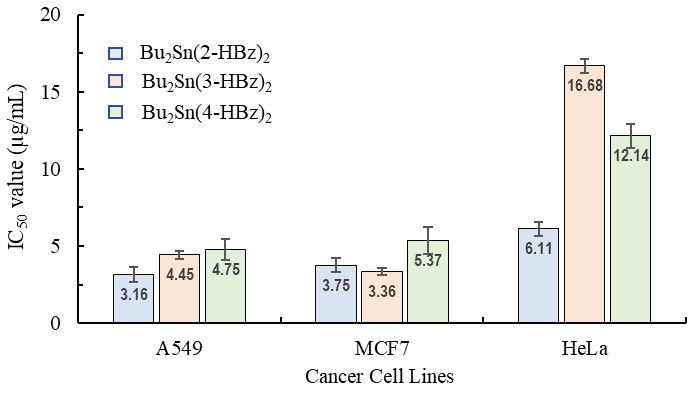
The adverse effects associated with conventional cancer therapies have intensified the search for anticancer agents with fewer side effects. One approach involves the synthesis of organotin(IV) hydroxybenzoates. In this study, dibutyltin(IV) bis(2-hydroxybenzoate) [Bu2Sn(2-HB)2 (3a)], dibutyltin(IV) bis(3-hydroxybenzoate) [Bu2Sn(3-HB)2 (3b)], and dibutyltin(IV) bis(4-hydroxybenzoate) [Bu2Sn(4-HB)2 (3c)] were successfully synthesized. Compounds 3a--3c were obtained by reacting dibutyltin(IV) oxide (Bu2SnO) (1) with 2-hydroxybenzoic acid (2-HBA, 2a), 3-hydroxybenzoic acid (3-HBA, 2b), and 4-hydroxybenzoic acid (4-HBA, 2c), respectively. Purity and structure were confirmed by ultraviolet--visible (UV--Vis), Fourier-transform infrared (FTIR), and nuclear magnetic resonance (NMR) spectroscopies and by micro-elemental analysis. Antiproliferative activity was evaluated against A549 (lung), MCF-7 (breast), and HeLa (cervical) cancer cells and compared with effects on normal Vero cells. Compound 3a was most active against A549 and HeLa cells, with half-maximal inhibitory concentration (IC50) values of 3.16 mu g/mL (6.23 mu M) and 6.11 mu g/mL (12.05 mu M), respectively, whereas 3b was most active against MCF-7 cells, with an IC50 of 3.36 mu g/mL (6.63 mu M). Based on the calculated selectivity index (SI), compound 3c showed the highest selectivity toward all three cancer cell lines.
Dimensions

[1] M. McCall, M. McDonald, S. Thorne, A. Ward & C. Heneghan, ``Yoga for health-related quality of life in adult cancer: A randomized controlled feasibility study'', Evidence-Based Complementary and Alternative Medicine 2015 (2015) 816820. https://doi.org/10.1155/2015/816820.

[2] H. Sung, J. Ferlay, R. L. Siegel, M. Laversanne, I. Soerjomataram, A. Jemal & F. Bray, ``Global cancer statistics 2020: GLOBOCAN estimates of incidence and mortality worldwide for 36 cancers in 185 countries'', CA: A Cancer Journal for Clinicians 71 (2021) 209. https://doi.org/10.3322/caac.21660.

[3] H. Sung, A.M. Filho, M. Laversanne, J. Ferlay, R. L. Siegel, I. Soerjomataram, A. Jemal & F. Bray, ``Global cancer statistics 2024: GLOBOCAN estimates of incidence and mortality worldwide for 34 cancers in 186 countries'', CA: A Cancer Journal for Clinicians 76 (2026) e70090. https://doi.org/10.3322/caac.70090.

[4] World Health Organization, Global Health Estimates 2021: Disease burden by cause, age, sex, by country and by region, 2000--2021, World Health Organization, Geneva, Switzerland, 2024. Available online: https://www.who.int/data/gho/data/themes/mortality-and-global-health-estimates.

[5] International Agency for Research on Cancer--World Health Organization, Indonesia fact sheet: Global Cancer Observatory, 2024. Available online: https://gco.iarc.who.int/media/globocan/factsheets/populations/360-indonesia-fact-sheet.pdf.

[6] Y. Bai, G. Aodeng, L. Ga, W. Hai & J. Ai, ``Research progress of metal anticancer drugs'', Pharmaceutics 15 (2023) 2750. https://doi.org/10.3390/pharmaceutics15122750.

[7] U. B. Amadi, M. Ogwuegbu, C. K. Enenebeaku & G. Onyedika, ``Design, synthesis and studies on thermodynamic and biological activities of lanthanide III complexes of hydrazinecarbothioamide ligands'', Journal of the Nigerian Society of Physical Sciences 7 (2025) 2540. https://doi.org/10.46481/jnsps.2025.2540.

[8] I. E. Otuokere, J. G. Ohwimu, K. C. Amadi, C. O. Alisa, F. C. Nwadire, O. U. Igwe, A. A. Okoyeagu & C. M. Ngwu, ``Synthesis, characterization and molecular docking studies of Mn(II) complex of sulfathiazole'', Journal of the Nigerian Society of Physical Sciences 1 (2019) 95. https://doi.org/10.46481/jnsps.2019.20.

[9] S. N. S. Annuar, N. F. Kamaludin, N. Awang & K. M. Chan, ``Cellular basis of organotin(IV) derivatives as anticancer metallodrugs: A review'', Frontiers in Chemistry 9 (2021) 657599. https://doi.org/10.3389/fchem.2021.657599.

[10] S. K. Hadjikakou & N. Hadjiliadis, ``Antiproliferative and anti-tumor activity of organotin compounds'', Coordination Chemistry Reviews 253 (2009) 235. https://doi.org/10.1016/j.ccr.2007.12.026.

[11] A. Attanzio, S. D'Agostino, R. Bus`a, A. Frazzitta, S. Rubino, M. A. Girasolo, P. Sabatino & L. Tesoriere, ``Cytotoxic activity of organotin(IV) derivatives with triazolopyrimidine containing exocyclic oxygen atoms'', Molecules 25 (2020) 859. https://doi.org/10.3390/molecules25040859.

[12] M. Sirajuddin, S. Ali & M. N. Tahir, ``Organotin(IV) derivatives based on 2-((2-methoxyphenyl)carbamoyl)benzoic acid: Synthesis, spectroscopic characterization, assessment of antibacterial, DNA interaction, anticancer and antileishmanial potentials'', Journal of Molecular Structure 1229 (2021) 129600. https://doi.org/10.1016/j.molstruc.2020.129600.

[13] J. Devi & J. Yadav, ``Recent advancements in organotin(IV) complexes as potential anticancer agents'', Anti-Cancer Agents in Medicinal Chemistry 18 (2018) 335. https://doi.org/10.2174/1871520617666171106125114.

[14] L. Pellerito & L. Nagy, ``Organotin(IV)$^{n+}$ complexes formed with biologically active ligands: Equilibrium and structural studies, and some biological aspects'', Coordination Chemistry Reviews 224 (2002) 111. https://doi.org/10.1016/S0010-8545(01)00399-X.

[15] S. Hadi, M. D. Fenska, N. Noviany, H. Satria, W. Simanjuntak & M. M. Naseer, ``Synthesis and antimalarial activity of some triphenyltin(IV) aminobenzoate compounds against Plasmodium falciparum'', Main Group Metal Chemistry 44 (2021) 256. https://doi.org/10.1515/mgmc-2021-0028.

[16] S. Hadi, T. Suhartati, N. Noviany, K. D. Pandiangan, Y. Yandri & W. Simanjuntak, ``Disinfecting activity of some diphenyltin(IV) benzoate derivative compounds'', Pure and Applied Chemistry 94 (2022) 799. https://doi.org/10.1515/pac-2021-1106.

[17] N. A. Abd Aziz, N. Awang, K. M. Chan, N. F. Kamaludin & N. N. Mohamad Anuar, ``Organotin(IV) dithiocarbamate compounds as anticancer agents: A review of syntheses and cytotoxicity studies'', Molecules 28 (2023) 5841. https://doi.org/10.3390/molecules28155841.

[18] Y. Tan, Z. Zhang, J. Liu, Y. Tan & W. Jiang, ``Syntheses, crystal structures, and anticancer activities of organotin carboxylates based on Alrestatin'', Journal of Molecular Structure 1322 (2025) 140697. https://doi.org/10.1016/j.molstruc.2024.140697.

[19] N. Uddin, F. Rashid, A. Haider, S. A. Tirmizi, A. Raheel, M. Imran, S. Zaib, P. L. Diaconescu, J. Iqbal & S. Ali, ``Triorganotin(IV) carboxylates as potential anticancer agents: Their synthesis, physiochemical characterization, and cytotoxic activity against HeLa and MCF-7 cancer cells'', Applied Organometallic Chemistry 35 (2021) e6165. https://doi.org/10.1002/aoc.6165.

[20] S. Hadi, E. K. Winarno, H. Winarno, K. N. Berawi, T. Suhartati, N. Noviany, W. Simanjuntak & Y. Yandri, ``Synthesis and in vitro activity investigation of some dibutyl-, diphenyl- and triphenyltin(IV) carboxylates against leukemia cancer cell, L-1210'', Pure and Applied Chemistry 95 (2023) 823. https://doi.org/10.1515/pac-2023-0107.

[21] S. Hadi, E. K. Winarno, H. Winarno, K. N. Berawi, T. Suhartati, Y. Yandri & W. Simanjuntak, ``Synthesis, characterization and in vitro activity study of some organotin(IV) carboxylates against leukemia cancer cell, L-1210'', Physical Sciences Reviews 9 (2024) 2187. https://doi.org/10.1515/psr-2022-0303.

[22] N. B. Alitheen, A. R. Mashitoh, S. K. Yeap, M. Shuhaimi, A. A. Manaf & L. Nordin, ``Cytotoxic effect of damnacanthal, nordamnacanthal, zerumbone and betulinic acid isolated from Malaysian plant sources'', International Food Research Journal 17 (2010) 711. Available online: https://eprints.unisza.edu.my/2885/.

[23] H. Winarno, S. Susanto & E. K. Winarno, ``Gamma irradiation effect on physicochemical properties of Guazuma ulmifolia leaves and their antiproliferative activities against human cancer cell lines'', Journal of Radiation Research and Applied Sciences 16 (2023) 100576. https://doi.org/10.1016/j.jrras.2023.100576.

[24] F. Bray, M. Laversanne, H. Sung, J. Ferlay, R. L. Siegel, I. Soerjomataram & A. Jemal, ``Global cancer statistics 2022: GLOBOCAN estimates of incidence and mortality worldwide for 36 cancers in 185 countries'', CA: A Cancer Journal for Clinicians 74 (2024) 229. https://doi.org/10.3322/caac.21834.

[25] S. Hadi, H. Mustafidah, Y. Yandri, W. Simanjuntak & T. Suhartati, ``Synthesis, characterization, and bioactivity test of dibutyltin(IV) dihydroxyibenzoate as disinfectant agent'', Pure and Applied Chemistry 96 (2024) 413. https://doi.org/10.1515/pac-2023-1102.

[26] S. Hadi, M. Rilyanti & Suharso, ``In vitro activity and comparative studies of some organotin(IV) benzoate derivatives against leukemia cancer cell, L-1210'', Indonesian Journal of Chemistry 12 (2012) 172. https://doi.org/10.22146/ijc.21359.

[27] S. Hadi, S. Lestari, T. Suhartati, H. I. Qudus, M. Rilyanti, D. Herasari & Y. Yandri, ``Synthesis and comparative study on the antibacterial activity organotin(IV) 3-hydroxybenzoate compounds'', Pure and Applied Chemistry 93 (2021) 623. https://doi.org/10.1515/pac-2020-1103.

[28] S. Hadi, E. K. Winarno, H. Winarno, S. Susanto, D. A. S. Thian, M. D. Fansang, K. N. Berawi & T. Suhartati, ``Synthesis, characterization and antiproliferative activity test of some diphenyltin(IV) hydroxybenzoates against A549, MCF-7 and HeLa human cancer cell lines'', Journal of Inorganic and Organometallic Polymers and Materials 34 (2024) 2980. https://doi.org/10.1007/s10904-024-03042-2.

[29] M. K. Amir, S. Khan, Zia-Ur-Rehman, A. Shah & I. S. Butler, ``Anticancer activity of organotin(IV) carboxylates'', Inorganica Chimica Acta 423 (2014) 14. https://doi.org/10.1016/j.ica.2014.07.053.

[30] Z. A. Siddiqi, M. Shahid, S. Kumar, M. Khalid & S. Noor, ``Synthesis, crystal structure and in vitro antitumor activity of carboxylate bridged dinuclear organotin(IV) complexes'', Journal of Organometallic Chemistry 694 (2009) 3768. https://doi.org/10.1016/j.jorganchem.2009.07.030.

[31] N. Awang, N. F. Kamaludin, I. Baba, K. M. Chan, N. F. Rajab & A. Hamid, ``Synthesis, characterization and antitumor activity of new organotin(IV) methoxyethyldithiocarbamate complexes'', Oriental Journal of Chemistry 32 (2016) 101. https://doi.org/10.13005/ojc/320110.

[32] A. Mohammed, R. Makia, M. Ali, R. Raheem & E. Yousif, ``Cytotoxic effects of valsartan organotin(IV) complexes on human lung cancer cells'', Biointerface Research in Applied Chemistry 11 (2021) 8156. https://doi.org/10.33263/BRIAC111.81568164.

[33] E. T. Khunoana, J. N. Eloff, T. E. Ramadwa, S. M. Nkadimeng, M. A. Selepe & L. J. McGaw, ``In vitro antiproliferative activity of ptaeroxylon obliquum leaf extracts, fractions and isolated compounds on several cancer cell lines'', Applied Sciences 12 (2022) 11004. https://doi.org/10.3390/app122111004.

[34] G. Indrayanto, G. S. Putra & F. Suhud, ``Validation of in-vitro bioassay methods: Application in herbal drug research'', Profiles of Drug Substances, Excipients, and Related Methodology 46 (2021) 273. https://doi.org/10.1016/bs.podrm.2020.07.005.

[35] O. A. Pe~na-Mor'an, M. L. Villarreal, L. 'Alvarez-Berber, A. Meneses-Acosta & V. Rodr'iguez-L'opez, ``Cytotoxicity, post-treatment recovery, and selectivity analysis of naturally occurring podophyllotoxins from Bursera fagaroides var. fagaroides on breast cancer cell lines'', Molecules 21 (2016) 1013. https://doi.org/10.3390/molecules21081013.

[36] M. L'opez-L'azaro, ``How many times should we screen a chemical library to discover an anticancer drug?'', Drug Discovery Today 20 (2015) 167. https://doi.org/10.1016/j.drudis.2014.12.006.

[37] N. Weerapreeyakul, A. Nonpunya, S. Barusrux, T. Thitimetharoch & B. Sripanidkulchai, ``Evaluation of the anticancer potential of six herbs against a hepatoma cell line'', Chinese Medicine 7 (2012) 15. https://doi.org/10.1186/1749-8546-7-15.

[38] M. L'opez-L'azaro, ``Two preclinical tests to evaluate anticancer activity and to help validate drug candidates for clinical trials'', Oncoscience 2 (2015) 91. https://doi.org/10.18632/oncoscience.132.

[39] M. L'opez-L'azaro, ``A simple and reliable approach for assessing anticancer activity in vitro'', Current Medicinal Chemistry 22 (2015) 1324. https://doi.org/10.2174/0929867322666150209150639.

FIG6

Published

2026-09-23

How to Cite

Antiproliferative activity of synthesized dibutyltin(IV) hydroxybenzoate derivatives against A549, MCF-7, and HeLa human cancer cells. (2026). Journal of the Nigerian Society of Physical Sciences, 8(4), 3552. https://doi.org/10.46481/jnsps.2026.3552

How to Cite

Antiproliferative activity of synthesized dibutyltin(IV) hydroxybenzoate derivatives against A549, MCF-7, and HeLa human cancer cells. (2026). Journal of the Nigerian Society of Physical Sciences, 8(4), 3552. https://doi.org/10.46481/jnsps.2026.3552

Similar Articles

51-60 of 240

You may also start an advanced similarity search for this article.