Geohydraulic characteristics and groundwater vulnerability assessment of tropically weathered and fractured gneissic aquifers using combined georesistivity and geostatistical methods
Keywords:
ERT, Schlumberger VES, geoelectrohydraulic method, regression analysis, groundwater vulnerability, gneissic aquiferAbstract
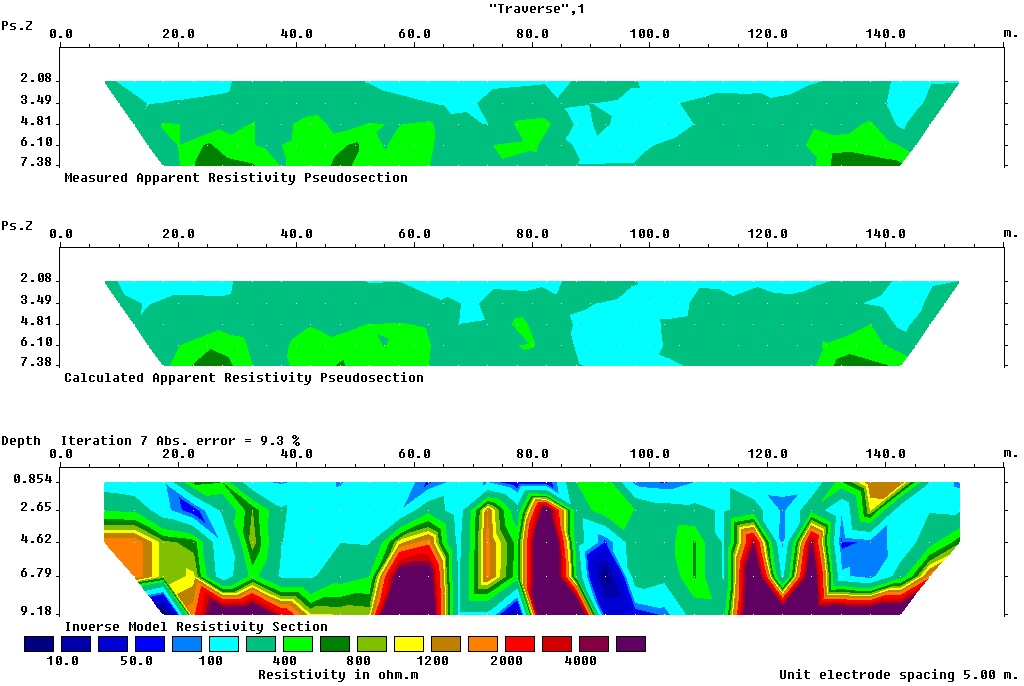
Sustainable groundwater yield in aquifers depends on the protective capacity of the subsurface lithologies and conduit systems. Electrical resistivity tomography (ERT) and its Schlumberger vertical electrical sounding (VES) technique were employed to assess the groundwater yield of aquifer units and their vulnerability to contaminants in Araromi (Akungba-Akoko), southwestern Nigeria. Geohydraulic parameters: aquifer resistivity (\rho0), hydraulic conductivity (K), transmissivity (T), permeability (\Psi), hydraulic resistance (KR), and longitudinal conductance (S) were also evaluated. In addition, regression analysis was utilized to establish the empirical relationships between the K and other geohydraulic parameters, with their percentage contributions to posing vulnerability risk. The georesistivity results revealed four distinct layers: topsoil, weathered layer, partially weathered/fractured bedrock unit, and fresh bedrock. The K model regression-assisted analysis showed that the \rho, T, \Psi, and S contributed about 97.8%, 14%, 99.9%, and 11.5%, respectively, to the estimated aquifers’ K values for the study area. Except for T and S, the regression results had moderate to strong positive correlations with K; hence, this illuminates the essentiality of K in assessing groundwater potential and vulnerability. The aquifer units have low to moderate groundwater yield based on T values (1.67-17.57 m/day) caused by the generally thin overburden (<4 m). However, the deep-weathered and fractured aquifer units with depths ranging from 39-55 m could supply high groundwater yield for sustainable abstraction. The estimated S values (0.0226-0.1926 mhos) for aquifer protective capacity ratings rated the aquifer units in the area as poor to weak. Based on the estimated low logarithm of KR (log KR) values of 0.79-2.25 years, these aquifers have extremely high to moderate aquifer vulnerability index. As a result, prospective wells/boreholes in the study area and settings with similar geohydraulic and vulnerability characteristics should be developed adequately to prevent the infiltration of surface contaminants for potable groundwater abstraction.
Published
How to Cite
Issue
Section
Copyright (c) 2022 A. S. Akingboye

This work is licensed under a Creative Commons Attribution 4.0 International License.
How to Cite
Similar Articles
- Folake Lois Joseph, Adeyemi Sunday Olagunju, Emmanuel Oluseye Adeyefa, Adewale Adeyemi James, Hybrid Block Methods with Constructed Orthogonal Basis for Solution of Third-Order Ordinary Differential Equations , Journal of the Nigerian Society of Physical Sciences: Volume 5, Issue 1, February 2023
- S. A. Yamusa, A. Shaari, I. Isah, U. B. Ibrahim, S. I. Kunya, S. Abdulkarim, Y. S. Itas, M. Alsalamh, Effects of Exchange Correlation Functional (Vwdf3) on the Structural, Elastic, and Electronic Properties of Transition Metal Dichalogenides , Journal of the Nigerian Society of Physical Sciences: Volume 5, Issue 1, February 2023
- A. A. Ibiyemi, O. Akinrinola, G. T. Yusuf, S. Olaniyan, J. Lawal, M. Orojo, B. Osuporu, Advance effect of magnetic field on the rheological properties of manganese zinc ferrite ferrofluid , Journal of the Nigerian Society of Physical Sciences: Volume 6, Issue 2, May 2024
- K. A Haruna, J. K. Raji, A. Y. Jimoh, J. A. Adeoye, O. O. Alu, A. A. Badmus, B. Garba, Biostratigraphy and paleoenvironment studies of shales from Owan-1 Well, Niger Delta Basin, Nigeria , Journal of the Nigerian Society of Physical Sciences: Volume 7, Issue 3, August 2025
- A. A. Willoughby, A. A. Soge, O. F. Dairo, O. D. Olukanni, E. U. Durugbo, W. S. Michael, T. A. Adebayo, Fabrication and Characterization of a Dye-Sensitized Solar Cell using Natural Dye Extract of Rosella (Hibiscus sabdariffa L.) as Photosensitizer , Journal of the Nigerian Society of Physical Sciences: Volume 3, Issue 4, November 2021
- Danat Nanle Tanko, Farah Aini Abdullah, Majid K. M Ali, Matthew O. Adewole, James Andrawus, Onchocerciasis control via Caputo-Fabrizio fractional dynamics: a focus on early treatment and vector management strategies , Journal of the Nigerian Society of Physical Sciences: Volume 8, Issue 1, February 2026
- Sulaiman Awwal Akinwunmi, David Opeoluwa Oyewola, Spectral convolution of star-like transformation semigroups for modeling telecommunication signal strength and user experience in Gombe state, Nigeria , Journal of the Nigerian Society of Physical Sciences: Volume 8, Issue 2, May 2026
- Muhammad Musa Liman, Rajesh Prasad, Hauwa Ahmad Amshi, Feature-optimized hybrid CNN–ViT architecture for sustainable vision-based condition assessment in agriculture , Journal of the Nigerian Society of Physical Sciences: Volume 8, Issue 2, May 2026
- K Deva, K Siva, Gamachu Adugna Ganati, Walid Abdelfattah, Fikadu Tesgera Tolasa, Naisr Ali, Aseel Smerat, A. Mehmood, Modeling traffic-light systems: A neutrosophic graph approach , Journal of the Nigerian Society of Physical Sciences: Volume 8, Issue 3, August 2026
- Oluwole Adigun, Lasisi Egibunu Umoru, Temidayo Nancy Iwatan, Effects of different electrolytes on the structure and yield ofgraphene oxide produced via electrochemical exfoliation , Journal of the Nigerian Society of Physical Sciences: Volume 5, Issue 4, November 2023
You may also start an advanced similarity search for this article.