A tuberculosis model with three infected classes
Keywords:
Optimal Control, Lyapunov function, Equilibrium, Basic , JacobianAbstract
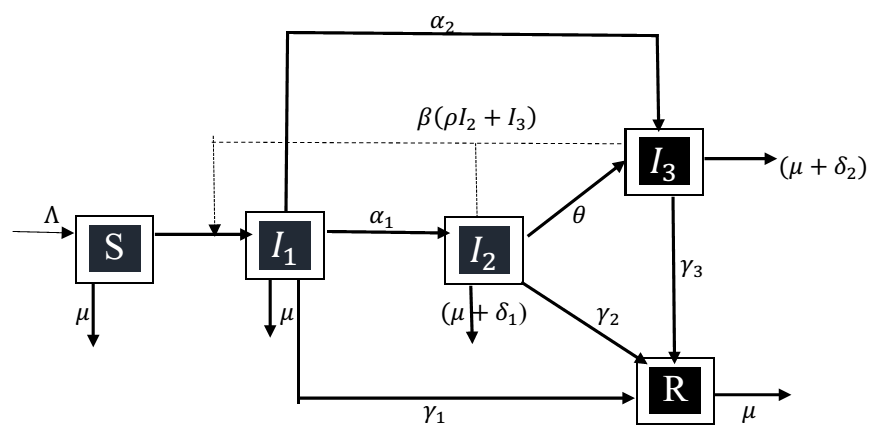
The dynamics of tuberculosis within a population cannot be adequately represented by a single infectious class. Therefore, this study develops a compartmental model encompassing latent, active, and drug-resistant populations to better capture tuberculosis dynamics in a community. Model analysis reveals that the disease-free equilibrium point is locally asymptotically stable when the basic reproduction number is below one. Moreover, the use of a suitable Lyapunov function demonstrates global asymptotic stability of the disease-free equilibrium point. An endemic equilibrium emerges when the basic reproduction number exceeds one. Sensitivity analysis is conducted for each parameter associated with the basic reproduction number, and optimal control analysis is employed to assess the impact of various control strategies on disease containment. Numerical simulations are conducted to supplement theoretical findings, illustrating the practical implications of the proposed control strategies.
Published
How to Cite
Issue
Section
Copyright (c) 2023 A. O. Sangotola, S. B. Adeyemo, O. A. Nuga, A. E. Adeniji, A. J. Adigun

This work is licensed under a Creative Commons Attribution 4.0 International License.
How to Cite
Similar Articles
- Oluwaseun IGE, Keng Hoon Gan, Ensemble feature selection using weighted concatenated voting for text classification , Journal of the Nigerian Society of Physical Sciences: Volume 6, Issue 1, February 2024
- Mokhtar Ali, Abdelkerim Souahlia, Abdelhalim Rabehi, Mawloud Guermoui, Ali Teta, Imad Eddine Tibermacine, Abdelaziz Rabehi, Mohamed Benghanem , A robust deep learning approach for photovoltaic power forecasting based on feature selection and variational mode decomposition , Journal of the Nigerian Society of Physical Sciences: Volume 7, Issue 3, August 2025
- Gurpreet Tuteja, Tapshi Singh, Comments on “The Solution of a Mathematical Model for Dengue Fever Transmission Using Differential Transformation Method: J. Nig. Soc. Phys. Sci. 1 (2019) 82-87” , Journal of the Nigerian Society of Physical Sciences: Volume 3, Issue 2, May 2021
- Kazeem A. Tijani, Chinwendu. E. Madubueze, Isaac O. Onwubuya, Nkiruka Maria-Assumpta Akabuike, John Olajide Akanni, Mathematical modelling of the dynamical system of military population, focusing on the impact of welfare , Journal of the Nigerian Society of Physical Sciences: Volume 7, Issue 4, November 2025
- J. A. Akinpelu, K. P. Ojo, S. O. Salawu, G. O. Olutona, F. O. Aweda, O. O. Jegede, Concentrations of heavy metal content in indoor dust and potential exposure in preschool children , Journal of the Nigerian Society of Physical Sciences: Volume 8, Issue 1, February 2026
- Chuchu Liang, Majid Khan Majahar Ali, Lili Wu, A novel multi-class classification method for arrhythmias using Hankel dynamic mode decomposition and long short-term memory networks , Journal of the Nigerian Society of Physical Sciences: Volume 7, Issue 2, May 2025
- Chinwendu Emilian Madubueze, Kazeem A. Tijani, Elijah Iji Ajogi, Madumelu H. C. Madubueze, A mathematical model of cybercrime contagion: impact ofemployment on youth offending , Journal of the Nigerian Society of Physical Sciences: Volume 8, Issue 3, August 2026
- L. Adamu, N. Hussaini, An Epidemic Model of Zoonotic Visceral Leishmaniasis with Time Delay , Journal of the Nigerian Society of Physical Sciences: Volume 1, Issue 1, February 2019
- Opeyemi O. Enoch, Adejimi A. Adeniji, Lukman O. Salaudeen, The Derivation of the Riemann Analytic Continuation Formula from the Euler’s Quadratic Equation , Journal of the Nigerian Society of Physical Sciences: Volume 5, Issue 1, February 2023
- Uthumporn Panitanarak, Aliyu Ismail Ishaq, Alfred Adewole Abiodun, Hanita Daud, Ahmad Abubakar Suleiman, A new Maxwell-Log logistic distribution and its applications for mortality rate data , Journal of the Nigerian Society of Physical Sciences: Volume 7, Issue 2, May 2025
You may also start an advanced similarity search for this article.