An empirical evaluation of mathematical, machine learning, and hybrid modeling approaches for COVID-19 forecasting
Keywords:
SEIR model, Hybrid modeling, Infectious disease prediction, Epidemic forecasting, COVID-19Abstract
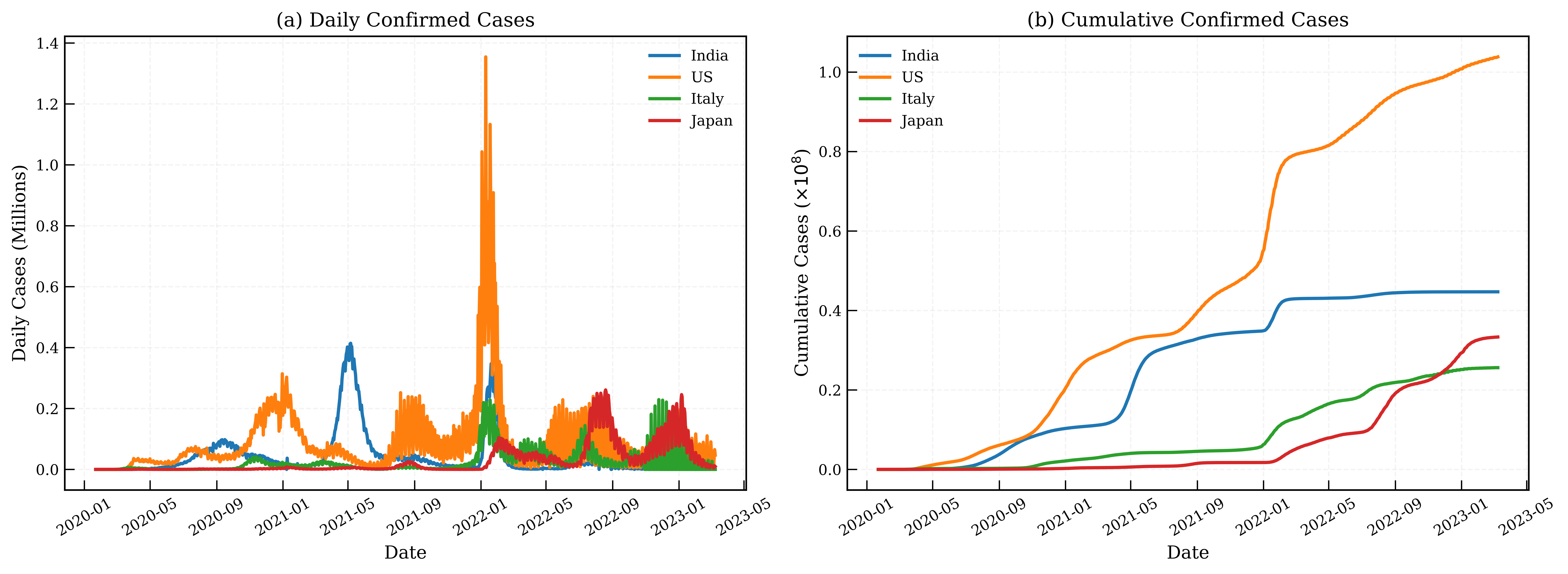
Accurate forecasting of infectious disease spread is essential for public health decision-making. This study compares mechanistic susceptible-exposed-infectious-removed (SEIR) models, machine-learning methods, and hybrid artificial intelligence (AI)-driven epidemiological frameworks using coronavirus disease 2019 (COVID-19) case data from India, the United States, Italy, and Japan. After preprocessing and exploratory analysis, we estimate time-varying transmission rates and develop two hybrid extensions: one predicts beta(t) using machine learning, and the other learns residual errors from the SEIR model. A baseline machine-learning model using lag-based and effective reproduction number (Rt)-driven features is also evaluated. Performance is assessed using mean absolute error (MAE), root mean squared error (RMSE), mean absolute percentage error (MAPE), high-incidence MAPE (on days with observed incidence ge 100 cases), and peak-timing error. With the SEIR transmission-rate spline fitted strictly to training data and all models evaluated on an identical 223-day held-out test window, a simple persistence baseline outperforms the mechanistic SEIR model, both hybrid AI extensions (Tracks A and B), and the pure machine-learning Random Forest model across all four countries (Diebold--Mariano test, p<0.001 in every comparison). The hybrid AI components do not consistently improve forecasting accuracy relative to the SEIR baseline. None of the mechanistic or machine-learning approaches anticipates new epidemic waves beyond the training period, underscoring the difficulty of medium-range epidemic forecasting under genuinely held-out conditions. The comparative evaluation highlights the complementary strengths and limitations of these approaches and provides guidance for future epidemic forecasting models.
Published
How to Cite
Issue
Section
Copyright (c) 2026 Pooja Satwani, Sudhir Kumar Mishra (Author)

This work is licensed under a Creative Commons Attribution 4.0 International License.
How to Cite
Similar Articles
- R. El chaal, M. O. Aboutafail, Statistical Modelling by Topological Maps of Kohonen for Classification of the Physicochemical Quality of Surface Waters of the Inaouen Watershed Under Matlab , Journal of the Nigerian Society of Physical Sciences: Volume 4, Issue 2, May 2022
- Nahid Salma, Majid Khan Majahar Ali, Raja Aqib Shamim, Machine learning-based feature selection for ultra-high-dimensional survival data: a computational approach , Journal of the Nigerian Society of Physical Sciences: Volume 7, Issue 3, August 2025
- Misbaudeen Abdul-Hammed, Ibrahim Olaide Adedotun, Tolulope Irapada Afolabi Afolabi, Ubeydat Temitope Ismail, Praise Toluwalase Akande, Balqees Funmilayo Issa, Analysis of the Bioactive Compounds from Carica papaya in the Management of Psoriasis using Computational Techniques , Journal of the Nigerian Society of Physical Sciences: Volume 5, Issue 1, February 2023
- Essodossomondom Anate, N’Detigma Kata, Hodo-Abalo Samah, Amadou Seidou Maiga, Study of the passivation of defects in the perovskite cell: application to Sahelian climate conditions , Journal of the Nigerian Society of Physical Sciences: Volume 5, Issue 2, May 2023
- Matthew Iseh, Anthony Usoro, Nsisong Ekong, Idara Ukpe, Juxtaposing Vertically Transmitted Infections (VTIs) and the Spread of HIV/AIDS in a Typically Infection Prevalent Region in Nigeria , Journal of the Nigerian Society of Physical Sciences: Volume 4, Issue 1, February 2022
- Abiola T. Owolabi, Kayode Ayinde, Taiwo J. Adejumo, Wakeel A. Kasali, Emmanuel T. Adewuyi, Comparative Analysis of the Implication of Periods Before and During Vaccination of COVID-19 Infection in Some Regional Leading African Countries , Journal of the Nigerian Society of Physical Sciences: Volume 4, Issue 2, May 2022
- S. N. Enemuo, O. N. Akande, M. O. Lawrence, I. C. Saidu, Optimized aspect level sentiment analysis of tweet data using deep learning and rule-based techniques , Journal of the Nigerian Society of Physical Sciences: Volume 7, Issue 2, May 2025
- Monika Saini, Ashish Kumar, Fuzzy semi-Markovian stochastic model for single-unit system with repairman arrival delay under Lindley lifetime distribution using bell-shaped membership function , Journal of the Nigerian Society of Physical Sciences: Volume 8, Issue 3, August 2026
- A. B Yusuf, R. M Dima, S. K Aina, Optimized Breast Cancer Classification using Feature Selection and Outliers Detection , Journal of the Nigerian Society of Physical Sciences: Volume 3, Issue 4, November 2021
- Ebere Uzoka Chidi, Edward Anoliefo, Collins Udanor, Asogwa Tochukwu Chijindu, Lois Onyejere Nwobodo, A blind navigation guide model for obstacle avoidance using distance vision estimation based YOLO-V8n , Journal of the Nigerian Society of Physical Sciences: Volume 7, Issue 1, February 2025
You may also start an advanced similarity search for this article.