An empirical evaluation of mathematical, machine learning, and hybrid modeling approaches for COVID-19 forecasting
Keywords:
SEIR model, Hybrid modeling, Infectious disease prediction, Epidemic forecasting, COVID-19Abstract
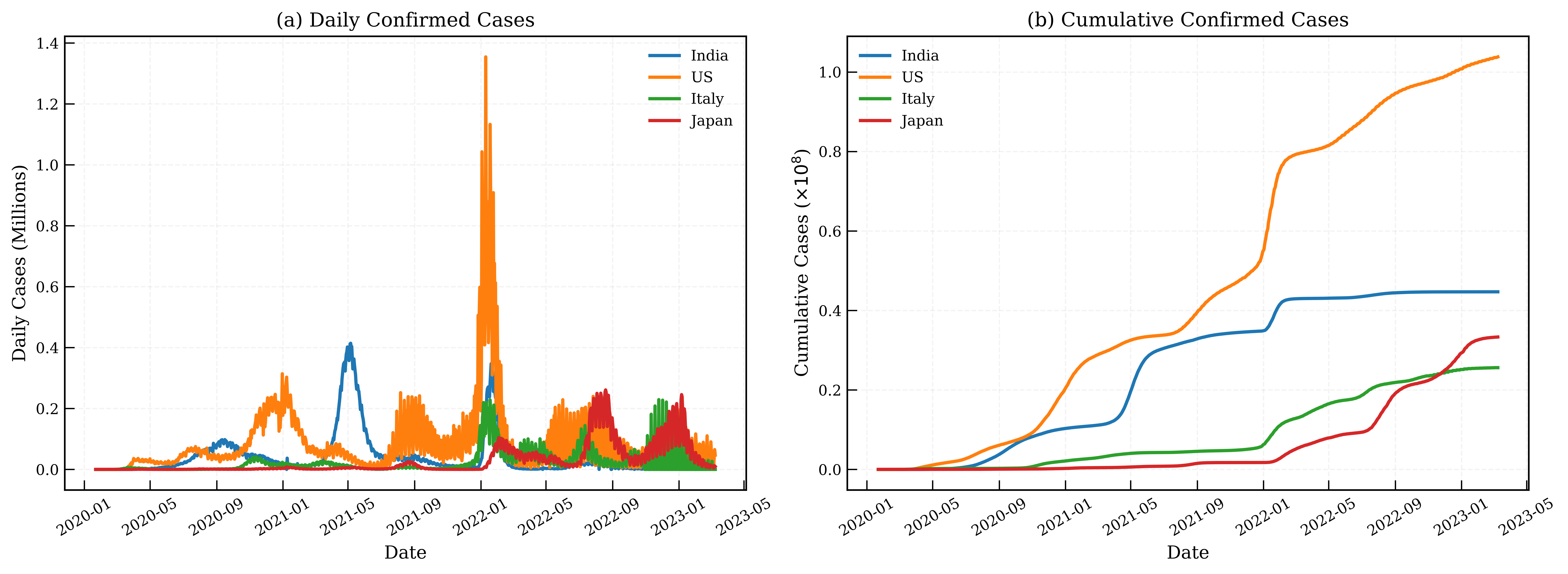
Accurate forecasting of infectious disease spread is essential for public health decision-making. This study compares mechanistic susceptible-exposed-infectious-removed (SEIR) models, machine-learning methods, and hybrid artificial intelligence (AI)-driven epidemiological frameworks using coronavirus disease 2019 (COVID-19) case data from India, the United States, Italy, and Japan. After preprocessing and exploratory analysis, we estimate time-varying transmission rates and develop two hybrid extensions: one predicts beta(t) using machine learning, and the other learns residual errors from the SEIR model. A baseline machine-learning model using lag-based and effective reproduction number (Rt)-driven features is also evaluated. Performance is assessed using mean absolute error (MAE), root mean squared error (RMSE), mean absolute percentage error (MAPE), high-incidence MAPE (on days with observed incidence ge 100 cases), and peak-timing error. With the SEIR transmission-rate spline fitted strictly to training data and all models evaluated on an identical 223-day held-out test window, a simple persistence baseline outperforms the mechanistic SEIR model, both hybrid AI extensions (Tracks A and B), and the pure machine-learning Random Forest model across all four countries (Diebold--Mariano test, p<0.001 in every comparison). The hybrid AI components do not consistently improve forecasting accuracy relative to the SEIR baseline. None of the mechanistic or machine-learning approaches anticipates new epidemic waves beyond the training period, underscoring the difficulty of medium-range epidemic forecasting under genuinely held-out conditions. The comparative evaluation highlights the complementary strengths and limitations of these approaches and provides guidance for future epidemic forecasting models.
Published
How to Cite
Issue
Section
Copyright (c) 2026 Pooja Satwani, Sudhir Kumar Mishra (Author)

This work is licensed under a Creative Commons Attribution 4.0 International License.
How to Cite
Similar Articles
- Idris Babaji Muhammad, Salisu Usaini, Dynamics of Toxoplasmosis Disease in Cats population with vaccination
- Oluwaseun IGE, Keng Hoon Gan, Ensemble feature selection using weighted concatenated voting for text classification , Journal of the Nigerian Society of Physical Sciences: Volume 6, Issue 1, February 2024
- Adebola Samuel Adeoye, Ezekiel Olaoluwa Omole, Sule Adekunle Jimoh, Victoria Iyadunni Ayodele, Taiwo Aanu Ogunlusi, A comprehensive investigation of dual-damped Euler-Bernoulli beam under moving mass on Pasternak foundation via spectral and central difference methods , Journal of the Nigerian Society of Physical Sciences: Volume 8, Issue 2, May 2026
- Olumide O. Olaiya, Mark I. Modebei, Saheed A. Bello, A One-Step Block Hybrid Integrator for Solving Fifth Order Korteweg-de Vries Equations
- A. E. Ibor, D. O. Egete, A. O. Otiko, D. U. Ashishie, Detecting network intrusions in cyber-physical systems using deep autoencoder-based dimensionality reduction approach anddeep neural networks , Journal of the Nigerian Society of Physical Sciences: Volume 7, Issue 3, August 2025
- R. El chaal, M. O. Aboutafail, Statistical Modelling by Topological Maps of Kohonen for Classification of the Physicochemical Quality of Surface Waters of the Inaouen Watershed Under Matlab , Journal of the Nigerian Society of Physical Sciences: Volume 4, Issue 2, May 2022
- David Opeoluwa Oyewola, Emmanuel Gbenga Dada, Juliana Ngozi ndunagu, Terrang Abubakar Umar, Akinwunmi S.A, COVID-19 Risk Factors, Economic Factors, and Epidemiological Factors nexus on Economic Impact: Machine Learning and Structural Equation Modelling Approaches , Journal of the Nigerian Society of Physical Sciences: Volume 3, Issue 4, November 2021
- Samuel Olorunfemi Adams, Davies Abiodun Obaromi, Alumbugu Auta Irinews, Goodness of Fit Test of an Autocorrelated Time Series Cubic Smoothing Spline Model , Journal of the Nigerian Society of Physical Sciences: Volume 3, Issue 3, August 2021
- I. T. Bello, Y. A. Odedunmoye, O. Adedokun, H. A. Shittu, A. O. Awodugba, Numerical Simulation of Sandwiched Perovskite-Based Solar Cell Using Solar Cell Capacitance Simulator (SCAPS-1D) , Journal of the Nigerian Society of Physical Sciences: Volume 1, Issue 2, May 2019
- Vanita R. Raikar, Lakshminarayanachari K, K. Bharathi, C. Bhaskar , Mathematical advection-diffusion model of primary and secondary pollutants emitted from the point source with mesoscale wind and removal mechanisms , Journal of the Nigerian Society of Physical Sciences: Volume 7, Issue 2, May 2025
You may also start an advanced similarity search for this article.