An empirical evaluation of mathematical, machine learning, and hybrid modeling approaches for COVID-19 forecasting
Keywords:
SEIR model, Hybrid modeling, Infectious disease prediction, Epidemic forecasting, COVID-19Abstract
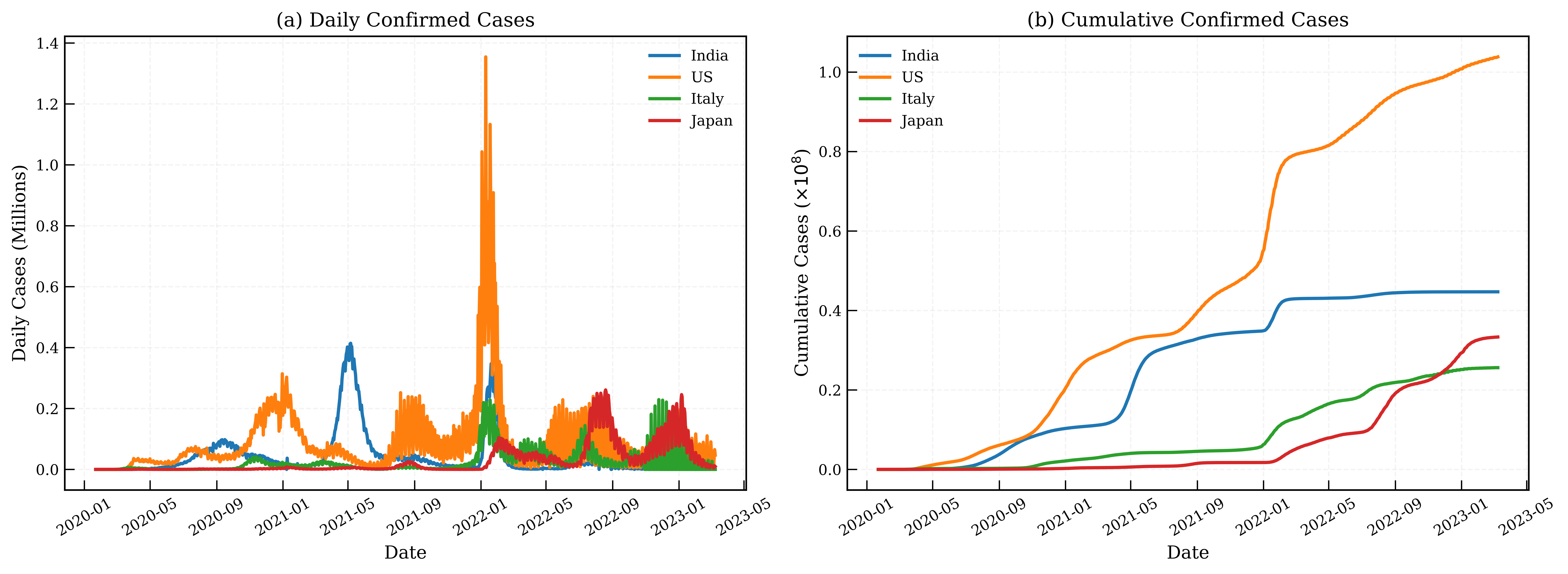
Accurate forecasting of infectious disease spread is essential for public health decision-making. This study compares mechanistic susceptible-exposed-infectious-removed (SEIR) models, machine-learning methods, and hybrid artificial intelligence (AI)-driven epidemiological frameworks using coronavirus disease 2019 (COVID-19) case data from India, the United States, Italy, and Japan. After preprocessing and exploratory analysis, we estimate time-varying transmission rates and develop two hybrid extensions: one predicts beta(t) using machine learning, and the other learns residual errors from the SEIR model. A baseline machine-learning model using lag-based and effective reproduction number (Rt)-driven features is also evaluated. Performance is assessed using mean absolute error (MAE), root mean squared error (RMSE), mean absolute percentage error (MAPE), high-incidence MAPE (on days with observed incidence ge 100 cases), and peak-timing error. With the SEIR transmission-rate spline fitted strictly to training data and all models evaluated on an identical 223-day held-out test window, a simple persistence baseline outperforms the mechanistic SEIR model, both hybrid AI extensions (Tracks A and B), and the pure machine-learning Random Forest model across all four countries (Diebold--Mariano test, p<0.001 in every comparison). The hybrid AI components do not consistently improve forecasting accuracy relative to the SEIR baseline. None of the mechanistic or machine-learning approaches anticipates new epidemic waves beyond the training period, underscoring the difficulty of medium-range epidemic forecasting under genuinely held-out conditions. The comparative evaluation highlights the complementary strengths and limitations of these approaches and provides guidance for future epidemic forecasting models.
Published
How to Cite
Issue
Section
Copyright (c) 2026 Pooja Satwani, Sudhir Kumar Mishra (Author)

This work is licensed under a Creative Commons Attribution 4.0 International License.
How to Cite
Similar Articles
- Pragati, Rajneesh Kumar, Sachin Kaushal, Effect of a moving thermal load in a modified couple stress medium with double porosity and hyperbolic two-temperature theory , Journal of the Nigerian Society of Physical Sciences: Volume 8, Issue 1, February 2026
- Waheed B. Yahya, Yusuf Bello, Abdulrazaq AbdulRaheem, Model Fitness and Predictive Accuracy in Linear Mixed-Effects Models with Latent Clusters , Journal of the Nigerian Society of Physical Sciences: Volume 5, Issue 3, August 2023
- Uthumporn Panitanarak, Aliyu Ismail Ishaq, Alfred Adewole Abiodun, Hanita Daud, Ahmad Abubakar Suleiman, A new Maxwell-Log logistic distribution and its applications for mortality rate data , Journal of the Nigerian Society of Physical Sciences: Volume 7, Issue 2, May 2025
- Solomon A. Ayuba, I. Akeyede, A. S. Olagunju, Stability and Sensitivity Analysis of Dengue-Malaria Co-Infection Model in Endemic Stage , Journal of the Nigerian Society of Physical Sciences: Volume 3, Issue 2, May 2021
- Adamu Shitu Hassan, Nafiu Hussaini, Analysis of an HIV - HCV simultaneous infection model with time delay , Journal of the Nigerian Society of Physical Sciences: Volume 3, Issue 1, February 2021
- Joshua Sunday, Joel N. Ndam, Lydia J. Kwari, An Accuracy-preserving Block Hybrid Algorithm for the Integration of Second-order Physical Systems with Oscillatory Solutions , Journal of the Nigerian Society of Physical Sciences: Volume 5, Issue 1, February 2023
- Muhammad Musa Liman, Rajesh Prasad, Hauwa Ahmad Amshi, Feature-optimized hybrid CNN–ViT architecture for sustainable vision-based condition assessment in agriculture , Journal of the Nigerian Society of Physical Sciences: Volume 8, Issue 2, May 2026
- Augustine Igwebuike Anya, Uko Ofe, Aftab Khan, Mathematical Modeling of Waves in a Porous Micropolar Fibrereinforced Structure and Liquid Interface , Journal of the Nigerian Society of Physical Sciences: Volume 4, Issue 3, August 2022
- Stephen Olushola Oladosu, Alfred Sunday Alademomi , James Bolarinwa Olaleye, Joseph Olalekan Olusina, Tosin Julius Salami, Evaluation of ANFIS Predictive Ability Using Computed Sediment from Gullies and Dam , Journal of the Nigerian Society of Physical Sciences: Volume 5, Issue 2, May 2023
- K Deva, K Siva, Gamachu Adugna Ganati, Walid Abdelfattah, Fikadu Tesgera Tolasa, Naisr Ali, Aseel Smerat, A. Mehmood, Modeling traffic-light systems: A neutrosophic graph approach , Journal of the Nigerian Society of Physical Sciences: Volume 8, Issue 3, August 2026
You may also start an advanced similarity search for this article.