An empirical evaluation of mathematical, machine learning, and hybrid modeling approaches for COVID-19 forecasting
Keywords:
SEIR model, Hybrid modeling, Infectious disease prediction, Epidemic forecasting, COVID-19Abstract
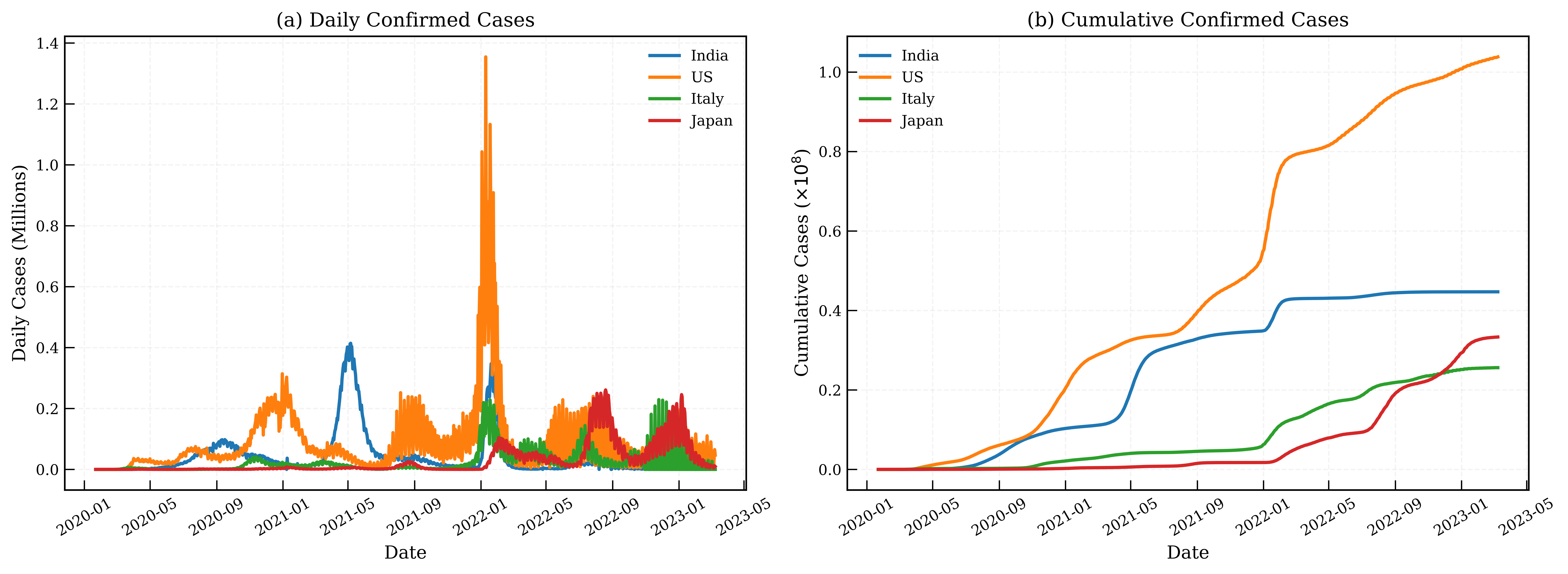
Accurate forecasting of infectious disease spread is essential for public health decision-making. This study compares mechanistic susceptible-exposed-infectious-removed (SEIR) models, machine-learning methods, and hybrid artificial intelligence (AI)-driven epidemiological frameworks using coronavirus disease 2019 (COVID-19) case data from India, the United States, Italy, and Japan. After preprocessing and exploratory analysis, we estimate time-varying transmission rates and develop two hybrid extensions: one predicts beta(t) using machine learning, and the other learns residual errors from the SEIR model. A baseline machine-learning model using lag-based and effective reproduction number (Rt)-driven features is also evaluated. Performance is assessed using mean absolute error (MAE), root mean squared error (RMSE), mean absolute percentage error (MAPE), high-incidence MAPE (on days with observed incidence ge 100 cases), and peak-timing error. With the SEIR transmission-rate spline fitted strictly to training data and all models evaluated on an identical 223-day held-out test window, a simple persistence baseline outperforms the mechanistic SEIR model, both hybrid AI extensions (Tracks A and B), and the pure machine-learning Random Forest model across all four countries (Diebold--Mariano test, p<0.001 in every comparison). The hybrid AI components do not consistently improve forecasting accuracy relative to the SEIR baseline. None of the mechanistic or machine-learning approaches anticipates new epidemic waves beyond the training period, underscoring the difficulty of medium-range epidemic forecasting under genuinely held-out conditions. The comparative evaluation highlights the complementary strengths and limitations of these approaches and provides guidance for future epidemic forecasting models.
Published
How to Cite
Issue
Section
Copyright (c) 2026 Pooja Satwani, Sudhir Kumar Mishra (Author)

This work is licensed under a Creative Commons Attribution 4.0 International License.
How to Cite
Similar Articles
- L. Adamu, N. Hussaini, An Epidemic Model of Zoonotic Visceral Leishmaniasis with Time Delay , Journal of the Nigerian Society of Physical Sciences: Volume 1, Issue 1, February 2019
- Kazeem A. Tijani, Chinwendu E. Madubueze, Reuben I. Gweryina, Terhemen Aboiyar, Mathematical modelling and optimal-control strategies of schistosomiasis–typhoid fever co-infection: using the demographic setting of Makurdi, Benue State, Nigeria , Journal of the Nigerian Society of Physical Sciences: Volume 8, Issue 3, August 2026
- Gurpreet Tuteja, Tapshi Singh, Comments on “The Solution of a Mathematical Model for Dengue Fever Transmission Using Differential Transformation Method: J. Nig. Soc. Phys. Sci. 1 (2019) 82-87” , Journal of the Nigerian Society of Physical Sciences: Volume 3, Issue 2, May 2021
- Olumide S. Adesina, Adedayo F. Adedotuun, Kayode S. Adekeye, Ogbu F. Imaga, Adeleke J. Adeyiga, Toluwalase J. Akingbade, On logistic regression versus support vectors machine using vaccination dataset , Journal of the Nigerian Society of Physical Sciences: Volume 6, Issue 1, February 2024
- Felix Yakubu Eguda, Andrawus James, Sunday Babuba, The Solution of a Mathematical Model for Dengue Fever Transmission Using Differential Transformation Method , Journal of the Nigerian Society of Physical Sciences: Volume 1, Issue 3, August 2019
- J. Sunday, G. M. Kumleng, N. M. Kamoh, J. A. Kwanamu, Y. Skwame, O. Sarjiyus, Implicit Four-Point Hybrid Block Integrator for the Simulations of Stiff Models , Journal of the Nigerian Society of Physical Sciences: Volume 4, Issue 2, May 2022
- A. K. Usman, Y. A. Hassan, A. A. Bery, A. S. Akingboye, M. D. Dick, B. M. Ahmed, R. O. Aderoju, Hybrid deep belief network and fuzzy clustering approach for geothermal prospectivity mapping in northeastern Nigeria using magnetic and landsat data , Journal of the Nigerian Society of Physical Sciences: Volume 8, Issue 1, February 2026
- Waheed B. Yahya, Yusuf Bello, Abdulrazaq AbdulRaheem, Model Fitness and Predictive Accuracy in Linear Mixed-Effects Models with Latent Clusters , Journal of the Nigerian Society of Physical Sciences: Volume 5, Issue 3, August 2023
- Pragati, Rajneesh Kumar, Sachin Kaushal, Effect of a moving thermal load in a modified couple stress medium with double porosity and hyperbolic two-temperature theory , Journal of the Nigerian Society of Physical Sciences: Volume 8, Issue 1, February 2026
- Uthumporn Panitanarak, Aliyu Ismail Ishaq, Alfred Adewole Abiodun, Hanita Daud, Ahmad Abubakar Suleiman, A new Maxwell-Log logistic distribution and its applications for mortality rate data , Journal of the Nigerian Society of Physical Sciences: Volume 7, Issue 2, May 2025
You may also start an advanced similarity search for this article.