An empirical evaluation of mathematical, machine learning, and hybrid modeling approaches for COVID-19 forecasting
Keywords:
SEIR model, Hybrid modeling, Infectious disease prediction, Epidemic forecasting, COVID-19Abstract
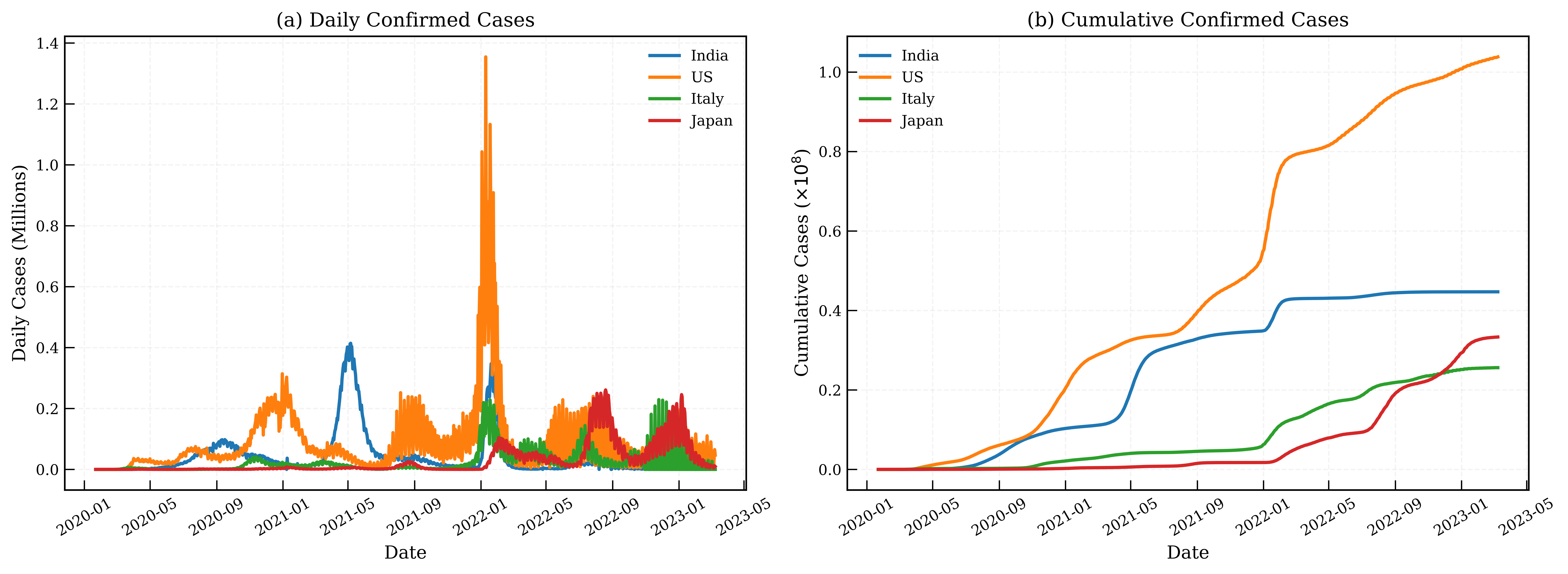
Accurate forecasting of infectious disease spread is essential for public health decision-making. This study compares mechanistic susceptible-exposed-infectious-removed (SEIR) models, machine-learning methods, and hybrid artificial intelligence (AI)-driven epidemiological frameworks using coronavirus disease 2019 (COVID-19) case data from India, the United States, Italy, and Japan. After preprocessing and exploratory analysis, we estimate time-varying transmission rates and develop two hybrid extensions: one predicts beta(t) using machine learning, and the other learns residual errors from the SEIR model. A baseline machine-learning model using lag-based and effective reproduction number (Rt)-driven features is also evaluated. Performance is assessed using mean absolute error (MAE), root mean squared error (RMSE), mean absolute percentage error (MAPE), high-incidence MAPE (on days with observed incidence ge 100 cases), and peak-timing error. With the SEIR transmission-rate spline fitted strictly to training data and all models evaluated on an identical 223-day held-out test window, a simple persistence baseline outperforms the mechanistic SEIR model, both hybrid AI extensions (Tracks A and B), and the pure machine-learning Random Forest model across all four countries (Diebold--Mariano test, p<0.001 in every comparison). The hybrid AI components do not consistently improve forecasting accuracy relative to the SEIR baseline. None of the mechanistic or machine-learning approaches anticipates new epidemic waves beyond the training period, underscoring the difficulty of medium-range epidemic forecasting under genuinely held-out conditions. The comparative evaluation highlights the complementary strengths and limitations of these approaches and provides guidance for future epidemic forecasting models.
Published
How to Cite
Issue
Section
Copyright (c) 2026 Pooja Satwani, Sudhir Kumar Mishra (Author)

This work is licensed under a Creative Commons Attribution 4.0 International License.
How to Cite
Similar Articles
- Adewunmi O. Adeyemi, Ismail A. Adeleke, Eno E. E. Akarawak, Modeling Extreme Stochastic Variations using the Maximum Order Statistics of Convoluted Distributions , Journal of the Nigerian Society of Physical Sciences: Volume 5, Issue 1, February 2023
- Retraction Notice: Fractional-order modeling of visceral leishmaniasis disease transmission dynamics: strategies in eastern Sudan , Journal of the Nigerian Society of Physical Sciences: Volume 8, Issue 2, May 2026
- Shaymaa Mohammed Ahmed, Majid Khan Majahar Ali, Arshad Hameed Hasan, Evaluating feature selection methods in a hybrid Weibull Freund-Cox proportional hazards model for renal cell carcinoma , Journal of the Nigerian Society of Physical Sciences: Volume 7, Issue 3, August 2025
- Bolarinwa Bolaji, Abdullahi Ibrahim, Favour Ani, Benjamin Omede, Godwin Acheneje, A model for the control of transmission dynamics of human monkeypox disease in Sub-Saharan Africa , Journal of the Nigerian Society of Physical Sciences: Volume 6, Issue 2, May 2024
- Helen Olaronke Edogbanya, Emmanuel Sabastine, Rosalio G. Artes Jr., Regimar A. Rasid, Dynamical and optimal control analysis of lymphatic filariasis and buruli ulcer co-infection , Journal of the Nigerian Society of Physical Sciences: Volume 6, Issue 4, November 2024
- Sulaiman Awwal Akinwunmi, David Opeoluwa Oyewola, Spectral convolution of star-like transformation semigroups for modeling telecommunication signal strength and user experience in Gombe state, Nigeria , Journal of the Nigerian Society of Physical Sciences: Volume 8, Issue 2, May 2026
- Benson Ade Eniola Afere, On the cluster of the families of hybrid polynomial kernels in kernel density estimation , Journal of the Nigerian Society of Physical Sciences: Volume 7, Issue 1, February 2025
- Gabriel James, Ifeoma Ohaeri, David Egete, John Odey, Samuel Oyong, Enefiok Etuk, Imeh Umoren, Ubong Etuk, Aloysius Akpanobong, Anietie Ekong, Saviour Inyang, Chikodili Orazulume, A fuzzy-optimized multi-level random forest (FOMRF) model for the classification of the impact of technostress , Journal of the Nigerian Society of Physical Sciences: Volume 7, Issue 3, August 2025
- S. A. Abdullahi, A. G. Habib, N. Hussaini, Mathematical Model of In-host Dynamics of Snakebite Envenoming , Journal of the Nigerian Society of Physical Sciences: Volume 4, Issue 2, May 2022
- Paavithashnee Ravi Kumar, Majid Khan Majahar Ali, Olayemi Joshua Ibidoja, Identifying heterogeneity for increasing the prediction accuracy of machine learning models , Journal of the Nigerian Society of Physical Sciences: Volume 6, Issue 3, August 2024
You may also start an advanced similarity search for this article.