An empirical evaluation of mathematical, machine learning, and hybrid modeling approaches for COVID-19 forecasting
Keywords:
SEIR model, Hybrid modeling, Infectious disease prediction, Epidemic forecasting, COVID-19Abstract
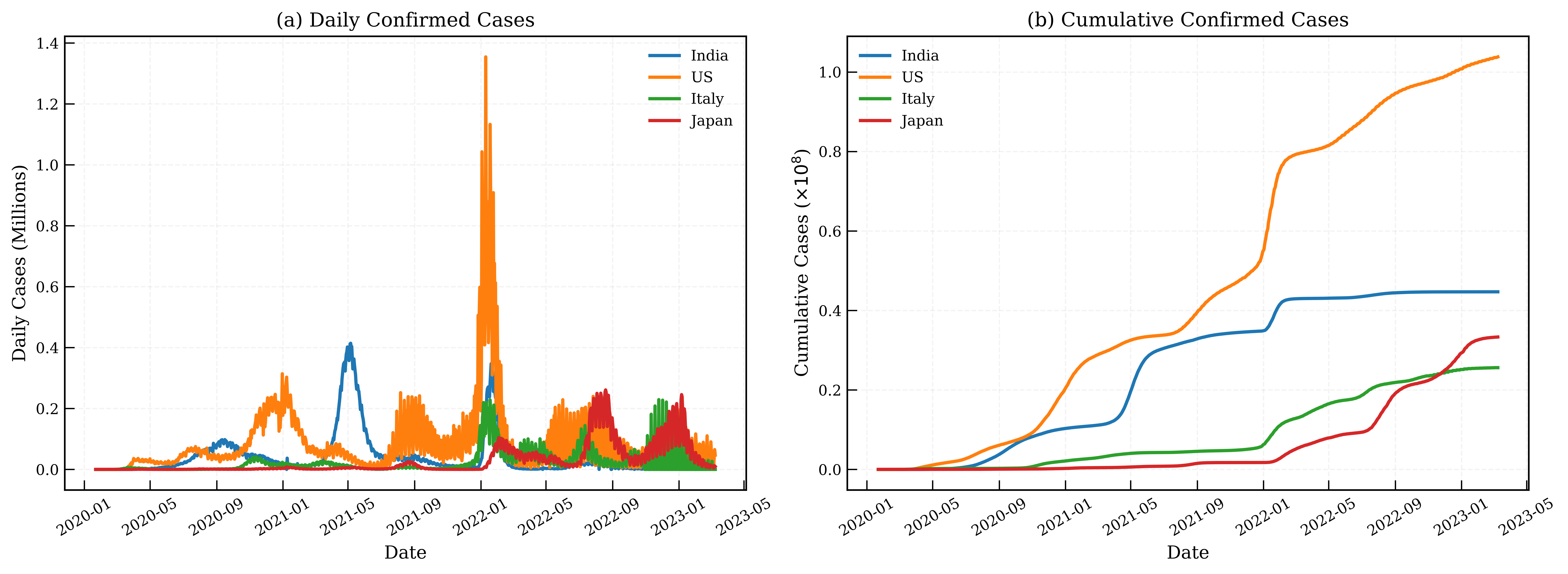
Accurate forecasting of infectious disease spread is essential for public health decision-making. This study compares mechanistic susceptible-exposed-infectious-removed (SEIR) models, machine-learning methods, and hybrid artificial intelligence (AI)-driven epidemiological frameworks using coronavirus disease 2019 (COVID-19) case data from India, the United States, Italy, and Japan. After preprocessing and exploratory analysis, we estimate time-varying transmission rates and develop two hybrid extensions: one predicts beta(t) using machine learning, and the other learns residual errors from the SEIR model. A baseline machine-learning model using lag-based and effective reproduction number (Rt)-driven features is also evaluated. Performance is assessed using mean absolute error (MAE), root mean squared error (RMSE), mean absolute percentage error (MAPE), high-incidence MAPE (on days with observed incidence ge 100 cases), and peak-timing error. With the SEIR transmission-rate spline fitted strictly to training data and all models evaluated on an identical 223-day held-out test window, a simple persistence baseline outperforms the mechanistic SEIR model, both hybrid AI extensions (Tracks A and B), and the pure machine-learning Random Forest model across all four countries (Diebold--Mariano test, p<0.001 in every comparison). The hybrid AI components do not consistently improve forecasting accuracy relative to the SEIR baseline. None of the mechanistic or machine-learning approaches anticipates new epidemic waves beyond the training period, underscoring the difficulty of medium-range epidemic forecasting under genuinely held-out conditions. The comparative evaluation highlights the complementary strengths and limitations of these approaches and provides guidance for future epidemic forecasting models.
Published
How to Cite
Issue
Section
Copyright (c) 2026 Pooja Satwani, Sudhir Kumar Mishra (Author)

This work is licensed under a Creative Commons Attribution 4.0 International License.
How to Cite
Similar Articles
- Rafiraza raza, Ahmad Termimi Ab Ghani, Lazim Abdullah, Extension of hesitant fuzzy weight geometric (HFWG)-VIKOR method under hesitant fuzzy information , Journal of the Nigerian Society of Physical Sciences: Volume 6, Issue 4, November 2024
- Pushap Lata Sharma, Mohini Kapalta, Ashok Kumar, Deepak Bains, Sumit Gupta, Pankaj Thakur, Electrohydro dynamics convection in dielectric rotating Oldroydian nanofluid in porous medium , Journal of the Nigerian Society of Physical Sciences: Volume 5, Issue 2, May 2023
- Raja Aqib Shamim, Majid Khan Majahar Ali, Mohamed Farouk Haashir bin Hamdullah, Computational optimization of auctioneer revenue in modified discrete Dutch auctions with cara risk preferences , Journal of the Nigerian Society of Physical Sciences: Volume 8, Issue 1, February 2026
- Emmanuel Agboeze, Henry Okechukwu Agboeze, Theresa Orieji Uchechukwu, Anayo Vitus Ofordile, Chukwuebuka Gabriel Eze, Environmental and health risk assessment of cadmium, zinc,iron, copper in crops and soil at Enugu State dumpsite , Journal of the Nigerian Society of Physical Sciences: Volume 8, Issue 1, February 2026
- J. O. Kuboye, O. F. Quadri, O. R. Elusakin, Solving third order ordinary differential equations directly using hybrid numerical models , Journal of the Nigerian Society of Physical Sciences: Volume 2, Issue 2, May 2020
- A. B. Disu, S. O. Salawu, Thermal distribution of magneto-tangent hyperbolic flowing fluid over a porous moving sheet: A Lie group analysis , Journal of the Nigerian Society of Physical Sciences: Volume 5, Issue 1, February 2023
- Timothy Kayode Samson, Francis Olatunbosun Aweda, Wind speed prediction in some major cities in Africa using Linear Regression and Random Forest algorithms , Journal of the Nigerian Society of Physical Sciences: Volume 6, Issue 4, November 2024
- Philemon Uten Emmoh, Christopher Ifeanyi Eke, Timothy Moses, A feature selection and scoring scheme for dimensionality reduction in a machine learning task , Journal of the Nigerian Society of Physical Sciences: Volume 7, Issue 1, February 2025
- O. Oderinde, C. L. Mgbechidinma, A. O. Agbeja, A. A. Ajayi, A. O. Ogundiran, O. O. Olaide, O. A. Orelaja, C. A. Mgbechidimma, C. O. Ajanaku, K. D. Oyeyemi, Appraising raw exhaust pollutant gases emissions from industrial generators using statistics and machine learning approaches , Journal of the Nigerian Society of Physical Sciences: Volume 7, Issue 4, November 2025
- P. A. Ejegwa, I. C. Onyeke, B. T. Terhemen, M. P. Onoja, A. Ogiji, C. U. Opeh, Modified Szmidt and Kacprzyk’s Intuitionistic Fuzzy Distances and their Applications in Decision-making , Journal of the Nigerian Society of Physical Sciences: Volume 4, Issue 2, May 2022
You may also start an advanced similarity search for this article.