A Bayesian approach to estimate transition models forzero-inflated count data
Keywords:
Bayesian inference, Zero-inflated models, Transition models, Count data, Simulation studyAbstract
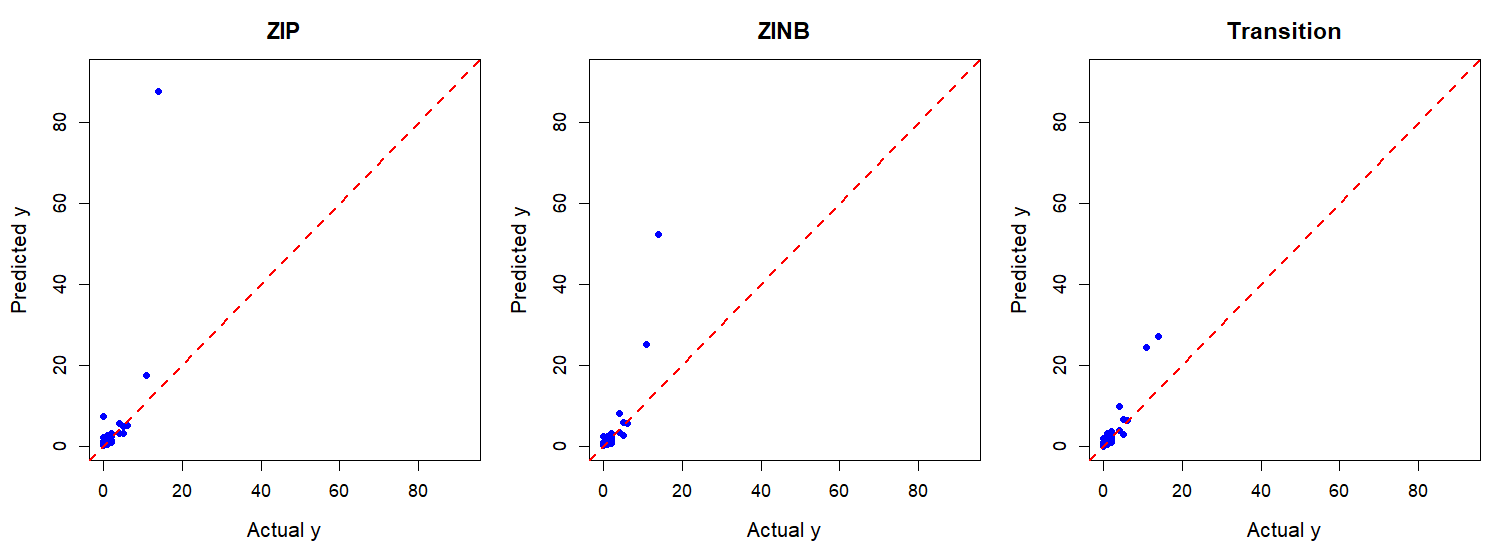
Zero-inflated count data are commonly modelled by mixing a degenerate distribution at zero with a Poisson or negative binomial component, thereby imposing a parametric form on the counts. The transition model of Berger and Tutz instead specifies the conditional probability of moving from one count to the next and treats excess zeros within a sequence of transition probabilities. We develop a Bayesian formulation of this model, derive its full conditional distributions, and address the treatment of probability above the largest represented category under finite parameterisation. The support is closed using a terminal category, and sensitivity checks show that two natural closure conventions give similar results for the data considered. We compare the Bayesian transition model with Bayesian zero-inflated Poisson (ZIP) and zero-inflated negative binomial (ZINB) regression across three simulated mechanisms and one real dataset. Because the models' coefficients represent different functionals, comparison is restricted to prediction on the expected-count scale. In all simulated scenarios, the transition model performs at least as well as the alternatives, with pairwise differences smaller than replication variability. In the real-data application, it gives lower prediction errors on all reported criteria, including median absolute error, with the largest advantage for observations beyond the training covariate range. The results indicate that the transition model can provide competitive prediction without specifying a fixed count distribution, while its bounded support remains a limitation for counts above the largest represented category.
References
[1] A. C. Cameron & P. K. Trivedi, Regression analysis of count data, 2nd ed., Cambridge University Press, Cambridge, UK, 2013. https://doi.org/10.1017/CBO9781139013567.
[2] J. M. Hilbe, Negative binomial regression, 2nd ed., Cambridge University Press, Cambridge, UK, 2011. https://doi.org/10.1017/CBO9780511973420.
[3] C. X. Feng, ``A comparison of zero-inflated and hurdle models for modeling zero-inflated count data'', Journal of Statistical Distributions and Applications 8 (2021) 8. https://doi.org/10.1186/s40488-021-00121-4.
[4] J. M. Hilbe, ``The statistical analysis of count data/El an'alisis estad'istico de los datos de recuento'', Culture and Education 29 (2017) 409. https://doi.org/10.1080/11356405.2017.1368162.
[5] Y. Min & A. Agresti, ``Random effect models for repeated measures of zero-inflated count data'', Statistical Modelling 5 (2005) 1. https://doi.org/10.1191/1471082X05st084oa.
[6] A. F. Zuur, E. N. Ieno, N. J. Walker, A. A. Saveliev & G. M. Smith, ``Zero-truncated and zero-inflated models for count data'', in Mixed effects models and extensions in ecology with R, Springer, New York, USA, 2009, pp. 261--293. https://doi.org/10.1007/978-0-387-87458-6_11.
[7] S. Yang & G. Berdine, ``The negative binomial regression'', The Southwest Respiratory and Critical Care Chronicles 3 (2015) 50. https://doi.org/10.12746/swrccc2015.0310.135.
[8] D. Lambert, ``Zero-inflated Poisson regression, with an application to defects in manufacturing'', Technometrics 34 (1992) 1. https://doi.org/10.2307/1269547.
[9] Y. Aliyu & U. Usman, ``On bivariate Nadarajah--Haghighi distribution derived from Farlie--Gumbel--Morgenstern copula in the presence of covariates'', Journal of the Nigerian Society of Physical Sciences 5 (2023) 871. https://doi.org/10.46481/jnsps.2023.871.
[10] M. Ridout, C. G. B. Dem'etrio & J. Hinde, Models for count data with many zeros, Proceedings of the XIXth International Biometric Conference, Cape Town, South Africa, 1998, pp. 179--192. https://www.kent.ac.uk/IMS/personal/msr/webfiles/zip/ibc_fin.pdf.
[11] J. Mullahy, ``Specification and testing of some modified count data models'', Journal of Econometrics 33 (1986) 341. https://doi.org/10.1016/0304-4076(86)90002-3.
[12] M. Xie, B. He & T. N. Goh, ``Zero-inflated Poisson model in statistical process control'', Computational Statistics & Data Analysis 38 (2001) 191. https://doi.org/10.1016/S0167-9473(01)00033-0.
[13] T. Loeys, B. Moerkerke, O. De Smet & A. Buysse, ``The analysis of zero-inflated count data: Beyond zero-inflated Poisson regression'', British Journal of Mathematical and Statistical Psychology 65 (2012) 163. https://doi.org/10.1111/j.2044-8317.2011.02031.x.
[14] W. H. Greene, ``Accounting for excess zeros and sample selection in Poisson and negative binomial regression models'', NYU Working Paper No. EC-94-10, Department of Economics, Stern School of Business, New York University, New York, USA, 1994. https://ssrn.com/abstract=1293115.
[15] J.-F. Angers & A. Biswas, ``A Bayesian analysis of zero-inflated generalized Poisson model'', Computational Statistics & Data Analysis 42 (2003) 37. https://doi.org/10.1016/S0167-9473(02)00154-8.
[16] H.-Y. Xu, M. Xie & T. N. Goh, ``Objective Bayes analysis of zero-inflated Poisson distribution with application to healthcare data'', IIE Transactions 46 (2014) 843. https://doi.org/10.1080/0740817X.2013.770190.
[17] A. M. Garay, V. H. Lachos & H. Bolfarine, ``Bayesian estimation and case influence diagnostics for the zero-inflated negative binomial regression model'', Journal of Applied Statistics 42 (2015) 1148. https://doi.org/10.1080/02664763.2014.995610.
[18] O. S. Adesina, ``Bayesian multilevel models for count data'', Journal of the Nigerian Society of Physical Sciences 3 (2021) 224. https://doi.org/10.46481/jnsps.2021.168.
[19] M. Berger & G. Tutz, ``Transition models for count data: a flexible alternative to fixed distribution models'', Statistical Methods & Applications 30 (2021) 1259. https://doi.org/10.1007/s10260-021-00558-6.
[20] UCLA Statistical Consulting Group, ``Zero-inflated Poisson regression'', R Data Analysis Examples, University of California, Los Angeles, n.d. Available online: https://stats.oarc.ucla.edu/r/dae/zip/.
Published
How to Cite
Issue
Section
Copyright (c) 2027 Qusai Shakhatreh, Ayat Almomani, Mohammed Obeidat (Author)

This work is licensed under a Creative Commons Attribution 4.0 International License.