Geohydraulic characteristics and groundwater vulnerability assessment of tropically weathered and fractured gneissic aquifers using combined georesistivity and geostatistical methods
Keywords:
ERT, Schlumberger VES, geoelectrohydraulic method, regression analysis, groundwater vulnerability, gneissic aquiferAbstract
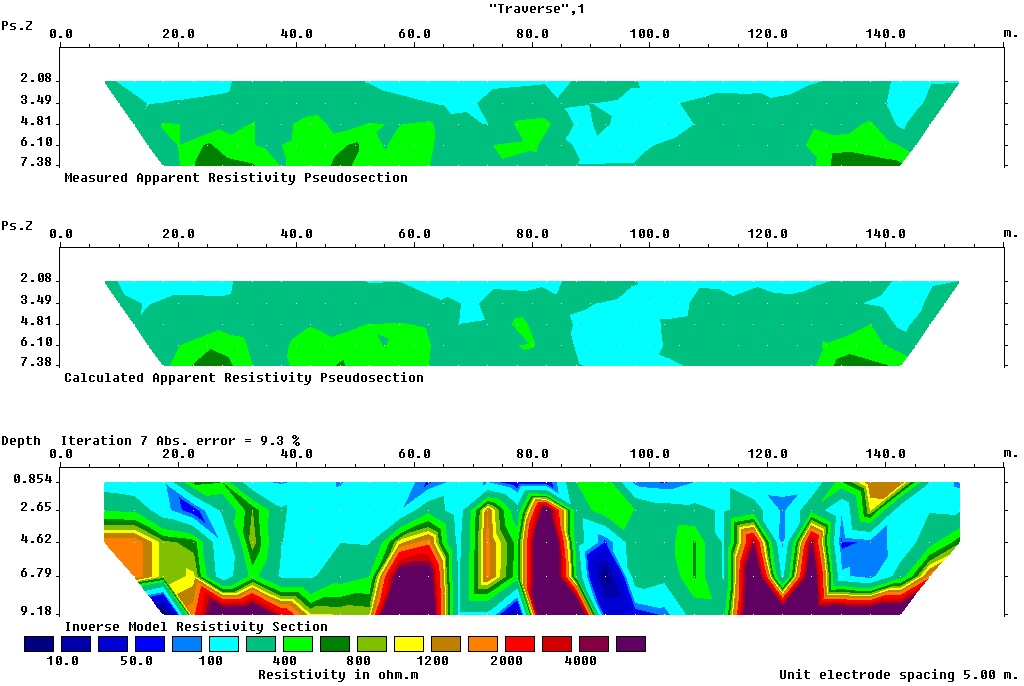
Sustainable groundwater yield in aquifers depends on the protective capacity of the subsurface lithologies and conduit systems. Electrical resistivity tomography (ERT) and its Schlumberger vertical electrical sounding (VES) technique were employed to assess the groundwater yield of aquifer units and their vulnerability to contaminants in Araromi (Akungba-Akoko), southwestern Nigeria. Geohydraulic parameters: aquifer resistivity (\rho0), hydraulic conductivity (K), transmissivity (T), permeability (\Psi), hydraulic resistance (KR), and longitudinal conductance (S) were also evaluated. In addition, regression analysis was utilized to establish the empirical relationships between the K and other geohydraulic parameters, with their percentage contributions to posing vulnerability risk. The georesistivity results revealed four distinct layers: topsoil, weathered layer, partially weathered/fractured bedrock unit, and fresh bedrock. The K model regression-assisted analysis showed that the \rho, T, \Psi, and S contributed about 97.8%, 14%, 99.9%, and 11.5%, respectively, to the estimated aquifers’ K values for the study area. Except for T and S, the regression results had moderate to strong positive correlations with K; hence, this illuminates the essentiality of K in assessing groundwater potential and vulnerability. The aquifer units have low to moderate groundwater yield based on T values (1.67-17.57 m/day) caused by the generally thin overburden (<4 m). However, the deep-weathered and fractured aquifer units with depths ranging from 39-55 m could supply high groundwater yield for sustainable abstraction. The estimated S values (0.0226-0.1926 mhos) for aquifer protective capacity ratings rated the aquifer units in the area as poor to weak. Based on the estimated low logarithm of KR (log KR) values of 0.79-2.25 years, these aquifers have extremely high to moderate aquifer vulnerability index. As a result, prospective wells/boreholes in the study area and settings with similar geohydraulic and vulnerability characteristics should be developed adequately to prevent the infiltration of surface contaminants for potable groundwater abstraction.
References
M. Offodile, Ground Water Study and Development in Nigeria, Mecon Geology and Engineering Service Limited, Jos, Nigeria, (2014).
W.J. Cosgrove & D.P. Loucks, “Water management: current and future challenges and research directions”, Water Resources Research 51 (2015) 4823.
A.S. Akingboye, A.A. Bery, J.S. Kayode, A.M. Asulewon, R. Bello, & O.E. Agbasi, “Near-Surface Crustal Architecture and Geohydrodynamics of the Crystalline Basement Terrain of Araromi, Akungba-Akoko, SW Nigeria, Derived from Multi-Geophysical Methods”, Natural Resources Research 31 (2022) 215. https://doi.org/10.1007/s11053-021-10000-z.
N.J. George, J.C. Ibuot, D.N. & Obiora, “Geoelectrohydraulic parameters of shallow sandy aquifer in Itu, Akwa Ibom State (Nigeria) using geoelectric and hydrogeological measurements”, Journal of African Earth Sciences 110 (2015) 52. https://doi.org/10.1016/j.jafrearsci.2015.06.006.
I. Stober, & K. Bucher, “Hydraulic conductivity of fractured upper crust: insights from hydraulic tests in boreholes and fluid-rock interaction in crystalline basement rocks”, Geofluids 15 (2015) 161. https://doi.org/10.1111/gfl.12104.
N.J. George, A.E. Akpan, & F.S. Akpan, “Assessment of spatial distrilbution of porosity and aquifer geohydraulic parameters in parts of the Tertiary - Quaternary hydrogeoresource of south-eastern Nigeria”, NRIAG Journal of Astronomy and Geophysics 6 (2017) 422. https://doi.org/10.1016/j.nrjag.2017.09.001.
A.S. Akingboye, & I.B. Osazuwa, “Subsurface geological, hydrogeophysical and engineering characterisation of Etioro-Akoko, southwestern Nigeria, using electrical resistivity tomography”, NRIAG Journal of Astronomy and Geophysics 10 (2021) 43. https://doi.org/10.1080/20909977.2020.1868659.
D.N. Obiora, J.C. Ibout, & N.J. George, “Geophysical assessment of potential hydrological units in hydrologically challenged geomaterials of Makurdi, Benue State, Nigeria”, International Journal of Physical Sciences 10 (2015) 479. https://doi.org/10.5897/IJPS2015.4386.
W.O. Raji, & K.A. Abdulkadir, “Evaluation of groundwater potential of bedrock aquifers in Geological Sheet 223 Ilorin, Nigeria, using geoelectric sounding”, Applied Water Science 10 (2020) 220. https://doi.org/10.1007/s13201-020-01303-2.
M. Hasan, Y. Shang, G. Akhter, & M. Khan, “Geophysical Investigation of Fresh-Saline Water Interface: A Case Study from South Punjab, Pakistan”, Groundwater 55 (2017) 841. https://doi.org/10.1111/gwat.12527.
A.S. Akingboye, & A.A. Bery, “Performance evaluation of copper and stainless-steel electrodes in electrical tomographic imaging”, Journal of Physical Science 32 (2021) 13. https://doi.org/10.21315/jps2021.32.3.2.
A.S. Akingboye, & A.A. Bery, “Evaluation of lithostratigraphic units and groundwater potential using the resolution capacities of two different electrical tomographic electrodes at dual-spacing”, Contributions to Geophysics and Geodesy 51 (2021) 295. https://doi.org/10.31577/congeo.2021.51.4.1.
M. Hasan, Y. Shang, W. Jin, & G. Akhter, “Assessment of Aquifer Vulnerability Using Integrated Geophysical Approach in Weathered Terrains of South China, Open Geosciences 11 (2019) 1129. https://doi.org/10.1515/geo-2019-0087.
M. Hasan, Y. Shang, G. Akhter, & W. Jin, “Delineation of contaminated aquifers using integrated geophysical methods in Northeast Punjab, Pakistan”, Environmental Monitoring and Assessment 192 (2020) 12. https://doi.org/10.1007/s10661-019-7941-y.
D.N. Obiora, U.D. Alhassan, J.C. Ibuot, & F.N. Okeke, “Geoelectric Evaluation of Aquifer Potential and Vulnerability of Northern Paiko, Niger State, Nigeria”, Water Environment Research 88 (2016) 644. https://doi.org/10.2175/106143016X14609975746569.
A.M. Ekanem, “Georesistivity modelling and appraisal of soil water retention capacity in Akwa Ibom State University main campus and its environs, Southern Nigeria”, Modeling Earth Systems and Environment 6 (2020) 2597. https://doi.org/10.1007/s40808-020-00850-6.
A.S. Akingboye, I.B. Osazuwa, & M.Z. Mohammed, “Electrical resistivity tomography for geoengineering investigation of subsurface defects: A case study of Etioro-Akoko highway, Ondo State, Southwestern Nigeria”, Studia Quaternaria 37 (2020) 101. https://doi.org/10.24425/sq.2020.133754.
M.Z. Mohammed, T.H.T. Ogunribido, & A.T. Funmilayo, “Electrical resistivity sounding for subsurface delineation and evaluation of groundwater potential of Araromi Akungba-Akoko Ondo State southwestern Nigeria”, Journal of Environment and Earth Science 2 (2012) 29. www.iiste.org.
M.B. Aminu, “Electrical Resistivity Imaging of a Thin Clayey Aquitard Developed on Basement Rocks in Parts of Adekunle Ajasin University Campus, Akungba-Akoko, South-western Nigeria”, Environmental Research, Engineering and Management 71 (2015) 47. https://doi.org/10.5755/j01.erem.71.1.9016.
M.A. Rahaman, Review of the Basement Geology of southwestern Nigeria, in: C.A. Kogbe (Ed.), Geology of Nigeria, Elizabeth Publisher. Co., Lagos, (1976).
M.A. Rahaman, Recent advances in the study of the Basement Complex of Nigeria, in: P.O. Oluyide, W.C. Mbonu, A.E.O. Ogezi, I.G. Egbuniwe, A.C. Ajibade, A.C. Umeji (Eds.), Precambrian Geology of Nigeria, Geological Survey of Nigeria, Kaduna, (1988).
A. Kröner, B.N. Ekwueme, & R.T. Pidgeon, “The Oldest Rocks in West Africa: SHRIMP Zircon Age for Early Archean Migmatitic Orthogneiss at Kaduna, Northern Nigeria”, The Journal of Geology 109 (2001) 399.
N.G. Obaje, “Geology and Mineral Resources of Nigeria”, Springer Berlin Heidelberg, Berlin, Heidelberg, (2009). https://doi.org/10.1007/978-3-540-92685-6.
B.J. Fagbohun, A.A. Omitogun, O.A. Bamisaiye, & F.J. Ayoola, “Gold potential of the Pan African Trans-Sahara belt and prospect for further exploration”, Ore Geology Reviews 116 (2020) 103260. https://doi.org/10.1016/j.oregeorev.2019.103260.
A.C. Ogunyele, S.O. Obaje, A.S. Akingboye, A.O. Adeola, A.O. Babalola, & A.T. Olufunmilayo, “Petrography and geochemistry of Neoproterozoic charnockite-granite association and metasedimentary rocks around Okpella, southwestern Nigeria”, Arabian Journal of Geosciences 13 (2020) 780. https://doi.org/10.1007/s12517-020-05785-x.
K.M. Goodenough, P.A.J. Lusty, N.M.W. Roberts, R.M. Key, & A. Garba, “Post-collisional Pan-African granitoids and rare metal pegmatites in western Nigeria: Age, petrogenesis, and the ’pegmatite’ conundrum,” Lithos 200-201 (2014) 22. https://doi.org/10.1016/j.lithos.2014.04.006.
A.C. Ogunyele, O.A. Oluwajana, I.Q. Ehinola, B.E. Ameh, & T.A. Salaudeen, “Petrochemistry and petrogenesis of the Precambrian Basement Complex rocks around Akungba-Akoko, southwestern Nigeria”, Materials and Geoenvironment 66 (2020) 173. https://doi.org/10.2478/rmzmag-2019-0036.
A.S. Akingboye, O. Ademila, C.C. Okpoli, A. V. Oyeshomo, R.O. Ijaleye, A.R. Faruwa, A.O. Adeola, & A.A. Bery, “Radiogeochemistry, uranium migration, and radiogenic heat of the granite gneisses in parts of the southwestern Basement Complex of Nigeria”, Journal of African Earth Sciences 188 (2022) 104469. https://doi.org/10.1016/j.jafrearsci.2022.104469.
A.S. Akingboye, A.C. Ogunyele, A.T. Jimoh, O.B. Adaramoye, A.O. Adeola, & T. Ajayi, “Radioactivity, radiogenic heat production and environmental radiation risk of the Basement Complex rocks of Akungba Akoko, southwestern Nigeria: insights from in situ gamma-ray spectrometry”, Environmental Earth Sciences 80 (2021) 228. https://doi.org/10.1007/s12665-021-09516-7.
S.M.A. Adelana, P.I. Olasehinde, R.B. Bale, P. Vrbka, A.E. Edet, & I.B. Goni, An overview of the geology and hydrogeology of Nigeria, in: Applied Groundwater Studies in Africa, (2008). https://doi.org/10.1201/9780203889497-13.
M. Woakes, M.A. Rahaman, & A.C. Ajibade, “Some metallogenetic features of the Nigerian basement”, Journal of African Earth Sciences 6 (1987) 655. https://doi.org/10.1016/0899-5362(87)90004-2.
M.H. Loke, Rapid 2D resistivity and IP inversion using the least-square method - Geoelectrical Imaging 2-D and 3D, (2004).
A.S. Akingboye & A.C. Ogunyele, “Insight into seismic refraction and electrical resistivity tomography techniques in subsurface investigations”, Rudarsko Geolosko Naftni Zbornik 34 (2019) 93. https://doi.org/10.17794/rgn.2019.1.9.
M.H. Loke & R.D. Barker, “Practical techniques for 3D resistivity surveys and data inversion 1”, Geophysical Prospecting 44 (1996) 499. https://doi.org/10.1111/j.1365-2478.1996.tb00162.x.
C. DeGroot-Hedlin & S. Constable, “Occam’s inversion to generate smooth, two-dimensional models from magnetotelluric data”, Geophysics 55 (1990) 1613. https://doi.org/10.1190/1.1442813.
M.H. Loke, J.E. Chambers, D.F. Rucker, O. Kuras, & P.B. Wilkinson, “Recent developments in the direct-current geoelectrical imaging method”, Journal of Applied Geophysics 95 (2013) 135. https://doi.org/10.1016/j.jappgeo.2013.02.017.
A. Kurniawan, Basic IP2 Win Tutorial: Basic Principles in Using IP2 Win Software, (2009).
K.P. Singh, “Nonlinear estimation of aquifer parameters from surficial measurements”, Hydrology and Earth System Sciences 2 (2005) 917. https://doi.org/10.5194/hessd-2-917-2005.
M. Oladapo, M. Mohammed, O. Adeoye, & B. Adetola, “Geoelectrical investigation of the Ondo State Housing Corporation Estate Ijapo Akure, southwestern Nigeria”, Journal of Mining and Geology 40 (2004) 41. https://doi.org/10.4314/jmg.v40i1.18807.
D. Van Stempvoort, L. Ewert, & L. Wassenaar, Aquifer vulnerability index: A GIS - compatible method for groundwater vulnerability mapping, Canadian Water Resources Journal 18 (1993) 25. https://doi.org/10.4296/cwrj1801025.
C.W. Fetter, Applied Hydrogeology, 4th ed., Waveland Press, Inc., Long Grove, Illinois, (2018). https://www.amazon.com/Applied-Hydrogeology-C-W-Fetter-ebook/dp/B07CM8Y415 (accessed March 20, 2022).
M.A. Rahaman, Review of the basement geology of SW Nigeria, in: C.A. Kogbe (Ed.), Geology of Nigeria, Elizabeth Publishing. Co. Nigeria, (1989). http://www.sciepub.com/reference/51950 (accessed March 20, 2022).
N.J. George, J.C. Ibuot, A.M. Ekanem, & A.M. George, “Estimating the indices of inter-transmissibility magnitude of active surficial hydrogeologic units in Itu, Akwa Ibom State, southern Nigeria”, Arabian Journal of Geosciences 11 (2018) 134. https://doi.org/10.1007/s12517-018-3475-9.
R.J. Freund, D. Mohr, & W.J. Wilson, Statistical Methods, Elsevier, 2010. https://doi.org/10.1016/C2009-0-20216-9.
G. Smith, Multiple Regression, in: Essential Statistics, Regression, and Econometrics, Elsevier, (2012). https://doi.org/10.1016/B978-0-12-382221-5.00010-6.
A.S. Akingboye, & A.A. Bery, “Characteristics and rippability conditions of near-surface lithologic units (Penang Island, Malaysia) derived from multimethod geotomographic models and geostatistics”, Journal of Applied Geophysics 204 (2022) 104723. https://doi.org/10.1016/j.jappgeo.2022.104723.
J. Krasny, “Classification of Transmissivity Magnitude and Variation”, Ground Water 31 (1993) 230. https://doi.org/10.1111/j.1745-6584.1993.tb01815.x.
J.P. Henriet, “Direct applications of the Dar-Zarrouk parameters in groundwater surveys”, Geophysical Prospecting 24 (1976) 344. https://doi.org/10.1111/j.1365-2478.1976.tb00931.x.
A.S. Akingboye, A.A. Bery, J.S. Kayode, A.C. Ogunyele, A.O. Adeola, O.O. Omojola & A.S. Adesida, “Groundwater-yielding capacity, water-rock interaction, and vulnerability assessment of typical gneissic hydrogeologic units using geoelectrohydraulic method”, Acta Geophysica, (2022). https://doi.org/10.1007/s11600-022-00930-4.
Published
How to Cite
Issue
Section
Copyright (c) 2022 A. S. Akingboye

This work is licensed under a Creative Commons Attribution 4.0 International License.