Geohydraulic characteristics and groundwater vulnerability assessment of tropically weathered and fractured gneissic aquifers using combined georesistivity and geostatistical methods
Keywords:
ERT, Schlumberger VES, geoelectrohydraulic method, regression analysis, groundwater vulnerability, gneissic aquiferAbstract
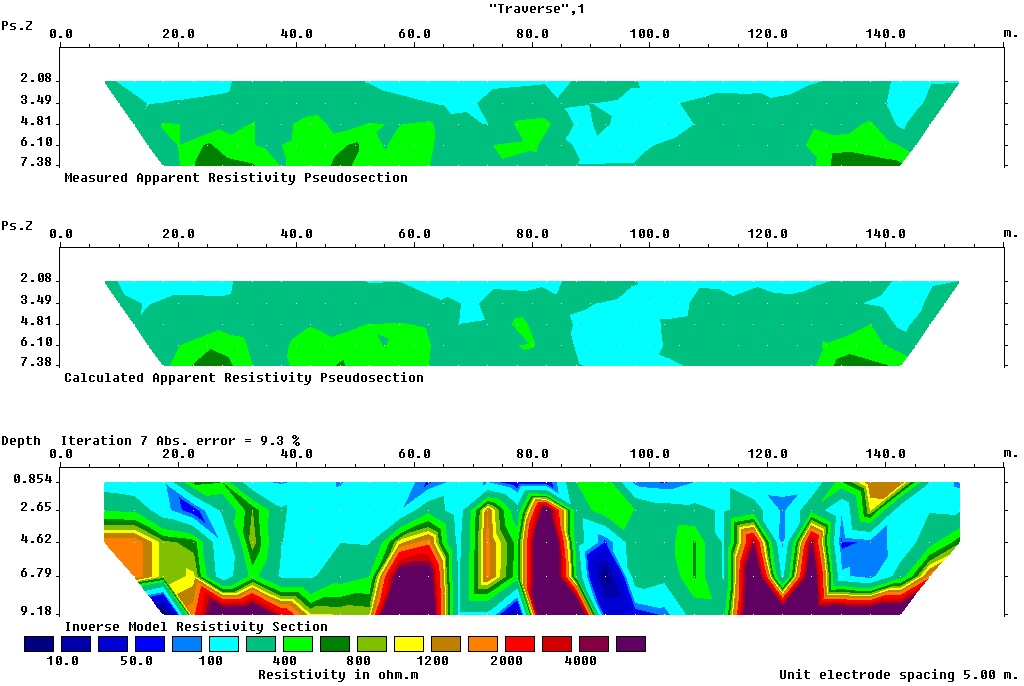
Sustainable groundwater yield in aquifers depends on the protective capacity of the subsurface lithologies and conduit systems. Electrical resistivity tomography (ERT) and its Schlumberger vertical electrical sounding (VES) technique were employed to assess the groundwater yield of aquifer units and their vulnerability to contaminants in Araromi (Akungba-Akoko), southwestern Nigeria. Geohydraulic parameters: aquifer resistivity (\rho0), hydraulic conductivity (K), transmissivity (T), permeability (\Psi), hydraulic resistance (KR), and longitudinal conductance (S) were also evaluated. In addition, regression analysis was utilized to establish the empirical relationships between the K and other geohydraulic parameters, with their percentage contributions to posing vulnerability risk. The georesistivity results revealed four distinct layers: topsoil, weathered layer, partially weathered/fractured bedrock unit, and fresh bedrock. The K model regression-assisted analysis showed that the \rho, T, \Psi, and S contributed about 97.8%, 14%, 99.9%, and 11.5%, respectively, to the estimated aquifers’ K values for the study area. Except for T and S, the regression results had moderate to strong positive correlations with K; hence, this illuminates the essentiality of K in assessing groundwater potential and vulnerability. The aquifer units have low to moderate groundwater yield based on T values (1.67-17.57 m/day) caused by the generally thin overburden (<4 m). However, the deep-weathered and fractured aquifer units with depths ranging from 39-55 m could supply high groundwater yield for sustainable abstraction. The estimated S values (0.0226-0.1926 mhos) for aquifer protective capacity ratings rated the aquifer units in the area as poor to weak. Based on the estimated low logarithm of KR (log KR) values of 0.79-2.25 years, these aquifers have extremely high to moderate aquifer vulnerability index. As a result, prospective wells/boreholes in the study area and settings with similar geohydraulic and vulnerability characteristics should be developed adequately to prevent the infiltration of surface contaminants for potable groundwater abstraction.
Published
How to Cite
Issue
Section
Copyright (c) 2022 A. S. Akingboye

This work is licensed under a Creative Commons Attribution 4.0 International License.
How to Cite
Similar Articles
- Jatin Kumar, Khem Chand, Pankaj Thakur, Numerical study of hall current and thermophoresis effect on the hydromagnetic casson nano fluid flow over a stretching surface , Journal of the Nigerian Society of Physical Sciences: Volume 8, Issue 2, May 2026
- P. K. Alimo, G. Lartey-Young, S. Agyeman, T. Y. Akintunde, E. Kyere-Gyeabour, F. Krampah, A. Awomuti, O. Oderinde, A. O. Agbeja, O. G. Afolabi, Spatial distribution and policy implications of the exhaust emissions of two-stroke motorcycle taxis: a case study of southwestern state in Nigeria , Journal of the Nigerian Society of Physical Sciences: Volume 6, Issue 2, May 2024
- Emmanuel P. Agbo, Golden C. Offorson, Abubakar S. Yusuf, John O. Bassey, Moses A. Okono, Ugochukwu Nkajoe, Patrick O. Ushie, Innovative trend analysis of precipitation changes over Nigeria: A case study of locations across the Niger and Benue Rivers , Journal of the Nigerian Society of Physical Sciences: Volume 7, Issue 1, February 2025
- Solomon A. Ayuba, I. Akeyede, A. S. Olagunju, Stability and Sensitivity Analysis of Dengue-Malaria Co-Infection Model in Endemic Stage , Journal of the Nigerian Society of Physical Sciences: Volume 3, Issue 2, May 2021
- A. A. Ibiyemi, G. T. Yusuf, O. Akirinola, M. Orojo, B. Osuporu, J. Lawal, Investigating the magnetic domain structure and photonics characters of Singled Phased hard ferromagnetic Ferrite MFe3O4 (M= Co2+, Zn2+, Cd2+) Compounds , Journal of the Nigerian Society of Physical Sciences: Volume 6, Issue 1, February 2024
- Solomon Nehemiah Yusuf, Williams Midala Wakili, Geological mapping and structural analysis from satellite imagery of a section of the Adamawa Massif: Implications for mineralization , Journal of the Nigerian Society of Physical Sciences: Volume 7, Issue 3, August 2025
- Kazeem Issa, Risikat A. Bello, Usman Jos Abubakar, Approximate analytical solution of fractional-order generalized integro-differential equations via fractional derivative of shifted Vieta-Lucas polynomial , Journal of the Nigerian Society of Physical Sciences: Volume 6, Issue 1, February 2024
- M. A. Okono, E. P. Agbo, B. J. Ekah, U. J. Ekah, E. B. Ettah, C. O. Edet, Statistical Analysis and Distribution of Global Solar Radiation and Temperature Over Southern Nigeria , Journal of the Nigerian Society of Physical Sciences: Volume 4, Issue 3, August 2022
- Muhammad Dahiru Liman, Salamatu Ibrahim Osanga, Esther Samuel Alu, Sa'adu Zakariya, Regularization Effects in Deep Learning Architecture , Journal of the Nigerian Society of Physical Sciences: Volume 6, Issue 2, May 2024
- Akila Dabara Kayit, Mohd Tahir Ismail, Novel way to predict stock movements using multiple models and comprehensive analysis: leveraging voting meta-ensemble techniques , Journal of the Nigerian Society of Physical Sciences: Volume 6, Issue 3, August 2024
You may also start an advanced similarity search for this article.