
Geohydraulic characteristics and groundwater vulnerability assessment of tropically weathered and fractured gneissic aquifers using combined georesistivity and geostatistical methods
Keywords:
ERT, Schlumberger VES, geoelectrohydraulic method, regression analysis, groundwater vulnerability, gneissic aquiferAbstract
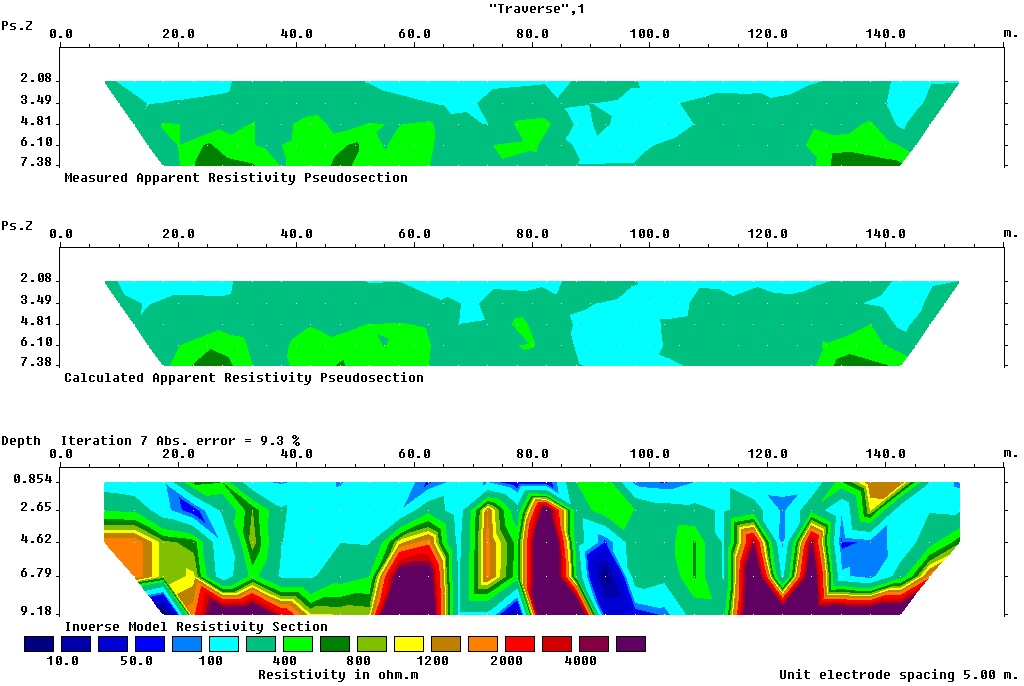
Sustainable groundwater yield in aquifers depends on the protective capacity of the subsurface lithologies and conduit systems. Electrical resistivity tomography (ERT) and its Schlumberger vertical electrical sounding (VES) technique were employed to assess the groundwater yield of aquifer units and their vulnerability to contaminants in Araromi (Akungba-Akoko), southwestern Nigeria. Geohydraulic parameters: aquifer resistivity (\rho0), hydraulic conductivity (K), transmissivity (T), permeability (\Psi), hydraulic resistance (KR), and longitudinal conductance (S) were also evaluated. In addition, regression analysis was utilized to establish the empirical relationships between the K and other geohydraulic parameters, with their percentage contributions to posing vulnerability risk. The georesistivity results revealed four distinct layers: topsoil, weathered layer, partially weathered/fractured bedrock unit, and fresh bedrock. The K model regression-assisted analysis showed that the \rho, T, \Psi, and S contributed about 97.8%, 14%, 99.9%, and 11.5%, respectively, to the estimated aquifers’ K values for the study area. Except for T and S, the regression results had moderate to strong positive correlations with K; hence, this illuminates the essentiality of K in assessing groundwater potential and vulnerability. The aquifer units have low to moderate groundwater yield based on T values (1.67-17.57 m/day) caused by the generally thin overburden (<4 m). However, the deep-weathered and fractured aquifer units with depths ranging from 39-55 m could supply high groundwater yield for sustainable abstraction. The estimated S values (0.0226-0.1926 mhos) for aquifer protective capacity ratings rated the aquifer units in the area as poor to weak. Based on the estimated low logarithm of KR (log KR) values of 0.79-2.25 years, these aquifers have extremely high to moderate aquifer vulnerability index. As a result, prospective wells/boreholes in the study area and settings with similar geohydraulic and vulnerability characteristics should be developed adequately to prevent the infiltration of surface contaminants for potable groundwater abstraction.
Published
How to Cite
Issue
Section
Copyright (c) 2022 A. S. Akingboye

This work is licensed under a Creative Commons Attribution 4.0 International License.
How to Cite
Similar Articles
- F. O. Akinpelu, R. A. Oderinu, A. D. Ohaegbue, Analysis of Hydromagnetic Double Exothermic Chemical Reactive Flow with Convective Cooling through a Porous Medium under Bimolecular Kinetics , Journal of the Nigerian Society of Physical Sciences: Volume 4, Issue 1, February 2022
- Nneka Ernestina Richard-Nnabu, Chinagolum Ituma, Henry Friday Nweke, Convolutional neural networks method for folded naira currency denominations recognition and analysis , Journal of the Nigerian Society of Physical Sciences: Volume 6, Issue 4, November 2024
- El Mehdi Chouit, Mohamed RACHDI, Mostafa BELLAFKIH, Brahim RAOUYANE, Forecasting of the epidemiological situation: Case of COVID-19 in Morocco , Journal of the Nigerian Society of Physical Sciences: Volume 4, Issue 4, November 2022
- Muhammad Farman, Kottakkaran Sooppy Nisar, Modeling and stability analysis of a fractional-order tuberculosisvmodel with different exposed populations progressing to infection , Journal of the Nigerian Society of Physical Sciences: Volume 8, Issue 3, August 2026
- C. Gopi, Edward Anand E, A. Charles, C. Manivannan, S .Ponsadai Lakshmi, A. Jose, M. Muthiyan, Physico-Chemical and Trace Metal Analysis in Groundwater of Nagapattinam Region in Nagapattinam District of Tamilnadu State , Journal of the Nigerian Society of Physical Sciences: Volume 5, Issue 2, May 2023
- Bukola Oluwatosin Falomo, Olugbenga John Fenuga, Israel Olutunji Abiala, Unsteady MHD Casson nanofluid transport over an inclined permeable cylinder in an anisotropic porous medium: effects of nonlinear radiation and Joule heating , Journal of the Nigerian Society of Physical Sciences: Volume 8, Issue 3, August 2026
- U. N. Bassey, U. E. Edeke, Convolution equation and operators on the Euclidean motion group , Journal of the Nigerian Society of Physical Sciences: Volume 6, Issue 4, November 2024
- James Andrawus, Kayode Isaac Omotoso, Agada Apeh Andrew, Felix Yakubu Eguda, Sunday Babuba, Kabiru Garba Ibrahim, Mathematical model analysis on the significance of surveillance and awareness on the transmission dynamics of diphtheria , Journal of the Nigerian Society of Physical Sciences: Volume 7, Issue 4, November 2025
- K. Issa, A. T. AbdulKareem, A D. Adeshola, R. A. Bello, Numerical solution of fractional advection-diffusion equation with generalized Caputo derivative using shifted ultraspherical collocation method , Journal of the Nigerian Society of Physical Sciences: Volume 8, Issue 2, May 2026
- V. Ramanjini, G. Gopi Krishna, Mani Ramanuja, Hari Kamala Sree, S. R. Mishra, Unsteady Prandtl nanofluidic flow through stretching sheet due to mixed convection, first-order slip, and chemical reaction , Journal of the Nigerian Society of Physical Sciences: Volume 5, Issue 4, November 2023
You may also start an advanced similarity search for this article.







