Effects of different electrolytes on the structure and yield ofgraphene oxide produced via electrochemical exfoliation
Keywords:
Graphene, electrochemical exfoliation, electrolyte, quality, yield/production rate, graphiteAbstract
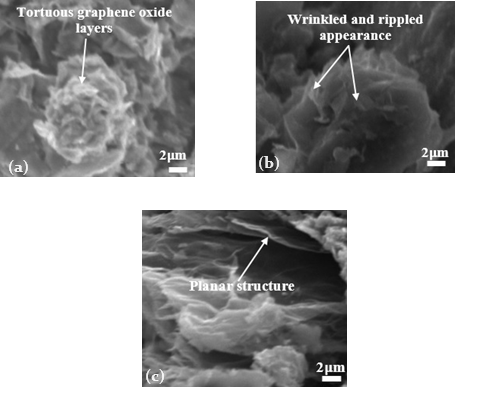
The most suitable electrolyte for graphene oxide synthesis, in terms of both production efficiency and quality, using the electrochemical exfoliation technique has been investigated and reported in this study. Simultaneous anodic and cathodic graphene oxide production using ten (10) different electrolytes, including acids (H2SO4, HCl, HNO3), bases (KOH, Ca(OH)2, Mg(OH)2, NaOH), and salts (NaCl, (NH4)2SO4, K2SO4), was studied under the same experimental conditions of bias voltage, graphite nature, exfoliation time, electrolyte molarity, and post-exfoliation treatments. Assessment of the graphene oxide structures and production rates was supported using Raman spectroscopy, high-resolution scanning electron microscopy (HRSEM), and EDS (energy dispersive x-ray spectroscopy), attached to the scanning electron microscope. Analysis of the results obtained reveals that H2SO4 showed the highest graphene oxide yield (86%) but with comparably low graphene oxide quality in terms of defect concentration, presence of oxygen functional group contamination, and crystallite properties. The aqueous NaCl, Ca(OH)2 and Mg(OH)2 electrolytes did not show any graphene oxide exfoliation effect. However, from the series of electrolytes examined, aqueous (NH4)2SO4 exhibited an excellent combination of efficient graphene oxide yield and high-quality characteristics due to its relatively high yield of 74% and superior quality of the produced graphene oxide with the comparatively lowest defect density, ?D, and highest C/O (carbon-to-oxygen) ratio. The tortuous, agglomerated, and planar layers of the distinct 2D graphene oxide sheets were also clearly revealed by the SEM images. In essence, the roles played by dissociated sulfate (SO42?), nitrate (NO32?), chlorides (Cl?), and hydroxides (OH?) ions in the series of complex electrochemical reactions toward the intercalation, exfoliation, yield, and properties of graphene oxide produced are discussed. From the series of electrolytes tested, aqueous (NH4)2SO4 emerged as the most relatively suitable electrolyte for the synthesis of graphene oxide because it combines both high yield and fine quality.
References
X. Wang & L. Zhang, “Green and facile production of high-quality graphene from graphite by the combination of hydroxyl radicals and electrical exfoliation in different electrolyte systems” RSC Advances 9 (2019) 3693. https://doi.org/10.1039/c8ra09752f.
J. Wang, X. Jin, C. Li, W. Wang, H. Wu & S. Guo, “Graphene and graphene derivatives toughening polymers: Toward high toughness and strength”, Chemical Engineering Journal 370 (2019) 851. https://doi.org/ 10.1016/j.cej.2019.03.229.
C. Shen, J. E. Calderon, E. Barrios, M. Soliman, A. Khater, A. Jeyaranjan, L. Tetard, A. Gordon, S. Seal & L. Zhai, “Anisotropic electrical conductivity in polymer derived ceramics induced by graphene aerogels”, Journal of Materials Chemistry C 5 (2017) 11708. https://doi.org/10.1039/ c7tc03846a.
M. Li, T. Chen, J. J. Gooding & J. Liu, “Review of carbon and graphene quantum dots for sensing”, ACS Sensor 4 (2019) 1732. https://doi.org/10. 1021/acssensors.9b00514.
D. Li, Z. Yang, D. Jia, D. Wu, Q. Zhu, B. Liang, S. Wang & Zhou, “Microstructure, oxidation and thermal shock resistance of graphene reinforced SiBCN ceramics”, Ceramics International 42 (2016) 4429. http://dx.doi.org/10.1016/j.ceramint.2015.11.127.
J. Shen, Y. Zhu, X. Yang & C. Li, “Graphene quantum dots: emergent nanolights for bioimaging, sensors, catalysis and photovoltaic devices”, Chemical communications (Cambridge, England) 48 (2012) 3686. https://doi.org/10.1039/c2cc00110a.
Y. Ren, B. Yang, X. Huang, F. Chu, J. Qiu & J. Ding, “Intercalated SiOC/graphene composites as anode material for li-ion batteries”, Solid State Ionics 278 (2015) 198. http://dx.doi.org/10.1016/j.ssi.2015.06.020.
S. O. Bolarinwa, E. Danladi, A. Ichoja, M. Y. Onimisia & C. U. Achem, “Synergistic study of reduced graphene oxide as interfacial buffer layer in HTL-free perovskite solar cells with carbon electrode”, Journal of the Nigerian Society of Physical Sciences 4 (2022) 909. https://doi.org/10. 46481/jnsps.2022.909
Q. Wang, Y. Wang & L. Dong, “MEMS flow sensor using suspended graphene diaphragm with microhole arrays” Journal of Microelectromechanical Systems 27 (2018) 951. https://doi.org/10.1109/JMEMS.2018. 2874231.
J. Schulte, Z. Jiang, O. Sevim & O. E. Ozbulut, “Graphene-reinforced cement composites for smart infrastructure systems”, The Rise of Smart Cities: Advanced Structural Sensing and Monitoring Systems 2022 (2022) 79. https://doi.org/10.1016/B978-0-12-817784-6.00008-4.
D. B. Shinde, J. Brenker, C. D. Easton, R. F. Tabor, A. Neild & M. Majumder, “Shear assisted electrochemical exfoliation of graphite to graphene”, Langmuir 32 (2016) 3552. https://doi.org/10.1021/acs. langmuir.5b04209
L. Li, M. Wang, J. Guo, M. Cao, H. Qiu, L. Dai & Z. Yang, “Regulation of radicals from electrochemical exfoliation of a double-graphite electrode to fabricate high-quality graphene”, Journal of Materials Chemistry C 6 (2018) 6257. https://doi.org/10.1039/c8tc01565a.
Q. Zhou, Y. Lu & H. Xu, “High-yield production of high-quality graphene by novel electrochemical exfoliation at air-electrolyte interface” Materials Letters 235 (2019) 153. https://doi.org/10.1016/j.matlet.2018.10.016
S. Yang, S. Bruller, Z. Wu, Z. Liu, K. Parvez, R. Dong, F. Richard, P.¨ Samori, X. Feng & K. Mullen, “Organic Radical-Assisted Electrochemi-¨ cal Exfoliation for the Scalable Production of High-Quality Graphene”, Journal of the American Chemical Society 137 (2015) 13927. https://doi.org/10.1021/jacs.5b09000.
J. Liu, Electrochemical Exfoliation Synthesis of Graphene” in GrapheneBased Composites for Electrochemical Energy Storage, 2017, pp. 39–50. https://doi.org/10.1007/978-981-10-3388-9 2.
L. Li, D. Zhang, J. Deng, J. Fang & Y. Gou, “Review—preparation and application of graphene-based hybrid materials through electrochemical xxfoliation”, Journal of The Electrochemical Society 167 (2020) 086511. https://doi.org/10.1149/1945-7111/ab933b.
L. Li, D. Zhang, J. Deng, Q. Kang, Z, Liu, J. Fang & Y. Gou, “Review— progress of research on the preparation of graphene oxide via electrochemical approaches”, Journal of The Electrochemical Society 167 (2020) 155519. https://doi.org/10.1149/1945-7111/abbbc0
M. Eredia, S. Bertolazzi, T. Leydecker, M. El Garah, I. Janica, G. Melinte, O. Ersen, A. Ciesielski & P. Samor`ı, ”Morphology and Electronic Properties of Electrochemically Exfoliated Graphene”, Journal of Physical Chemistry Letters 8 (2017) 3347. https://doi.org/10.1021/acs. jpclett.7b01301.
J. H. Zhong, J. Zhang, X. Jin, J. Y. Liu, Q. Li, M. H. Li, W. Cai, D. Y. Wu, D. Zhan & B. Ren, ”Quantitative correlation between defect density and heterogeneous electron transfer rate of single layer graphene”, Journal of the American Chemical Society 136 (2014) 16609. https://doi.org/10. 1021/ja508965w.
T. C. Achee, W. Sun, J. T. Hope, S. G. Quitzau, C. B. Sweeney, S. A. Shah, T. Habib & M. J. Green, “High-yield scalable graphene nanosheet production from compressed graphite using electrochemical exfoliation”, Scientific Reports 8 (2018) 1. http://dx.doi.org/10.1038/s41598-018-32741-3.
Y. Hong, Z. Wang & X. Jin, “Sulfuric acid intercalated graphite oxide for graphene preparation”, Sci. Rep. 3 (2013) 5. https://doi.org/10.1038/ srep03439.
H. Yu, B. Zhang, C. Bulin, R. Li & R. Xing, “High-efficient Synthesis of Graphene Oxide Based on Improved Hummers Method”, Scientific Reports 6 (2016) 1. https://doi.org/10.1038/srep36143.
C. Y. Su, A. Y. Lu, Y. Xu, F. R. Chen, A. N. Khlobystov & L. J. Li, “Highquality thin graphene films from fast electrochemical exfoliation”, ACS Nano 5 (2011) 2332. https://doi.org/10.1021/nn200025p.
F. Liu, C. Wang, X. Sui, M. A. Riaz, M. Xu, L. Wei, & Y. Chen, “Synthesis of graphene materials by electrochemical exfoliation: Recent progress and future potential”, Carbon Energy 1 (2019) 173. https: //dx.doi.org/10.1002/cey2.14
J. M. Munuera, J. I. Paredes, M. Enterr´ıa, A. Pagan, S. Villar-Rodil, M. F.´ R. Pereira, J. I. Martins, J. L. Figueiredo, J. L. Cenis, A. Mart´ınez-Alonso & J. M. D. Tascon, “Electrochemical Exfoliation of Graphite in Aqueous´ Sodium Halide Electrolytes toward Low Oxygen Content Graphene for Energy and Environmental Applications”, ACS Applied Materials and Interfaces 9 (2017) 24085. https://doi.org/10.1021/acsami.7b04802.
C. H. Chen, S. W. Yang, M. C. Chuang, W. Y. Woon & C. Y. Su, “Towards the continuous production of high crystallinity graphene via electrochemical exfoliation with molecular in situ encapsulation”, Nanoscale 7 (2015) 15362. https://doi.org/10.1039/c5nr03669k.
J. M. Munuera, J. I. Paredes, S. Villar-Rodil, M. Ayan-Varela, A.´ Mart´ınez-Alonso & J. M. D. Tascon, “Electrolytic exfoliation of graphite´ in water with multifunctional electrolytes: En route towards high quality, oxide-free graphene flakes”, Nanoscale 8 (2016) 2982. https://doi.org/10. 1039/c5nr06882g
A. Ambrosi & M. Pumera, “Electrochemically Exfoliated Graphene and Graphene Oxide for Energy Storage and Electrochemistry Applications” Chemistry - A European Journal 22 (2016) 153. https://doi.org/10.1002/chem.201503110.
K. Parvez, Z. Wu, R. Li, X. Liu, R. Graf, X. Feng & K. Mullen, “Exfoliation of Graphite into Graphene in Aqueous Solutions ofInorganic Salts”, American Chemical Society 136 (2014) 6083. https://doi.org/10. 1021/ja5017156.
C. H. Chuang, C. Y. Su, K. T. Hsu, C. H. Chen, C. H. Huang, C. W. Chu & W. R. Liu, “A green, simple and cost-effective approach to synthesize high quality graphene by electrochemical exfoliation via process optimization”, RSC Advances 5 (2015) 54762. https://doi.org/10.1039/ c5ra07710a.
K. Parvez, R. Li, S. R. Puniredd, Y. Hernandez, F. Hinkel, S. Wang, X. Feng & K. Mullen, “Electrochemically exfoliated graphene as solution-¨ processable, highly conductive electrodes for organic electronics”, ACS Nano 7 (2013) 3598. https://doi.org/10.1021/nn400576v.
X. Huang, S. Li, Z. Qi, W. Zhang, W. Ye & Y. Fang, “Low defect concentration few-layer graphene using a two-step electrochemical exfoliation”, Nanotechnology 26 (2015) 105602. http://dx.doi.org/10.1088/ 0957-4484/26/10/105602
P. Zhang, Q. Wang, Y. Fang, W. Chen, A. A. Kirchon, M. Baci, M. Feng, V. K. Sharma, & H. C. Zhou, 7 - Metal-organic frameworks for capture and degradation of organic pollutants. In: Metal-Organic Frameworks (MOFs) for Environmental Applications Elsevier Inc., 2019, pp 203–29. https://dx.doi.org/10.1016/B978-0-12-814633-0.00009-0.
X. Feng, X. Wang, W. Cai, S. Qiu, Y. Hu & K. M. Liew, “Studies on Synthesis of Electrochemically Exfoliated Functionalized Graphene and Polylactic Acid/Ferric Phytate Functionalized Graphene Nanocomposites as New Fire Hazard Suppression Materials” ACS Applied Materials and Interfaces 8 (2016) 25552. https://doi.org/10.1021/acsami.6b08373.
Y. Lin, X. Sun, D. S. Su, G. Centi & S. Perathoner, “Catalysis by hybrid sp2/sp3 nanodiamonds and their role in the design of advanced nanocarbon materials” Chemical Society Reviews 47 (2018) 8438. https://doi.org/10.1039/c8cs00684a.
S. Yang, A. G. Ricciardulli, S. Liu, R. Dong, M. R. Lohe, A. Becker,
M. A. Squillaci, P. Samor`ı, K. Mullen & X. Feng, “Ultrafast Delami-¨ nation of Graphite into High-Quality Graphene Using Alternating Currents”, Angewandte Chemie - International Edition 56 (2017) 6669. https://doi.org/10.1002/anie.201702076.
H. Lee, J. Il Choi, J. Park, S. S. Jang & S. W. Lee, “Role of anions on electrochemical exfoliation of graphite into graphene in aqueous acids”, Carbon N Y. 167 (2020) 816. https://doi.org/10.1016/j.carbon.2020.06. 044.
M. Wall, “The Raman Spectroscopy of Graphene and the Determination of Layer Thickness” Thermo scientific 170 (2011) 35. http://dx.doi.org/ 10.31399/asm.amp.2012-04.p035.
N. Kure, I. H. Daniel, N. M. Hamidon, I. I. Lakin, B. U. Machu & E. J. Adoyi, “Effect of Time on the Syntheses of Carbon Nanotubes via Domestic Oven”, Journal of the Nigerian Society of Physical Sciences 4 (2022) 59. https://doi.org/10.46481/jnsps.2022.355.
L. G. Canc¸ado, A. Jorio, E. H. M. Ferreira, F. Stavale, C. A. Achete,
R. B. Capaz, M. V. O. Moutinho, A. Lombardo, T. S. Kulmala & A. C. Ferrari, “Quantifying defects in graphene via Raman spectroscopy at different excitation energies”, Nano Letters 11 (2011) 3190. https://doi.org/10.1021/nl201432g.
A. C. Ferrari, “Raman spectroscopy of graphene and graphite: Disorder, electron-phonon coupling, doping and nonadiabatic effects”, Solid State Communications 143 (2007) 47. https://doi.org/10.1016/j.ssc.2007. 03.052.
A. C. Ferrari & D. M. Basko, “Raman spectroscopy as a versatile tool for studying the properties of graphene”, Nature Nanotechnology 8 (2013) 235. https://doi.org/10.1038/nnano.2013.46.
J. Bin Wu, M. L. Lin, X. Cong, H. N. Liu & P. H. Tan, “Raman spectroscopy of graphene-based materials and its applications in related devices”, Chemical Society Reviews 47 (2018) 1822. http://dx.doi.org/10. 1039/c6cs00915h.
M. A. Pimenta, G. Dresselhaus, M. S. Dresselhaus, L. G. Canc¸ado, A. Jorio & R. Saito, “Studying disorder in graphite-based systems by Raman spectroscopy”, Physical Chemistry Chemical Physics 9 (2007) 1276. https://doi.org/10.1039/b613962k.
Q. Wen, Z. Yu & R. Riedel, “The fate and role of in situ formed carbon in polymer-derived ceramics”, Progress in Materials Science 109 (2020) 100623. https://doi.org/10.1016/j.pmatsci.2019.100623.
N. Larouche & B. L. Stansfield, “Classifying nanostructured carbons using graphitic indices derived from Raman spectra”, Carbon N Y 48 (2010) 620. http://dx.doi.org/10.1016/j.carbon.2009.10.002.
H. Lee, J. Baek, K. S. Dae, S. Jeon & J. M. Yuk, “Hydrogen-Assisted Fast Growth of Large Graphene Grains by Recrystallization of Nanograins”, ACS Omega 5 (2020) 31502. https://doi.org/10.1021/acsomega.0c02701.
T. Majumder & S. P. Mondal, “Advantages of nitrogen-doped graphene quantum dots as a green sensitizer with ZnO nanorod based photoanodes for solar energy conversion”, Journal of Electroanalytical Chemistry 769 (2016) 48. http://dx.doi.org/10.1016/j.jelechem.2016.03.018.
S. Ullah, Q. Shi, J. Zhou, X. Yang, H. Q. Ta, M. Hasan, N. M. Ahmad, L. Fu, A. Bachmatiuk, & M. H. Rummeli, “Advances and Trends in¨ Chemically Doped Graphene”, Advanced Materials Interfaces 7 (2020) 1. https://doi.org/10.1002/admi.202000999.
P. T. Araujo, M. Terrones & M. S. Dresselhaus, “Defects and impurities in graphene-like materials”, Materials Today 15 (2012) 98. http://dx.doi. org/10.1016/S1369-7021(12)70045-7.
D. Savvas & G. Stefanou, “Determination of random material properties of graphene sheets with different types of defects”, Composites Part B: Engineering 143 (2018) 47. https://doi.org/10.1016/j.compositesb.2018.01.008.
Published
How to Cite
Issue
Section
Copyright (c) 2023 Oluwole Adigun, Lasisi Egibunu Umoru, Temidayo Nancy Iwatan

This work is licensed under a Creative Commons Attribution 4.0 International License.