Typhoid fever dynamical model with cost-effective optimalcontrol
Keywords:
Cost-effectiveness analysis, global sensitivity analysis, optimal control analysis, typhoid feverAbstract
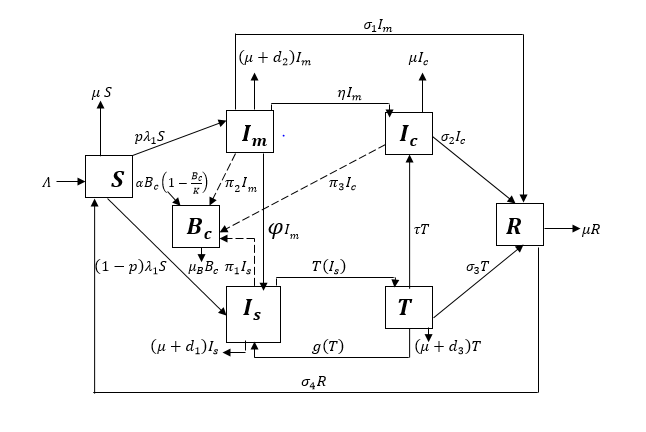
Typhoid fever is a highly communicable and infectious disease that can be fatal and causes severe complications if unattended to timely. The infection, at times, can be more complex, challenging, and impossible to treat as antibiotics become less effective. Hence, the effect of limited clinical efficacy of the antibiotics with corresponding relapse response to treatment on infected humans is considered in this paper by formulating a deterministic model for direct and indirect transmission mode of Typhoid infection. The basic reproduction number is analytically derived and used to implement the global sensitivity analysis. Following the sensitivity analysis result, the optimal control analysis is carried out and simulated numerically with four controls: sanitation and hygiene practice and awareness campaign control, sterilisation and disinfection control, the potency of antibiotics control and screening control. Finally, the cost-effectiveness analysis for infected and susceptible humans with four cases that compared fifteen strategies is analysed. The results indicate that the sanitation and hygiene practice and awareness campaign is good to implement for single control implementation, while for double control implementation, Strategy 6, which is the combination of Strategy 1 and the potency of antibiotics administered to typhoid patients, is the best to consider. Combining Strategy 6 and screening control is the most cost-effective for triple controls. Furthermore, the overall computation of cost-effectiveness among all the most cost-effective with all the controls combined suggests that sanitation and hygiene practice and awareness campaign is the most cost-effective strategy to implement for eradicating typhoid infection in the population and for preventing susceptible populations from contracting the bacteria.
Published
How to Cite
Issue
Section
Copyright (c) 2023 Chinwendu E. Madubueze, Kazeem A. Tijani, Reuben I. Gweryina

This work is licensed under a Creative Commons Attribution 4.0 International License.
How to Cite
Similar Articles
- S. E. Ogunfeyitimi, M. N. O Ikhile, P. O. Olatunji, High order boundary value linear multistep method for the numerical solution of IVPs in ODEs , Journal of the Nigerian Society of Physical Sciences: Volume 7, Issue 4, November 2025
- David Opeoluwa Oyewola, Emmanuel Gbenga Dada, Juliana Ngozi ndunagu, Terrang Abubakar Umar, Akinwunmi S.A, COVID-19 Risk Factors, Economic Factors, and Epidemiological Factors nexus on Economic Impact: Machine Learning and Structural Equation Modelling Approaches , Journal of the Nigerian Society of Physical Sciences: Volume 3, Issue 4, November 2021
- Atiek Iriany, Wigbertus Ngabu, Henny Pramoedyo, Amarifai, Geographically weighted regression random forest for modeling soil particles , Journal of the Nigerian Society of Physical Sciences: Volume 8, Issue 2, May 2026
- O. E. Ojo, M. K. Kareem, O. Samuel, C. O. Ugwunna, An Internet-of-Things based Real-time Monitoring System for Smart Classroom , Journal of the Nigerian Society of Physical Sciences: Volume 4, Issue 2, May 2022
- Retraction Notice: Fractional-order modeling of visceral leishmaniasis disease transmission dynamics: strategies in eastern Sudan , Journal of the Nigerian Society of Physical Sciences: Volume 8, Issue 2, May 2026
- Daniel B. Tsado, Muhammed M. Ndamitso, Yahaya A. Iyaka, John O. Jacob, Saheed Mustapha, Green synthesis of gold nanoparticles using Telfairia occidentalis leaf extract and evaluation of their antioxidant activity for possible industrial applications , Journal of the Nigerian Society of Physical Sciences: Volume 8, Issue 4, November 2026 (in progress)
- G. Ajileye, A. A. James, Collocation Method for the Numerical Solution of Multi-Order Fractional Differential Equations , Journal of the Nigerian Society of Physical Sciences: Volume 5, Issue 3, August 2023
- S. Ponsadai Lakshmi, C. Gopi, P. Adwin Jose, Mamdani-type fuzzy inference system for irrigational water quality , Journal of the Nigerian Society of Physical Sciences: Volume 6, Issue 2, May 2024
- Chuchu Liang, Majid Khan Majahar Ali, Lili Wu, A novel multi-class classification method for arrhythmias using Hankel dynamic mode decomposition and long short-term memory networks , Journal of the Nigerian Society of Physical Sciences: Volume 7, Issue 2, May 2025
- A. E. Ibor, D. O. Egete, A. O. Otiko, D. U. Ashishie, Detecting network intrusions in cyber-physical systems using deep autoencoder-based dimensionality reduction approach anddeep neural networks , Journal of the Nigerian Society of Physical Sciences: Volume 7, Issue 3, August 2025
You may also start an advanced similarity search for this article.
Most read articles by the same author(s)
- Kazeem A. Tijani, Chinwendu. E. Madubueze, Isaac O. Onwubuya, Nkiruka Maria-Assumpta Akabuike, John Olajide Akanni, Mathematical modelling of the dynamical system of military population, focusing on the impact of welfare , Journal of the Nigerian Society of Physical Sciences: Volume 7, Issue 4, November 2025
- Kazeem A. Tijani, Chinwendu E. Madubueze, Reuben I. Gweryina, Terhemen Aboiyar, Mathematical modelling and optimal-control strategies of schistosomiasis–typhoid fever co-infection: using the demographic setting of Makurdi, Benue State, Nigeria , Journal of the Nigerian Society of Physical Sciences: Volume 8, Issue 3, August 2026
- Agatha Abokwara, Chinwendu E. Madubueze, Reuben I. Gweryina, Terhemen Aboiyar, Strategic interventions in schistosomiasis control: leveraging mass drug administration, public engagement, and intermediate host control to disrupt transmission dynamics , Journal of the Nigerian Society of Physical Sciences: Volume 8, Issue 2, May 2026
- Chinwendu Emilian Madubueze, Kazeem A. Tijani, Elijah Iji Ajogi, Madumelu H. C. Madubueze, A mathematical model of cybercrime contagion: impact ofemployment on youth offending , Journal of the Nigerian Society of Physical Sciences: Volume 8, Issue 3, August 2026