Chemometric authentication of branded and crude spices using integrated GC–MS fingerprints and elemental profiling
Keywords:
Spice authentication, Integrated chemical fingerprinting, GC–MS profiling, Elemental analysis, ChemometricsAbstract
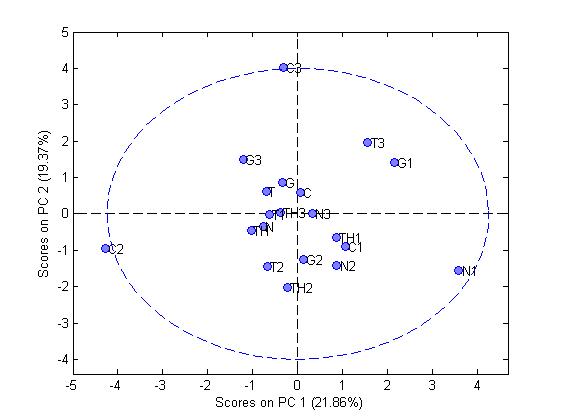
Counterfeit and substandard spice products present significant risks to food safety, nutritional quality, and consumer confidence. This study applied an integrated chemometric approach, GC--MS chemical profiling, and elemental analysis to authenticate and discriminate among crude, genuine-branded, and potentially adulterated spice products. Twenty spice samples from curry, ginger, turmeric, nutmeg, and thyme were analysed using gas chromatography--mass spectrometry (GC--MS) for volatile compounds, flame photometry for macroelements, and atomic absorption spectrometry (AAS) for microelements, respectively. Principal component analysis (PCA) and hierarchical cluster analysis (HCA) revealed clear separation between crude and branded spices. An optimized model framework using two principal components explained 70.55% of the total calibration variance (70.29% cross-validated variance). The hierarchical cluster analysis (HCA) dendrograms confirmed distinct clustering, highlighting close substitutability among certain spices based on their nutrient profiles. Elemental analysis indicated significant variation across samples: branded curry 3 and branded ginger 3 were rich in zinc and selenium, while branded nutmeg 1 exhibited exceptionally high iron content. Conversely, some branded products, such as branded curry powder, consistently showed low or absent levels of essential micronutrients. GC--MS profiling identified dominant fatty acids, including Octadec-9-enoic acid and Octadecanoic acid. These compositional differences underpin the discriminatory power of chemometric models, enabling reliable authentication of the crude and branded spices and the detection of potential adulteration. The study demonstrated that integrated chemical fingerprinting with multivariate analysis provides a robust framework for quality assurance and regulatory monitoring of commercial spice products.
Published
How to Cite
Issue
Section
Copyright (c) 2026 E. Udensi, R. B. Salau, S. O. Salihu, M. M. Ndamitso, M. T. Bisiriyu (Author)

This work is licensed under a Creative Commons Attribution 4.0 International License.
How to Cite
Similar Articles
- S. Adamu, O. O. Aduroja, A. S. Onanaye, M. R. Odekunle, Iterative method for the numerical solution of optimal control model for mosquito and insecticide , Journal of the Nigerian Society of Physical Sciences: Volume 6, Issue 2, May 2024
- George Muddu, Shefiu Olusegun Ganiyu, Adekunle Olugbenga Ejidokun, Yusuf Abass Aleshinloye, Integrated data-driven credit default prediction in Uganda using machine learning models , Journal of the Nigerian Society of Physical Sciences: Volume 8, Issue 1, February 2026
- C. B. Adindu, S. C. Nwanonenyi, C. B. C. Ikpa, Experimental and computational studies of the corrosion inhibitive effects of Zingiber officinale rhizomes on mild steel corrosion in acidic solutions , Journal of the Nigerian Society of Physical Sciences: Volume 5, Issue 3, August 2023
- Tertsea Igbawua, Aondongu Alexander Tyovenda, Terver Sombo, Idugba Mathias Echi, Spatio-temporal assessment of aerosol-induced atmospheric heating rates in Nigeria , Journal of the Nigerian Society of Physical Sciences: Volume 7, Issue 2, May 2025
- Samson Olaniyi, Furaha M. Chuma, Sulaimon F. Abimbade, Asymptotic stability analysis of a fractional epidemic model for Ebola virus disease in Caputo sense , Journal of the Nigerian Society of Physical Sciences: Volume 7, Issue 1, February 2025
- Muhammad Farman, Kottakkaran Sooppy Nisar, Modeling and stability analysis of a fractional-order tuberculosisvmodel with different exposed populations progressing to infection , Journal of the Nigerian Society of Physical Sciences: Volume 8, Issue 3, August 2026
- Mariya Helen, Prabhakar V, Computational investigation of free convection flow inside inclined square cavities , Journal of the Nigerian Society of Physical Sciences: Volume 4, Issue 2, May 2022
- Opeyemi O. Enoch, Adejimi A. Adeniji, Lukman O. Salaudeen, The Derivation of the Riemann Analytic Continuation Formula from the Euler’s Quadratic Equation , Journal of the Nigerian Society of Physical Sciences: Volume 5, Issue 1, February 2023
- Unyime Ufok Ibekwe, Uche M. Mbanaso, Nwojo Agwu Nnanna, Umar Adam Ibrahim, A machine learning sentiment classification of factors that shape trust in smart contracts , Journal of the Nigerian Society of Physical Sciences: Volume 7, Issue 1, February 2025
- Rhoda Bernard Gusikit, Solomon Nehemiah Yusuf, Hyeladi Usman Dibal, Victor Bulus Diyelmak, Ahmed Isah Haruna, Comparative analysis of lithium enrichment mechanisms in aquifers in the Benue Trough , Journal of the Nigerian Society of Physical Sciences: Volume 7, Issue 3, August 2025
You may also start an advanced similarity search for this article.