Geohydraulic characteristics and groundwater vulnerability assessment of tropically weathered and fractured gneissic aquifers using combined georesistivity and geostatistical methods
Keywords:
ERT, Schlumberger VES, geoelectrohydraulic method, regression analysis, groundwater vulnerability, gneissic aquiferAbstract
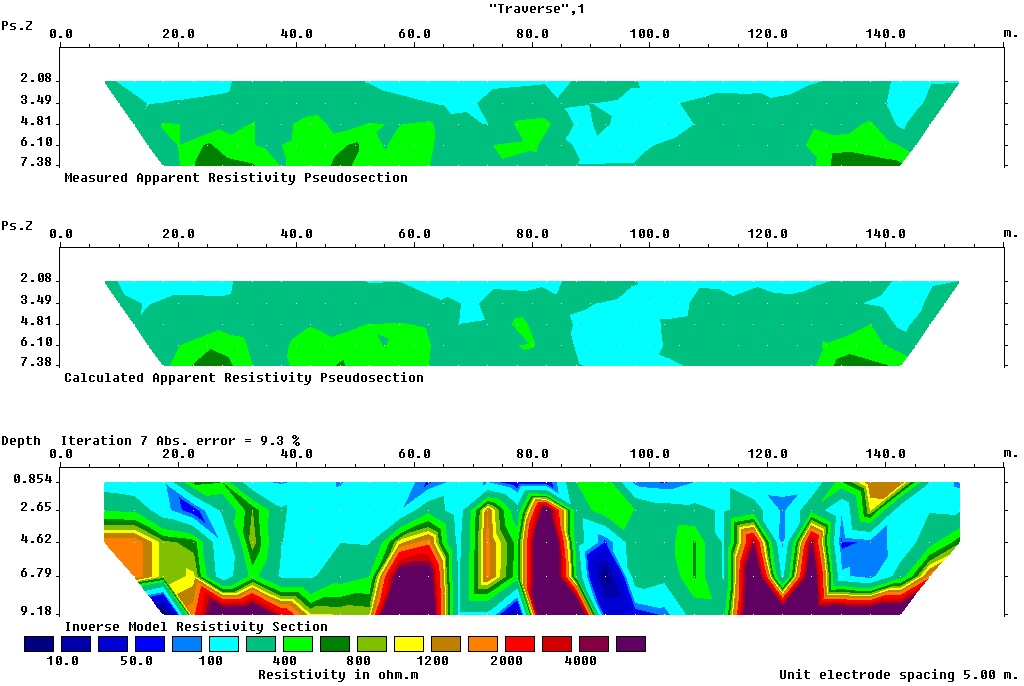
Sustainable groundwater yield in aquifers depends on the protective capacity of the subsurface lithologies and conduit systems. Electrical resistivity tomography (ERT) and its Schlumberger vertical electrical sounding (VES) technique were employed to assess the groundwater yield of aquifer units and their vulnerability to contaminants in Araromi (Akungba-Akoko), southwestern Nigeria. Geohydraulic parameters: aquifer resistivity (\rho0), hydraulic conductivity (K), transmissivity (T), permeability (\Psi), hydraulic resistance (KR), and longitudinal conductance (S) were also evaluated. In addition, regression analysis was utilized to establish the empirical relationships between the K and other geohydraulic parameters, with their percentage contributions to posing vulnerability risk. The georesistivity results revealed four distinct layers: topsoil, weathered layer, partially weathered/fractured bedrock unit, and fresh bedrock. The K model regression-assisted analysis showed that the \rho, T, \Psi, and S contributed about 97.8%, 14%, 99.9%, and 11.5%, respectively, to the estimated aquifers’ K values for the study area. Except for T and S, the regression results had moderate to strong positive correlations with K; hence, this illuminates the essentiality of K in assessing groundwater potential and vulnerability. The aquifer units have low to moderate groundwater yield based on T values (1.67-17.57 m/day) caused by the generally thin overburden (<4 m). However, the deep-weathered and fractured aquifer units with depths ranging from 39-55 m could supply high groundwater yield for sustainable abstraction. The estimated S values (0.0226-0.1926 mhos) for aquifer protective capacity ratings rated the aquifer units in the area as poor to weak. Based on the estimated low logarithm of KR (log KR) values of 0.79-2.25 years, these aquifers have extremely high to moderate aquifer vulnerability index. As a result, prospective wells/boreholes in the study area and settings with similar geohydraulic and vulnerability characteristics should be developed adequately to prevent the infiltration of surface contaminants for potable groundwater abstraction.
Published
How to Cite
Issue
Section
Copyright (c) 2022 A. S. Akingboye

This work is licensed under a Creative Commons Attribution 4.0 International License.
How to Cite
Similar Articles
- Chinwendu Emilian Madubueze, Kazeem A. Tijani, Elijah Iji Ajogi, Madumelu H. C. Madubueze, A mathematical model of cybercrime contagion: impact ofemployment on youth offending , Journal of the Nigerian Society of Physical Sciences: Volume 8, Issue 3, August 2026
- Rafiraza raza, Ahmad Termimi Ab Ghani, Lazim Abdullah, Extension of hesitant fuzzy weight geometric (HFWG)-VIKOR method under hesitant fuzzy information , Journal of the Nigerian Society of Physical Sciences: Volume 6, Issue 4, November 2024
- B. I. Akinnukawe, K. O. Muka, L-Stable Block Hybrid Numerical Algorithm for First-Order Ordinary Differential Equations , Journal of the Nigerian Society of Physical Sciences: Volume 2, Issue 3, August 2020
- Diva Marchandra Mulansari, Maulana Malik, Sindy Devila, Ibrahim Mohammed Sulaiman, Dian Lestari, Fevi Novkaniza, Fida Fathiyah Addini, A hybrid IFR-IDY conjugate gradient algorithm for unconstrained optimization and its application in portfolio selection , Journal of the Nigerian Society of Physical Sciences: Volume 8, Issue 1, February 2026
- E. C. Duru, M. C. Anyanwu , T. N. Nnamani , C. N. Nwosu, G. C. E. Mbah, Semi-analytical solution and numerical simulations of a coinfection model of Malaria and Zika virus disease , Journal of the Nigerian Society of Physical Sciences: Volume 7, Issue 2, May 2025
- L. O. Afolagboye, Z. O. Arije, A. O. Talabi, O. O. Owoyemi, Effect of Pre-Test Drying Temperature on the Properties of Lateritic Soils. , Journal of the Nigerian Society of Physical Sciences: Volume 5, Issue 1, February 2023
- A. O. Sangotola, S. B. Adeyemo, O. A. Nuga, A. E. Adeniji, A. J. Adigun, A tuberculosis model with three infected classes , Journal of the Nigerian Society of Physical Sciences: Volume 6, Issue 1, February 2024
- Gabriel James, Anietie Ekong, Etimbuk Abraham, Enobong Oduobuk, Peace Okafor, Analysis of support vector machine and random forest models for predicting the scalability of a broadband network , Journal of the Nigerian Society of Physical Sciences: Volume 6, Issue 3, August 2024
- Pragati, Rajneesh Kumar, Sachin Kaushal, Effect of a moving thermal load in a modified couple stress medium with double porosity and hyperbolic two-temperature theory , Journal of the Nigerian Society of Physical Sciences: Volume 8, Issue 1, February 2026
- David O. Adekunle, Esther O. Faboro, Labunmi Lajide, Identification and quantification of bioactive compounds indifferent extracts of morinda lucida benth (rubiaceae) root using GC–MS analysis , Journal of the Nigerian Society of Physical Sciences: Volume 5, Issue 4, November 2023
You may also start an advanced similarity search for this article.