A DFT study of optoelectronic, elastic and thermo-electric properties of the double perovskites Rb2SeX6 (X=Br,Cl)
Keywords:
Double perovskite, opto-electronic properties, Elastic propertiies, Seebeck coefficients, Figure of merit, DFTAbstract
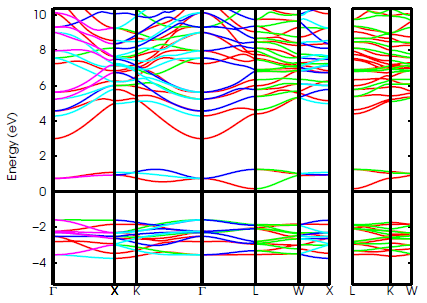
Thermo-electric (TE) material applications reduce reliance on traditional energy resources by converting heat to electric energy. We have studied, for the first time, the thermo-electric properties of Rb2SeX6 (X=Br,Cl). Using norm-conserving pseudo potentials in a plane wave basis set of Quantum Espresso code, the optoelectronic, elastic and thermo-electric properties of Rb2SeX6 (X=Br,Cl) have been investigated using density functional theory. Generalized Gradient Approximation of Perdew Burke Ernzerhof (GGA-PBE) and Generalized Gradient Approximation of Perdew Burke Ernzerhof adapted for Solid (GGA-PBESol) exchange correlation functionals were employed in all calculations. The band structure plots suggest that the studied double perovskites have indirect band gaps. Rb2SeBr6 band gap values of 1.7574/ 1.569 eV (using GGA-PBE/PBEsol) are remarkably similar to that of two effective inorganic/organic perovskites FAPbI3 and MAPbI3 . Maximum peaks generated from refractive index results indicate possible solar cell uses of the materials because they are in the visible and ultraviolet ranges. The results of other optical properties such as absorption coefficients, electron energy loss, conductivity, and reflectivity concludes that Rb2SeX6 (X=Br,Cl) have good values for electron generation, high potential for applications in the optoelectronic industry and are semiconductor in nature. The calculated shear anisotropy values of Rb2SeBr6/Cl6 are 3.09/1.71, suggesting that they are isotropic materials. With calculated Poisson’s ratio of 0.32 and 0.26, the materials are predicted to be ductile in nature. The two materials are appropriate for thermo-electric applications since their thermal to electrical conductivity ratio are small (the order of 10-5). The calculated minimum values of Seebeck coefficient values of 0.198×10³ / 0.166 ×10³ (mV/K) at 750 K, for Rb2SeBr6/Cl6 are positive, indicating that they have p-type conduction. Figure of merit values at all temperature range considered are greater than one (ZT > 1) for both Rb2SeBr6 and Rb2SeCl6, suggesting that they are good thermo-electric materials. The results of the calculations provide the basis for the industrial application of Rb2SeBr6/Cl6 as solar cells.
References
A. B. Siad, M. Biara, & M. B. Siad, “Structural mechanical optoelectronic and thermoelectric properties of double perovskite compounds Cs2TeX6 (X Br,I) for energy storage applications: First principles investigation”, Journal of Physics and chemistry of solids 152 (2021) 109955.
Q. Mahmood, M. H. Alhossainy, M. S. Rashid, T. H. Flemban, H. Althib, T. Alshahrani, M. Rashid, & A. Laref, “First-principles study of lead-free double perovskites Rb 2 TeX 6 (X Cl,Br,I) for solar cells and renewable energy”, Materials Science and Engineering B 266 (2021) 115064.
W. J. Yin, B. Weng, J. Ge, Q. Sun, Z. Li, & Y. A. Yan, “Oxide perovskites, double perovskites, and derivatives for electrocatalysis, photocatalysis, and photovoltaics”, Energy Environ. Sci. 12 (2019) 442.
K. C. Bhamu, A. Soni,& J. Sahariya, “Revealing optoelectronic and transport properties of potential perovskites Cs 2 PdX 6 (X Cl,Br): A probe from density functional theory (DFT)”. Solar Energy 162 (2018) 336.
A. A. P. Mansur, H. S. Mansur, C. Tabare, A. Paiva, N. S. V. Capanema,“Eco-friendly AgInS 2 /ZnS quantum dot nanohybrids with tunable luminescent properties modulated by pH-sensitive biopolymer for potential solar energy harvesting applications”, Journal of Materials Science: Materials in Electronics 30 (2019) 16702, 10.1007/s10854-019-00719-0.
A. Yerudkar, M. Nair, H. D. Vishwanath, V. P. Sudhir, D. D. Vineeta, B. J. Jyeshtharaj, “Development of inexpensive, simple and environment-friendly solar selective absorber using copper nanoparticle”, International Journal of Chemical Reactor Engineering 19 (2021) 727, doi:10.1515/ijcre-2020-0154.
A. A. Sholagberu, W. A. Yahya, & A. A. Adewale,“Pressure effects on the opto-electronic and mechanical properties of the double perovskite Cs 2 AgInCl 6 ”, Phys. Scr. 97 (2022) (085824).
A. A. Adewale, A. Chik, O. k. Yusuff, S. A. Ayinde, & Y. K. Sanusi, “First principle calculation of structural, electronic and optical properties of cds and doped Cd x–1 A x S(A Co,Fe,Ni) compounds”, Materials Today Communications 26 (2021) 101882.
X. Diao, Y. Diao, Y. Tang, G. Zhao, Q. X. Gu, Y. Shi,P. Zhu, & l. Zhang, “High-throughput screening of stable and efficient double inorganic halide perovskite materials by DFT”, Scientific Reports 12 (2022) 12633.
F. I. H. Alias, M. H. Ridzwan, M. K. Yaakob, C. W. Loy, & Z. Mohamed, “Structural, electronic and optical studies of SrNiTeO double perovskite by first-principle DFT - LDA + U calculation”, Journal of Materials Research and Technology 18 (2022) 1623.
R. Chaurasiya, S. Auluck, & A. Dixit, “Cation modified a (ba, sr and ca) znwo cubic double perovskites: A theoretical study”, Computational Condensed Matter 14 (2018) 27.
M. K. Kim, J. Y. Moon, S. H. Oh, D. G. Oh, Y. J. Choi, & N. Lee, “Strong magnetoelectric coupling in mixed ferrimagnetic-multiferroic phases of a double perovskite”, Sci. Rep. 9 (2019) 1.
L. Schade, S. Mahesh, G. Volonakis, M. Zacharias, B. Wenger, F. Schmidt, S. V. Kesava, D. Prabhakaran, M. Abdi-Jalebi, M. Lenz, F. Giustino, G. Longo, P. G. Radaelli, & H. J. Snaith, “Crystallographic, optical, and electronic properties of the Cs 2 AgBi 1 xInxBr 6 double perovskite: Understanding the fundamental photovoltaic efficiency challenges”, ACS Energy Lett. 6 (2021) 1073.
Z. Xia, Y. Liu, & L. Manna, “Lead-free double perovskite Cs 2 AgInCl 6 ”, Ange wandte Chemie, WILEY-VCH, (2020).
I. Deretzis, A. Alberti, G. Pellegrino, E. Smecca, F. Giannazzo, N. Sakai, T. Miyasaka, & A. La Magna, “Atomistic origins of CH 3 NH 3 PbI 3 degradation to PbI 2 in vacuum”, J. Appl. Phys. Lett. 106 (2015) 131904.
L. Bertoluzzi, “Light induced structural changes in CH 3 NH 3 PbI 3 perovskite solar cells”, J. Phys.: Conf. Series 609 (2015) 012001.
G. Sadoughi, D. E. Starr, E. Handick, S. D. Stranks, M. Gorgoi, R. G. Wilks, M. Baer, & H. Snaith, “Observation and mediation of the presence of metallic lead in organic-inorganic perovskite films”, J. ACS Appl. Mater. Interfaces 7 (2015) 13440.
W. Li, S. Zhu, Y. Zha0, & Q. Y. Yongqing, “Structural, electrical, optical properties and stability of Cs2InBr5yXy · H2O(X Cl,I,y 0. 1. 2. 3. 4. 5) perovskites: the first principles investigation. Thin Solid Films 733 (2021) 138805.
P. Giannozzi, S. Baroni, N. Bonini, M. Calandra, R. CaR, C. Cavazzoni, D. Ceresoli, G. L. Chiarotti, M. Cococcioni, I. Dabo, A. Dal-Corso, S. de Gironcoli, S. Fabris, G. Fratesi, R. Gebauer, U. Gerstmann, C. Gougoussis, A. Kokalj, M. Lazzeri, L. Martin-Samos, N. Marzari, F. Mauri, R. Mazzarello, S. Paolini, A.
Pasquarello, L. Paulatto, C. Sbraccia, S. Scandolo, G. Sclauzero, A. P. Seitsonen, A. Smogunov, P. Umari, & W. R. M, “Quantum espresso: a modular and open-source software project for quantum simulations of materials”, J. Phys.: Condens. Matter, 21 (2009) 395502.
P. Giannozzi, O. Andreussi, T. Brumme, O. Bunau, M. Buongiorno, Nardelli, M. Calandra, R. Car, C. Cavazzoni, D. Ceresoli, M. N. C. Cococcioni, I. Carnimeo, A. Dal-Corso, S. de Gironcoli, P. Delugas, J. R. A. DiStasio, A. Ferretti, A. Floris, G. Fratesi, G. Fugallo, R. Gebauer, U Gerstmann, F. Giustino, T.
Gorni, J. Jia, M. Kawamura, H. Y. Ko, F. A. Kokalj, E. Küçükbenli, M. Lazzeri, M. Marsili, N. Marzari, F. Mauri, N. L. Nguyen, H. V. Nguyen, A. Otero-de-la Roza, L. Paulatto, S. Ponce, D. Rocca, R. Sabatini, B. Santra, M. Schlip, A. P. Seitsonen, A. Smogunov, I. Timrov, T. Thonhauser, P. Umari, N. Vast, X. Wu,
& S. Baroni, “Advanced capabilities for materials modelling with quantum espresso”, J. Phys.: Condens. Matter 29 (2017) 465901.
J. P. Perdew, K. Burke, & M. Ernzerhof, “Generalized gradient approximation made simple”, Phys. Rev. Lett. 77 (1996) 3865.
J. D. Pack, & H. J. Monkhorst, “Special points for brillouin-zone integrations”-a reply”, Phys. Rev. B Condens. Matter Mater. Phys. 16 (1977) 1748.
C. G. Broyden, “The convergence of a class of double-rank minimization algorithms 1. general considerations”, IMA J. Appl. Math. (Institute Math. Its Appl.) 6 (1970) 76.
C. G. Broyden, “The convergence of a class of double-rank minimization algorithms: 2. the new algorithm”, IMA J. Appl. Math. (Institute Math. Its Appl.) 6 (1970) 222.
M. Tariq, M. A. Ali, A. Laref, A. & G. Murtaza, “Anion replacement effect on the physical properties of metal halide double perovskites Cs 2 AgInX 6 (X F,Cl,Br,I)”, Solid State Communications, 314-315 (2020) 113929.
Q. Bao, O. Sandberg, D. Dagnelund, S. Sanden, S. Braun, H. Aarnio, X. W. Liu, & M. F. “Trap-assisted recombination via integer charge transfer states in organic bulk heterojunction photovoltaics”, Advanced Functional Materials 24 (2014) 6309.
V. D. Mihailetchi, P. W. M. Blom, J. C. Hummelen, & M. T. Rispens,“Cathode dependence of the open-circuit voltage of polymer:fullerene bulk heterojunction solar cells”, Journal of applied physics 94 (2003) 10.
W. Shockley, & H. J. Queisser, “Detailed balance limit of efficiency of pn-junction solar cells”, J. Appl. Phys. 32 (1961) 510.
S. Shah, Z. Ali, S. Mehmood, I. Khan, & I. Ahmad, “Electronic structure, optical and magnetic properties of double perovskites La 2 MTiO 6 (M Co,Ni,CuandZn)”, Materials Chemistry and Physics 272 (2021) 125050.
J. Guillemoles, T. Kirchartz, D. Cahen, & U. Rau, “Guide for the perplexed to the Shockley-Queisser model for solar cells”, Nature Photonics 13 (2019) 501, https://doi.org/10.1038/s41566-019-0479-2.
P. D. Mayengbam, R. S. Manas, K. Aparna, D. Prahlad, D. Madhumita, & P. Narenda, “Infleunec of microwave cooking on approximate, mineral and radical scavening activitiesof tree bean seeds pods”, International Jpurnal of current microbiology and applied sciences 7 (2018) 3909.
M. Huma, M. Rashid, Q. Mahmood, E. Algrafy, N. A. Kattan, A. Laref, & A. S. Bhatti,“Physical properties of lead-free double perovskites A 2 SnI 6 (A Cs,Rb) using ab-initio calculations for solar cell applications”, Materials Science in Semiconductor Processing 121 (2020) 1369.
S. Zhao, C. Lan, J. Ma, S. S. Pandey, S. Hayase, & T. Ma, “First principles study on the electronic and optical properties of B-site-ordered double perovskite Sr 2 MMoO 6 (M = Mg, Ca and Zn)”, Solid State Communications 213-214 (2015) 19.
A. Abdulganiyu,“Elastic and optoelectronic study of the double perovskites Cs 2 PdX 6 (X Br,Cl)”, Master’s thesis, Kwara State University, Malete, Nigeria, (2020).
P. Blaha, K. Schwarz, G. K. H. Madsen, D. Kvasnicka, J. Luitz, R. Laskowski, F. Tran, & L. D. Marks, “An augmented plane wave plus local orbitals program for calculating crystal properties: Wien2k,”, J. Phys. 474 23474 (2019).
B. Y. Yang, J. M. Zhang, A. Ali, Y. H. Huang, & X. Wei, “Computational investigation of structural, magnetic, electronic and optical properties of the cluster MnX6 (X P,S,Cl,BrorTe) doped monolayer WSe2 ”, Thin Solid Films 732 (2021) 138793.
P. A. Cox, ”The electronic structure and chemistry of solids”, A Clarendon Press Publication, Wolfgang Tremel (1988).
N. Zarabinia, & R. Rasuli, “Electronic and optical properties of halide double perovskites under strain: a density functional study Energy Sources Part A: Recovery Utilization and Environmental Effects”, Energy Sources, Part A: Recovery, Utilization, and Environmental Effects 43 (2020) 2443, https://doi.org/10.1080/15567036.2020.1867672.
M. H. Alia, J. M. Islam, A. Kumer, S. Hossain, U. Chakmaa, D. Howlader, T. Islam, & T. Hossain,“Investigation of structural, electronic and optical properties of Na 2 InAgCl 6 , K 2 InAgCl 6 , and Rb 2 InAgCl 6 , lead-free halide double perovskites regarding with Cs 2 InAgCl 6 , perovskites cell and a comparative study by dft functionals”, Materials Research 24 (2021) e20210086.
A. A. Adewale, A. Chik, T. Adam, T. M. Joshua, & M. O. Durowoju, “Optoelectronic behavior of ZnS compound and its alloy: A first principle approach”, Materials Today Communications. 27 (2021) 102077. [41] H. Umm, G. Murtaza, & H. R. Hafiz, “Optoelectronic and thermal properties of cubic SiMO 3 (M Sn,Pb) oxides for device application: a first principle study”, Optical and Quantum Electronics 52 (2020) 466.
M. A. Lahiji, & A. A. Ziabari, “First-principle calculation of the elastic, band structure, electronic states, and optical properties of Cu-doped ZnS nanolayers”, Physica B Condens. Matter 501 (2016) 146.
A. A. Audu, W. A. Yahya, & A. A. Abdulkareem, “ab-initio studies of the sructural, electronic and mechanical properties of Zn 1?x Cr x Te”, Physics memoir, Journal of theoretical and applied physics 3 (2021) 38.
T. M. J. Abdulkadhim, S. A. A. Alsaati, M. H. Shinen,“Theoretical Investigation of Diameter Effects and Edge Configuration on the Optical Properties of Graphdiyne Nanotubes in the Presence of Electric Field”, J. Nig. Soc. Phys. Sci. 5 (2023) 1083.
S. C. Onuegbu, S. S. Oluyamo, O. I. Olusola, “Influence of Bath pH values on the Structural and Optical Properties of Electrodeposited MgO Thin Films for Optoelectronic applications”, J. Nig. Soc. Phys. Sci. 5 (2023) 931.
A. A. Adewale, A. Chik, T. Adam, O. K. Yusuff, S. A. Ayinde, & Y. K. Sanusi, “First principles calculations of structural, electronic, mechanical and thermoelectric properties of cubic ATiO 3 (A= Be, Mg, Ca, Sr and Ba) perovskite oxide”, Computational Condensed Matter 28 (2021) e00562.
S. A. Dar, V. Srivastava, U. Kumar, U. K. Sakalle, A. Vanshree, A., & V. Parey, “Electronic structure, magnetic, mechanical and thermo-physical behavior of double perovskite Ba 2 MgOsO 6 ”, Eur. Phys. J. Plus 133 (2018) 64.
M. Born, K. Huang, & M. Lax, “Electronic structure, magnetic”, Am. J. Phys 23 (1955) 474.
M. K. Butt, M. Yaseen, I. A. Bhatti, J. B. M. Iqbal, A. Murtaza, M. Iqbal, M. M. AL-Anazy, M. H. Alhossainy, & A. L. “A DFT study of structural, magnetic, elastic and optoelectronic properties of lanthanide based XAlO 3 (X Nd,Gd) compounds”, Journal of Materials Research and Technology. 9 (2020) 16488.
A. Reuss, “Berechnung der fliessgrenze von mischkristallen auf grund der plastizitätsbedingung für einkristalle”, ZAMM-Journal of Applied Mathematics and Mechanics/Zeitschrift fur Angewandte Mathematik und Mechanik, 9 (1929) 49.
R. Hill, “The elastic behaviour of a crystalline aggregate”, Proceedings of the Physical Society. 65 (1952) 349.
D. H. Chung, & W. R. Buessem,“The voigt-reuss-hill (VRH) approximation and the elastic moduli of polycrystalline ZnO, TiO 2 (rutile), and ? Al 2 O 3 ”, Journal of Applied Physics 39 (1968) 2777, https://doi.org/10.1063/1.1656672.
T. Jinzhong, Z. Yuhong, H. Hua, & W. Bing, “The effect of alloying elements on the structural stability, mechanical properties, and debye temperature of Al 3 Li: A first-principles study”, Materials 11 (2018) 1471.
W. Qing, J. Peng, & X. Wang, X. “First principles investigation of pressure dependent stability, phonon, debye temperature, physical, mechanical and thermodynamic properties of Rh 3 Al intermetallic compound”, Molecular Simulation 44 (2018) 1554.
R. Singh, & G. Balasubramanian, “Impeding phonon transport through super lattices of organic-inorganic halide perovskites”, RSC Adv. 7 (2017) 37015.
M. Marathe, A. Grünebohm, T. Nishimatsu, P. Entel, & C. Ederer, “First-principles-based calculation of the electrocaloric effect in BaTiO 3 : A comparison of direct and indirect methods”, Phys. Rev. B. 93 (2016) 054110.
A. H. Reshak,“Bismuth-containing semiconductors GaAs 1 xBix for energy conversion: Thermoelectric properties”, Materials Science in Semiconductor Processing 148 (2022) 106850.
R. Ullah, A. H. Reshak, & M. A. Ali, “Pressure-dependent elastomechanical stability and thermoelectric properties of MYbF 3 (M Rb,Cs) materials for renewable energy”, Int J Energy Res. 45 (2021) 8711.
N. A. Noor, Q. Mahmood, M. Rashid, B. Ul-Haq, A. Laref, & S. A. Ahmad, “ab-initio study of thermodynamic stability, thermoelectric and optical properties of perovskites ATiO 3 (A Pb,Sn)”, J. Solid State Chem. 263 (2018) 115
L. D. Zhao, S. H. Lo, Y. Zhang, H. Sun, G. Tan, C. Uher, C. Wolverton, V. P. Dravid, & M. G. Kanatzidis, ”Ultralow thermal conductivity and high thermoelectric figure of merit in SnSe crystals”, Science Nature 508 (2014) 373.
J. P. Heremans, V. Jovovic, E. S. Toberer, A. Saramat, K. Kurosaki, A. Charoenphakdee, S. Yamanaka, & G. J. Snyder, “Enhancement of thermoelectric efficiency in PbTe by distortion of the electronic density of states”, Journal of Science 80 (2008) 554.
I. H. Kim, “Mg 2 Biv: Narrow bandgap thermoelectric semiconductors”, J. Korean Phys. Soc. 72 (2018) 1095.
G. K. Madsen, J. Carrete, & M. J. Verstraete,“BoltzTraP2: A program for interpolating band structures and calculating semi-classical transport coefficients”, Comput. Phys. Commun. 231 (2018) 140.
M. Hassan, I. Arshad, Q. M. “Computational study of electronic, optical and thermoelectric properties of X3PbO(X Ca,Sr,Ba) anti-perovskites”, Semicond Sci Technol. 32 (2017) 115002.
T. Ghrib, A. Rached, I. A. Al-nauim, A. Albalawi, H. Ashiq, B. Ul-Haq, & Mahmood, Q. “A new lead free double perovskites K 2 Ti(Cl/Br) 6 : a promising materials for optoelectronic and transport properties; probed by DFT”, Materials Chemistry and Physics. 264 (2021) 264.
Q. Mahmood, M. Hassan, T. H. Flemban, B. Ul-Haq, S. AlFaify, N. A. Kattan, A. Laref, “Optoelectronic and thermoelectric properties of double perovskite Rb 2 PtX 6 (X Cl,Br) for energy harvesting: first-principles investigations”, J. Phys. Chem. solids. 148 (2021) 109665.
A. H. Reshak,“Thermoelectric properties for aa - and ab -stacking of a carbon nitride polymorph (C3N4 )”, RSC Adv. 4 (2014) 63137.
V. Kumar, M. Kumar, & M. Singh, “Investigation of electronic, mechanical and thermoelectric properties of quaternary heusler compounds ZrRhTiZ(Z In,Al)”, Materials Today: Proceedings 62 (2022) 3811.
M. Saeed, I. Ul-Haq, A. S. Saleemi, S. Ur-Rehman, B. Ul-Haq, A. R. Chaudhry, I. Khan, “First-principles prediction of the ground-state crystal structure of double-perovskite halides Cs 2 AgCrX 6 (X Cl,Br,andI)”, Journal of Physics and Chemistry of Solids 160 (2022) 110302, https://doi.org/10.1016/j.jpcs.2021.110302.
O. Benguerine, Z. Nabi, A. Hachilif, B. Bouabdallah, B. Benichou, “Bright future in optoelectronics, photo-voltaics and thermoelectric using the double perovskites oxides BaSrMgB’O 6 (B’ Te,W)”, Computational Condensed Matter 30 (2022) e00649, https://doi.org/10.1016/j.cocom.2022.e00649.
G. Woolman, Computational investigations of thermoelectric properties of lead telluride, magnesium silicide, and magnesium stannide under high pressure and anisotropic stress, PhD thesis, The University of Edinburgh, (2021).
O. Rabin, L. Yu-Ming, D. M. S, “Anomalously high thermoelectric figure of merit in Bi 1?x Sb x nanowires by carrier pocket alignment”, Appl. Phys. Lett. 79 (2001) 81.
T. Takeuchi,“Conditions of electronic structure to obtain large dimensionless figure of merit for developing practical thermoelectric materials”, Materials Transactions 50 (2009) 2359.
Published
How to Cite
Issue
Section
Copyright (c) 2023 W. A. Yahya, A. A. Yahaya, A. A. Adewale, A. A. Sholagberu, N. K. Olasunkanmi

This work is licensed under a Creative Commons Attribution 4.0 International License.