Enhanced methods for multicollinearity mitigation in stochastic frontier analysis estimation
Keywords:
Stochastic Frontier Analysis, Multicollinearity, Assumption Violations, Correction MethodologiesAbstract
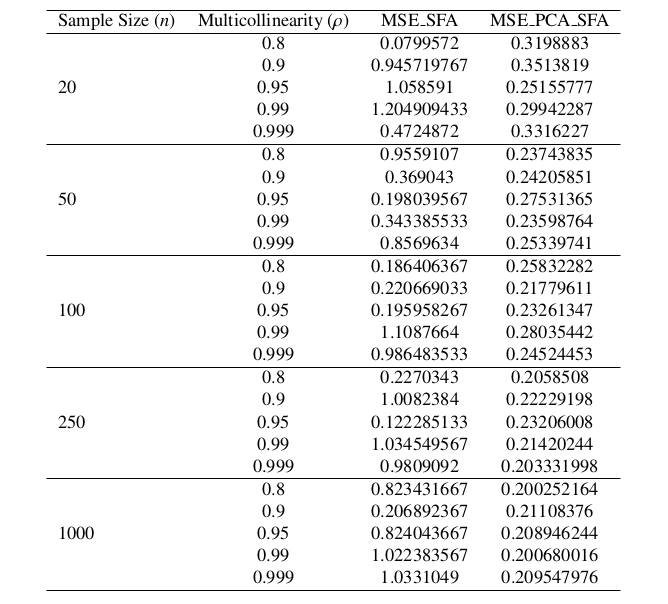
Efficiency estimation in production technology has been a concern in economics, with methodologies such as Stochastic Frontier Analysis (SFA) playing a key role in this area. SFA has been pivotal in evaluating the efficiency of entities by isolating technical inefficiency from random production errors. However, despite its significance, the application of SFA faces challenges when the multicollinearity assumption underlying the model is violated. Therefore, this study presents a novel estimator, termed “Principal Component Analysis Estimation for Stochastic Frontier Analysis” (PCA-SFA), to address the problem of multicollinearity in the classical SFA model. The PCA-SFA estimator integrates Principal Component Analysis (PCA) to correct assumption violation arising from multicollinearity. Monte Carlo simulation study was conducted to ascertain the PCA-SFA performance, involving no fewer than 2,000 replications based on the Cobb-Douglas production function with varying levels of multicollinearity, represented by correlation coefficients ranging from 0.8, 0.9, 0.95, 0.99, and 0.999, and sample sizes (n) of 20, 50, 100, 250, and 1,000. The proposed estimator’s performance was compared to the classical SFA model using the Mean Square Error (MSE), Akaike Information Criterion (AIC), and Bayesian Information Criterion (BIC) as evaluation metrics. The results demonstrate that the PCA-SFA estimator consistently outperforms the classical SFA model. The PCA-SFA model showed significantly lower MSE, AIC, and BIC values, indicating improved precision and reliability in parameter estimation. The study, therefore, recommends that researchers and practitioners in econometrics and related fields consider integrating PCA-SFA into their production efficiency analytical frameworks, particularly when dealing with datasets prone to multicollinearity issues.
References
D. Aigner, C. A. K. Lovell & P. Schmidt, “Formulation and estimation of stochastic frontier production function models”, J. Econom. 6 (1977) 21. https://doi.org/10.1016/0304-4076(77)90052-5.
W. Meeusen & J. van Den Broeck, “Efficiency estimation from Cobb-Douglas production functions with composed error”, Int. Econ. Rev. 18 (1977) 435. https://doi.org/10.2307/2525757.
H.-J. Wang, “Heteroscedasticity and non-monotonic efficiency effects of a stochastic frontier model”, J. Product. Anal. 18 (2002) 241. https://ink.springer.com/article/10.1023/A:1020638827640.
K. Hadri, C. Guermat & J. Whittaker, “Estimating farm efficiency in the presence of double heteroscedasticity using panel data”, J. Appl. Econ. 6 (2003) 255. https://doi.org/10.1080/15140326.2003.12040594.
K. Hadri, C. Guermat & J. Whittaker, “Estimation of technical inefficiency effects using panel data and doubly heteroscedastic stochastic production frontiers”, Empir. Econ. 28 (2003) 203. https://link.springer.com/article/10.1007/s001810100127.
K. Hadri, “Estimation of a doubly heteroscedastic stochastic frontier cost function”, J. Bus. Econ. Stat. 17 (1999) 359. https://doi.org/10.1080/07350015.1999.10524824.
D. K. Christopoulos, S. E. G. Lolos & E. G. Tsionas, “Efficiency of the Greek banking system in view of the EMU: a heteroscedastic stochastic frontier approach”, J. Policy Model. 24 (2002) 813. https://doi.org/10.1016/S0161-8938(02)00174-6.
S. C. Kumbhakar, M. Denny & M. Fuss, “Estimation and decomposition of productivity change when production is not efficient: A paneldata approach”, Econom. Rev. 19 (2000) 312. https://doi.org/10.1080/07474930008800481.
M. U. Karakaplan & L. Kutlu, “Handling endogeneity in stochastic frontier analysis”, Economics Bulletin, AccessEcon 37 (2017) 889. https://ideas.repec.org/a/ebl/ecbull/eb-16-00551.html.
O. G. Obadina, A. F. Adedotuun & O. A. Odusanya, “Ridge estimation’s effectiveness for multiple linear regression with multicollinearity: An investigation using Monte-Carlo simulations”, Journal of the Nigerian Society of Physical Sciences 3 (2021) 278. https://doi.org/10.46481/jnsps.2021.304.
G. A. Shewa & F. I. Ugwuowo, “Combating the multicollinearity in Bell regression model: Simulation and application”, Journal of the Nigerian Society of Physical Sciences 4 (2022) 713. https://doi.org/10.46481/jnsps.2022.713.
S. L. Jegede, A. F. Lukman, K. Ayinde & K. A. Odeniyi, “Jackknife Kibria-Lukman M-Estimator: Simulation and application”, Journal of the Nigerian Society of Physical Sciences 3 (2022) 251. https://doi.org/10.46481/jnsps.2022.664.
R. I. Rauf, A. H. Bello, B. O. Kikelomo, K. Ayinde & O. O. Alabi, “Heteroscedasticity correction measures in stochastic frontier analysis”, The Annals of the University of Oradea. Economic Sciences ? TOM XXXIII 1 (2024) 155. https://anale.steconomiceuoradea.ro/en/wp-content/uploads/2024/08/AUOES.July_.2024.pdf.
T. J. Coelli, D. S. P. Rao, C. J. O’Donnell & G. E. Battese, An introduction to efficiency and productivity analysis, Springer Science & Business Media, New York, 2005. https://doi.org/10.1007/b136381.
G. E. Battese & T. J. Coelli, “Prediction of firm-level technical efficiencies with a generalized frontier production function and panel data”, J. Econom. 38 (1988) 387. https://doi.org/10.1016/0304-4076(88)90053-X.
W. H. Greene, “A gamma-distributed stochastic frontier model”, J. Econom. 46 (1990) 141. https://doi.org/10.1016/0304-4076(90)90052-U
S. B. Caudill, J. M. Ford & D. M. Gropper, “Frontier estimation and firm-specific inefficiency measures in the presence of heteroscedasticity”, J. Bus. Econ. Stat. 13 (1995) 105. https://doi.org/10.1080/07350015.1995.10524583.
D. J. Aigner & G. G. Cain, “Statistical theories of discrimination in labor markets”, Ilr Rev. 30 (1977) 175. https://doi.org/10.1177/001979397703000204.
R. Stevenson, “Measuring technological bias”, Am. Econ. Rev. 70 (1980) 162. http://www.jstor.org/stable/1814745.
A. K. Bera & S. C. Sharma, “Estimating production uncertainty in stochastic frontier production function models”, J. Product. Anal. 12 (1999) 187. https://doi.org/10.1023/A:1007828521773.
K. L. Coxe, “Principal components regression analysis”, in Encycl. Stat. Sci., S. Kotz, C. B. Read, N. Balakrishnan, B. Vidakovic and N. L. Johnson (Ed.), Wiley, 2006. https://doi.org/10.1002/0471667196.ess2056.pub2.
J. N. Darroch, “An optimal property of principal components”, Ann. Math. Stat. 36 (1965) 1579. https://www.jstor.org/stable/2238448.
S. Daultrey, Principal components analysis, Geo Abstracts Ltd., Norwich, 1976. https://www.google.com/url?sa=t&source=web&rct=j&opi=89978449&url=https://quantile.info/wp-content/uploads/2014/09/8-principle-components-analysis.pdf.
G. H. Dunteman, “Principal components analysis”, in Quantitative Applications in the Social Sciences, Sage, 1989. https://us.sagepub.com/en-us/nam/book/principal-components-analysis.
J. D. Jobson, “Principal components, factors and correspondence analysis”, in Appl. Multivar. Data Anal, Springer Texts in Statistics, Springer, New York, NY, 1992, pp. 345. https://doi.org/10.1007/978-1-4612-0921-8_4.
B. Flury, Common principal components & related multivariate models, John Wiley & Sons, Inc., 1988. https://doi.org/10.1007/s00180-020-01041-8.
I. T. Jolliffe, “Principal component analysis”, Technometrics 45 (2003) 276. https://www.tandfonline.com/doi/abs/10.1198/tech.2003.s783.
R. A. Johnson & D. W. Wichern, “Applied multivariate statistical analysis”, Biometrics 54 (1998) 1203. https://doi.org/10.2307/2533879.
W. Meredith & R. E. Millsap, “On component analyses”, Psychometrika 50 (1985) 495. https://doi.org/10.1007/BF02296266.
C. R. Rao, “The use and interpretation of principal component analysis in applied research”, Sankhya Indian J. Stat. Ser. A 26 (1964) 329. https://www.jstor.org/stable/25049339.
D. G. Gibbons, “A simulation study of some ridge estimators”, J. Am. Stat. Assoc. 76 (1981) 131. https://doi.org/10.1080/01621459.1981.10477619.
D. W. Wichern & G. A. Churchill, “A comparison of ridge estimators”, Technometrics 20 (1978) 301. https://doi.org/10.1080/00401706.1978.10489675.
G. C. McDonald & D. I. Galarneau, “A Monte Carlo evaluation of some ridge-type estimators", J. Am. Stat. Assoc. 70 (1975) 407. https://doi.org/10.1080/01621459.1975.10479882.
B. M. G. Kibria, “Performance of some new ridge regression estimators”, Commun. Stat. Comput. 32 (2003) 419. https://doi.org/10.1081/SAC-120017499.
A. F. Lukman & K. Ayinde, “Review and classications of the ridge parameter estimation techniques”, Hacettepe J. Math. Stat. 46 (2017) 953. https://dergipark.org.tr/en/pub/hujms/issue/38493/446611.
T. S. Fayose & K. Ayinde, “Different forms biasing parameter for generalized ridge regression estimator”, Int. J. Comput. Appl. 181 (2019) 2. https://doi.org/10.214/ssrn.2607276.
Published
How to Cite
Issue
Section
Copyright (c) 2024 Rauf I. Rauf, Ayinde Kayode, Bello A. Hamidu, Bodunwa O. Kikelomo, Alabi O. Olusegun

This work is licensed under a Creative Commons Attribution 4.0 International License.