Forecasting of the epidemiological situation: Case of COVID-19 in Morocco
Keywords:
ARIMA, COVID-19, Pandemic, FBProphet, Time series forecastingAbstract
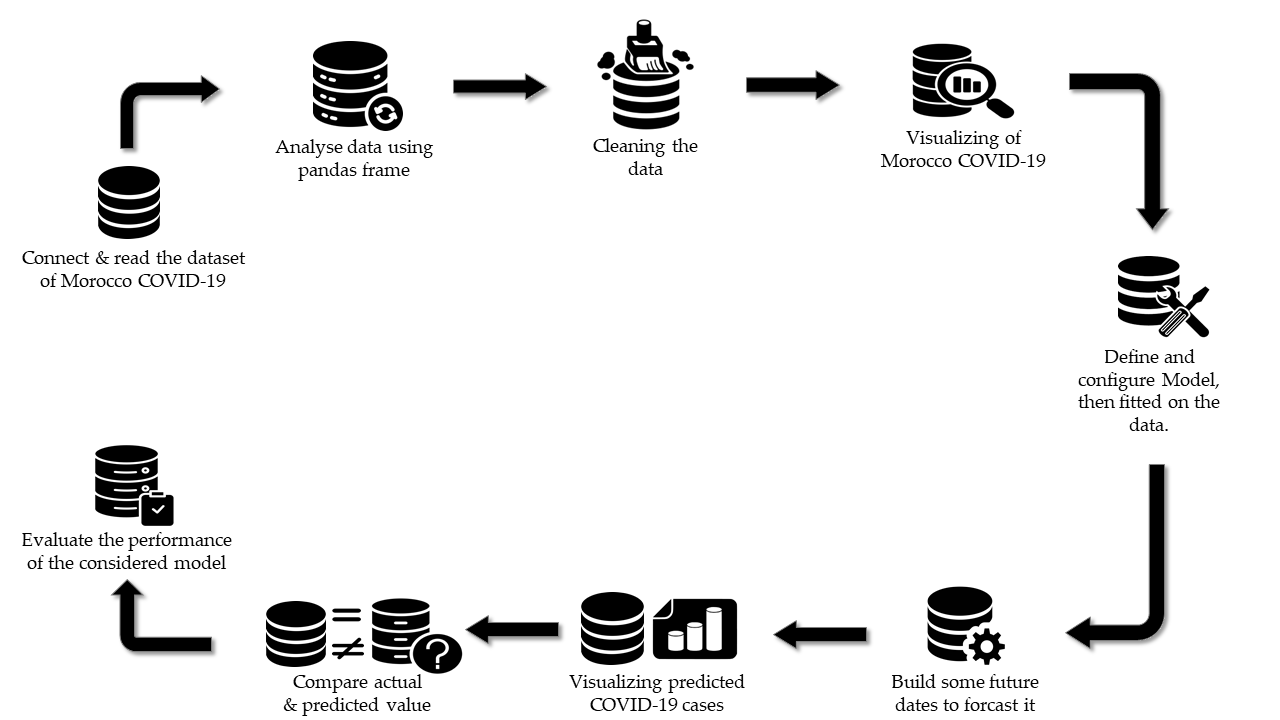
Since the coronavirus pandemic started, many people have died due to the disease. The epidemic has been challenging to predict, as it progresses and spreads throughout the world. We used Auto-Regressive Integrated Moving Average (ARIMA) models to predict the outbreak of COVID-19 in the upcoming months in Morocco. In this work, we measured the effective reproduction number using the real data and the forecasted data produced by the two commonly used approaches, to reveal how effective the measures taken by the Moroccan government have been in controlling the COVID-19 outbreak. The prediction results for the next few months show a strong evolution in the number of confirmed and death cases in Morocco. We study the spread of COVID-19 in Morocco to see how many cases are discovered, recovered, and dead, and the forecasting of further cases is used as a basic novel method. It is based on time series models. We used coronavirus outbreak data from March 02, 2020, to August 04, 2021. ARIMA (Autoregressive integrated moving average) and Prophet time-series models are used to forecast the development of COVID-19, which is not a novel method. The mean absolute error, root mean square error, and coefficient of determination R2 were computed to assess the model's performance. Our study aims to provide a better understanding of the infectious disease outbreak that affected Morocco. It also provides information on the disease outbreak's epidemiology. Our study shows that the FBProphet model is more accurate in predicting the prevalence of COVID-19. It can help guide the government's efforts to prevent the virus' spread.
Published
How to Cite
Issue
Section
Copyright (c) 2022 El Mehdi Chouit, Mohamed RACHDI, Mostapha BELLAFKIH, Brahim RAOUYANE

This work is licensed under a Creative Commons Attribution 4.0 International License.
How to Cite
Similar Articles
- Danat Nanle Tanko, Farah Aini Abdullah, Majid K. M Ali, Matthew O. Adewole, James Andrawus, Onchocerciasis control via Caputo-Fabrizio fractional dynamics: a focus on early treatment and vector management strategies , Journal of the Nigerian Society of Physical Sciences: Volume 8, Issue 1, February 2026
- Priya Dahiya, Jasdev Bhatti, Pankaj Thakur, Weibull-based reliability and profitability analysis of an industrial multi-state repairable system , Journal of the Nigerian Society of Physical Sciences: Volume 8, Issue 3, August 2026
- S. O. Ikubanni, S. J. Adebiyi, B. O. Adebesin, O. S. Bolaji, B. J. Adekoya, B. W. Joshua, J. O. Adeniyi, GPS-TEC Variations over the African Low-latitude Ionosphereduring March 2013 and 2015 Geomagnetic Storms , Journal of the Nigerian Society of Physical Sciences: Volume 2, Issue 4, November 2020
- O. E. Ojo, M. K. Kareem, O. Samuel, C. O. Ugwunna, An Internet-of-Things based Real-time Monitoring System for Smart Classroom , Journal of the Nigerian Society of Physical Sciences: Volume 4, Issue 2, May 2022
- Opeyemi O. Enoch, Adejimi A. Adeniji, Lukman O. Salaudeen, The Derivation of the Riemann Analytic Continuation Formula from the Euler’s Quadratic Equation , Journal of the Nigerian Society of Physical Sciences: Volume 5, Issue 1, February 2023
- S. D. Umoh, A. K. Asekunowo, I. S. Okoro, N. X. Siwe, R. W. M. Kraus, O. O. Okoh, A. O. T. Ashafa, O. T. Asekun, O. B. Familoni, Antioxidant evaluation and bio-guided isolation from methanol leaf extract of Acalypha godseffiana , Journal of the Nigerian Society of Physical Sciences: Volume 6, Issue 3, August 2024
- Ammar A. Oglat, Khalid A Rabaeh, Mohammed Dawood Salman, Molham M Eyadeh, Kholoud Zyoid, Temperature- and frequency-dependent ultrasound response of a Poly(N-vinylcaprolactam) polymer gel dosimeter , Journal of the Nigerian Society of Physical Sciences: Volume 8, Issue 2, May 2026
- A. M. Asere, T. O. Owolabi, B. D. Alafe, O. P. Alabi, M. B. Alimi, Assessment of Excess Gamma Dose Exposure Level in Typical Nigeria Commercial Building Materials Distribution Outlets , Journal of the Nigerian Society of Physical Sciences: Volume 3, Issue 3, August 2021
- K. Manickavelan, S. Ahmed, K. Mithun, P. Sathish, R. Rajasekaran , N. Sellappan, A review on Transforming plastic wastes into fuel , Journal of the Nigerian Society of Physical Sciences: Volume 4, Issue 1, February 2022
- Tertsea Igbawua, Aondongu Alexander Tyovenda, Terver Sombo, Idugba Mathias Echi, Spatio-temporal assessment of aerosol-induced atmospheric heating rates in Nigeria , Journal of the Nigerian Society of Physical Sciences: Volume 7, Issue 2, May 2025
You may also start an advanced similarity search for this article.